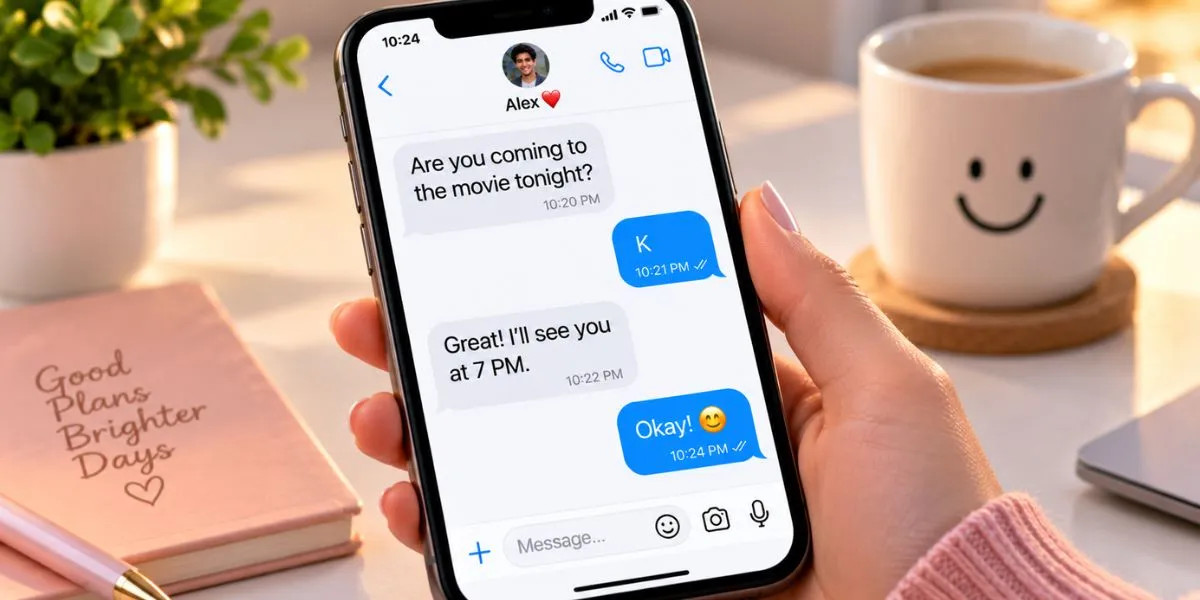
what does K mean in text Have you ever received a text message containing just one letter: “K”? If so, you may have wondered whether the person is simply saying okay or trying to show that they are annoyed. Although this tiny reply looks simple, its meaning can sometimes feel confusing.
K usually means “Okay” in text messages. People use it as a quick way to acknowledge a message, agree with a plan, or confirm that they understand something. However, depending on the conversation, a single “K” can also sound cold, dismissive, or uninterested.
For example, a friend might reply “K” because they are busy, while someone responding during an argument might use it to end the conversation. Nevertheless, you should not assume that every short reply means someone is angry.
In this guide, you will learn what K means in texting, why its tone can change, what it means when a girl or guy sends it, and how to respond naturally. Additionally, you will discover the differences between K, OK, Okay, and KK through simple examples.
What Does K Mean in Text?
In texting, K is a shortened form of “Okay.” It is an informal expression that people use to acknowledge information, agree with something, or show that they have received a message.
Instead of typing a complete word, someone can simply send K to save time. Consequently, this abbreviation is common in casual conversations, instant messaging, and online chats.
For example:
You: “I’ll meet you outside the restaurant at 7 PM.”
Friend: “K”
In this conversation, your friend is probably confirming the plan. There is no clear reason to assume that they are upset.
Similarly, someone might reply with K after you tell them that you have completed a task.
You: “I’ve sent you the document.”
Them: “K, thanks.”
Here, the sender acknowledges your message and moves on.
However, context can change how this response feels. If you send an emotional message and receive only “K,” the reply might seem less caring than you expected. Even so, the letter alone cannot tell you exactly what the other person is thinking.
What Does K Stand For?
In everyday texting, K usually stands for the informal response “Okay.” More precisely, it functions as a shortened version of OK or Okay rather than a separate acronym with a different full form.
People may use it to communicate several simple ideas:
- Okay.
- I understand.
- I agree.
- Got it.
- Message received.
- All right.
The intended meaning depends on what was said before the reply.
For instance, if someone asks whether you can attend an event and you answer K, they may interpret it as agreement. On the other hand, if someone tells you something important and you respond with only K, they might think you are not particularly interested.
Therefore, the meaning is usually straightforward, but the tone may need more attention.
Why Do People Reply With Just K?
There are several reasons why someone might choose K instead of writing Okay.
First, they may be in a hurry and want to acknowledge your message quickly. Second, they might naturally prefer short replies. Third, the conversation may not require a detailed answer.
For example, if your friend texts, “Bring your charger tomorrow,” replying K is an easy way to confirm that you understand.
Additionally, some people use short messages throughout the day because they are working, studying, or doing other activities. They may not realize that a one-letter reply can sound unfriendly to someone else.
However, a short response can occasionally indicate that the sender wants to finish the conversation. The best way to understand it is to consider the circumstances rather than focusing on the letter alone.
Is K Rude in Texting?

K is not automatically rude, but it can sometimes sound cold or dismissive. Because text messages do not include a person’s voice or facial expression, readers often interpret tone through small details, such as word choice, punctuation, and the length of a reply.
Compare these two messages:
- “Okay! Sounds good 😊”
- “K.”
Both can communicate agreement. Nevertheless, the first response appears more enthusiastic, while the second may feel more abrupt.
That difference does not prove that the sender is angry. It simply shows how short replies can be interpreted differently.
When K Sounds Cold or Dismissive
A single K may feel unfriendly when the conversation calls for a more thoughtful response.
For example:
You: “I worked really hard on this project, and I’m proud of the result.”
Friend: “K.”
You might feel disappointed because you expected encouragement or interest. In this situation, the response can seem dismissive because it does not acknowledge the emotion in your message.
Similarly, receiving K after apologizing can feel uncomfortable.
You: “I’m sorry I hurt your feelings. I didn’t mean to.”
Them: “K.”
The reply may suggest that the person has nothing more to say at that moment. However, they could also be processing their feelings or be unsure how to respond. what does K mean in text
Therefore, avoid treating one short message as definite proof of anger.
When K Is Just a Normal Reply
Sometimes K is simply an acknowledgment with no hidden meaning.
For example:
You: “The meeting starts at 10 AM.”
Coworker: “K.”
The coworker may only be confirming that they received the information.
Likewise:
You: “I’ll call you when I get home.”
Friend: “K, talk later.”
This is a practical, ordinary response.
If someone consistently uses short replies with everyone, their message may reflect their normal texting style rather than their feelings toward you.
Does K With a Period Sound Ruder?
Some people interpret “K.” as more final or irritated than “K” without punctuation. The period can make the response appear deliberate, particularly during a tense conversation.
For example:
- “K” — potentially neutral or brief.
- “K.” — potentially more formal, final, or cold.
- “K!” — may appear more energetic, depending on the conversation.
- “K 😂” — may seem playful.
These are tendencies, not universal rules. Many people use punctuation automatically, so you should consider the sender’s usual writing style before interpreting it.
What Does K Mean From a Girl or a Guy?
When someone you like sends a short message, it is natural to wonder whether it has a deeper meaning. However, K generally means Okay regardless of the sender’s gender.
The surrounding conversation and the person’s usual communication style are more useful clues than the abbreviation itself.
What Does K Mean From a Girl?
If a girl texts you K, she may simply be acknowledging what you said.
For example:
You: “I’ll message you when I finish work.”
Her: “K 😊”
In this case, the message may be a casual confirmation.
However, if the conversation has been tense, the same reply might feel distant.
You: “I’m sorry I couldn’t make it today.”
Her: “K.”
She might be disappointed, busy, or unsure what to say. Although the reply could indicate frustration, you cannot know her feelings from the letter alone.
Consider the wider conversation. Does she usually send short messages? Has something upsetting happened? Does she continue talking afterward?
These details provide more context than the single letter.
What Does K Mean From a Guy?
If a guy sends K, he may be saying that he understands or agrees with your message.
For example:
You: “The movie starts at 8. Meet me at the entrance.”
Him: “K, see you there.”
This is a straightforward confirmation.
On the other hand, if he normally sends detailed replies but suddenly responds with K during a disagreement, the change might feel noticeable.
Nevertheless, there are several possible explanations. He could be busy, tired, frustrated, or simply ready to end the conversation.
Instead of assuming the worst, look for a consistent pattern or ask a calm question if something genuinely seems wrong. what does K mean in text
Does K Mean Someone Is Mad at You?
Not necessarily. K can sound annoyed in certain situations, but it can also be a perfectly normal response.
Consider these examples:
Neutral situation
You: “I’ll send the pictures tonight.”
Friend: “K.”
Likely interpretation: The friend has acknowledged your message.
Potentially tense situation
You: “I feel like you’ve been ignoring me lately.”
Friend: “K.”
Possible interpretation: The friend may be upset, uncomfortable, or unsure how to respond. However, the message alone does not confirm any of these possibilities.
If you are concerned, you could ask, “Hey, is everything okay? I wasn’t sure how to read your last message.”
This gives the other person an opportunity to clarify without creating unnecessary conflict.
Does K Mean Someone Is Losing Interest?
A single K does not mean that someone is losing interest in you.
Although short replies can sometimes reflect reduced engagement, they may also result from a busy schedule, personal communication habits, or a temporary lack of time.
Instead of judging the relationship by one message, consider the bigger picture. Is they they regularly initiate conversations? Do they make plans with you? Do they respond thoughtfully when they have time?
A consistent change in communication may be worth discussing. However, one short reply is not enough to draw a conclusion.
K vs. OK vs. Okay vs. KK: What’s the Difference?

K, OK, Okay, and KK generally communicate acknowledgment or agreement. However, people may interpret their tone differently.
| Text reply | Common meaning | Possible tone |
|---|---|---|
| K | Okay | Very brief; may seem cold |
| OK | Okay | Usually neutral |
| Okay | Okay or agreement | Neutral to friendly |
| KK | Okay | Often casual and friendly |
| Okay! | Agreement | May sound enthusiastic |
| Got it | I understand | Clear and direct |
| Sure | Yes or agreement | Usually cooperative |
| Fine | Agreement or acceptance | Can sound annoyed in some contexts |
These differences are not fixed rules. A person who regularly types K may intend it just as warmly as someone who writes Okay.
K vs. OK
The main difference is length. K is a one-letter response, while OK is a slightly fuller acknowledgment.
For example:
You: “Can you pick up the package?”
Reply A: “K.”
Reply B: “OK.”
Both replies can mean that the person agrees to pick up the package.
However, Reply A may feel more abrupt because it contains less information. If the conversation is casual and the sender normally writes short messages, this difference may not matter.
K vs. Okay
Okay is the complete, commonly used spelling of the expression. In text messages, it can feel more conversational because it contains more letters. what does K mean in text
For example:
- “K” — brief acknowledgment.
- “Okay” — acknowledgment that may feel more complete.
- “Okay, no problem!” — clear and friendly agreement.
Nevertheless, a longer reply does not always mean greater enthusiasm. Tone depends on the conversation and the person writing it.
K vs. KK
KK usually means Okay as well. In casual messaging, some people use KK as a quick and friendly acknowledgment.
For example:
You: “I’ll send you the address.”
Friend: “KK 😊”
The response may feel relaxed and positive.
In contrast, K can appear more abrupt, especially if the conversation has been emotional. However, both abbreviations are informal, and their tone depends on the sender’s habits.
K vs. Sure and Got It
Sure and Got It can be useful alternatives when you want your reply to be clear.
For example, “Sure, I’ll be there at 6” confirms agreement and adds useful information. Likewise, “Got it, thanks!” acknowledges a message politely.
In professional conversations, these fuller responses may be preferable because they reduce ambiguity.
Ultimately, choose the response that suits the situation rather than worrying about a strict rule for every abbreviation. what does K mean in text
Read More: What Do GTS Mean in Text? Meaning, Slang, Examples & Replies
What Does K Mean on Snapchat, Instagram, and WhatsApp?
K generally means Okay across messaging platforms. The app itself does not automatically change the meaning, although the style of the conversation may influence how the reply feels.
K Meaning on Snapchat
On Snapchat, K may appear in quick exchanges between friends.
For example:
You: “Want to meet after school?”
Friend: “K.”
The likely meaning is that your friend agrees or acknowledges the suggestion.
However, if the reply follows an argument or an emotional message, it might seem less enthusiastic. Check the surrounding conversation before assuming the sender is annoyed.
K Meaning on Instagram
On Instagram, people may use K in direct messages, replies to stories, and casual conversations.
For example:
You: “I’ll tag you in the post.”
Friend: “K, thanks.”
Here, the sender is simply confirming your message.
Because Instagram conversations can be brief, a one-letter reply may be entirely normal. It does not necessarily indicate that the person is bored or uninterested.
K Meaning on WhatsApp
On WhatsApp, K is often used as a quick response to messages about plans, reminders, and everyday tasks.
For example:
You: “Please bring the documents tomorrow.”
Reply: “K.”
The sender is probably acknowledging the instruction.
If you need a more explicit confirmation, you can ask a follow-up question. For example, “Just confirming, you’ll bring the documents tomorrow, right?”
K in Regular Text Messages
In ordinary SMS conversations, K has the same common meaning: Okay.
People may use it when they are busy, responding quickly, or discussing simple plans. However, as with other messaging platforms, the tone can be interpreted differently depending on the situation.
Therefore, do not assume that K means anger simply because it is short.
Examples of K in Text Conversations
Here are several everyday examples showing how K may be used and interpreted.
Example 1: Confirming Plans
Alex: “I’ll meet you outside at 6 PM.”
Sam: “K.”
Meaning: Sam is acknowledging the plan. There is no clear sign of a negative tone.
Example 2: Responding to a Reminder
Mia: “Don’t forget to bring your charger.”
Lily: “K, thanks!”
Meaning: Lily has received the reminder and acknowledged it.
Example 3: During a Disagreement
Jordan: “I didn’t like the way you spoke to me earlier.”
Taylor: “K.”
Meaning: Taylor’s response may feel dismissive because Jordan raised an emotional concern. However, Taylor could also be unsure how to respond or need time to think.
Example 4: When Someone Is Busy
Chris: “Can you call me later?”
Ryan: “K, at 8.”
Meaning: Ryan agrees and provides a time. The extra information makes the response clearer.
Example 5: When Someone Shares Good News
You: “I finally passed my driving test!”
Friend: “K.”
Meaning: The response may feel uninterested because it does not match the excitement of the news. Still, the friend might be distracted or may have sent the message without considering how it sounds.
Example 6: Ending a Conversation
You: “Okay, I’ll talk to you tomorrow.”
Friend: “K, goodnight.”
Meaning: The friend is acknowledging the message and ending the conversation.
Example 7: A Short Work Message
Manager: “Please review the file before noon.”
Employee: “K, I’ll review it.”
Meaning: The employee has acknowledged the instruction and confirmed the next step.
These examples show that the same letter can serve different conversational purposes. Therefore, look at the message that came before it and consider the sender’s normal style.
How to Respond When Someone Texts K
Your response depends on the situation. In most cases, you do not need to make a big deal out of a short acknowledgment.
1. Reply Normally
If K appears to be a neutral response, continue the conversation as usual.
You could reply:
- “Sounds good!”
- “Thanks!”
- “See you then.”
- “Perfect, talk later.”
- “Okay, great.”
For example, if someone confirms a meeting time with K, you can simply continue discussing the plans.
2. Respond With Humor
If you are close to the person and the conversation is playful, a lighthearted response may work.
For example:
- “Shortest reply ever 😂”
- “Got it, captain!”
- “Okayyy, message received 😄”
Use these responses only when they suit your relationship. If the conversation is already tense, joking about the short reply could make the situation worse.
3. Ask If Something Is Wrong
If K seems unusually cold after an important conversation, ask for clarification rather than assuming the sender is angry.
For example:
- “Hey, is everything okay?”
- “I’m not sure how to read that. Are we good?”
- “Did I say something that upset you?”
- “Let me know if you want to talk about it.”
These messages are direct without being accusatory.
4. Do Not Overthink Every Short Reply
Sometimes the best response is no special response at all.
People have different texting habits. Some write long messages, while others prefer brief answers. Additionally, someone may be busy or distracted when they reply.
If there is no other sign of a problem, it is usually reasonable to accept K as a simple acknowledgment and move on.
5. Use Clearer Replies Yourself
If you want to avoid being misunderstood, consider using a few extra words.
Instead of sending only K, try:
- “Okay, sounds good!”
- “Got it, thank you.”
- “Sure, I’ll do that.”
- “Okay, talk to you soon.”
These responses communicate the same basic message while giving the other person more context.
Why Do People Read Different Emotions Into K?
Texting removes many of the signals people rely on in face-to-face conversations. When someone speaks, you can hear their voice and see their facial expression. However, a text message provides fewer clues.
As a result, readers sometimes interpret short replies according to their expectations or concerns.
For example, if you are worried that a friend is upset, you might interpret K negatively even when the sender intended no offence. On the other hand, if you regularly communicate with someone who uses brief messages, you may not notice anything unusual.
Three factors can influence the interpretation:
1. Previous conversation: A neutral reply after discussing plans may seem ordinary, while the same reply after an argument may feel dismissive.
2. Usual communication style: Someone who normally writes short messages may use K without thinking about its tone.
3. The importance of the message: A one-letter response to a simple reminder may be fine, but a short response to personal news may feel disappointing.
Consequently, context is more reliable than guessing what a single letter means emotionally.
Frequently Asked Questions About K Meaning in Text
1. What does K mean in text?
K usually means Okay. It is a shortened response used to acknowledge a message, confirm information, or express agreement. Its tone depends on the conversation.
2. Is K rude in texting?
Not necessarily. K can be neutral, but it may sound cold or dismissive in certain situations. Consider the sender’s usual texting style and the message that came before it.
3. Why do people reply with just K?
People may use K because they are busy, prefer short replies, or simply want to acknowledge a message quickly. It does not automatically indicate anger.
4. Does K mean someone is mad at you?
No. Although K can sound annoyed in a tense conversation, the letter alone cannot confirm someone’s feelings. If you are concerned, ask politely whether everything is okay.
5. What does K mean from a girl?
A girl may use K to mean Okay or to acknowledge your message. It does not automatically mean she is angry, uninterested, or romantically interested.
6. What does K mean from a guy?
A guy may use K as a quick acknowledgment or confirmation. The meaning depends on the context and his usual communication habits.
7. What is the difference between K and OK?
Both usually mean Okay. K is shorter and may seem more abrupt, while OK can feel slightly more complete. However, neither has a fixed emotional tone.
8. Is KK friendlier than K?
Some people interpret KK as more casual or friendly than K. Nevertheless, this is a communication preference rather than a universal rule.
9. What does K mean on Snapchat?
On Snapchat, K generally means Okay or that the sender has acknowledged your message. The conversation determines whether it sounds neutral or dismissive.
10. How should I respond when someone texts K?
If the message seems neutral, continue normally. If it feels unusually cold, you can ask, “Hey, is everything okay?” Avoid assuming that the sender is upset without further context.
Final Thoughts on What K Means in Text
So, what does K mean in text? In most conversations, K simply means Okay. It is a quick way to acknowledge a message, agree with a plan, or confirm that you understand something.
However, a short reply can sometimes feel cold or dismissive, especially during an emotional conversation. Therefore, consider the context, the sender’s usual texting habits, and the subject of the discussion before drawing conclusions.
If you are unsure about someone’s intention, asking a calm question is often better than guessing. And if you want your own messages to sound warmer, adding a few words can make your meaning much clearer.
