
what does IK mean in text Have you ever received a text message containing “IK” and wondered what the person meant? You’re not alone! People use texting abbreviations every day to make conversations quicker and easier. However, some short replies can be confusing when you don’t know their meaning or tone.
IK usually means “I know” in text messages and online conversations. People use it to show that they already know something, understand what someone is saying, or agree with a statement. Depending on the situation, IK can sound friendly, casual, sarcastic, or even slightly annoyed.
For example, if your friend texts, “The movie starts at 8 PM,” you might reply, “IK!” to show that you’re already aware of the time.
However, IK doesn’t always communicate the same feeling. A quick “IK” can sound different from “I know 😊” or “Yeah, I already know.”
In this guide, we’ll explain what IK means in text, how people use it on social media, what it means when a girl or guy sends it, and how to reply naturally. We’ll also compare IK with similar abbreviations such as IKR, IDK, and IDC.
What Does IK Mean in Text?
IK means “I know.” It is a common abbreviation used in texting, online chats, and social media conversations. Instead of typing the complete phrase, people write IK to acknowledge information or show that they already understand something.
For example:
Friend: Don’t forget that we have class tomorrow!
You: IK! I’ve already set my alarm.
In this conversation, IK simply means “I know.” It shows that you have already received the information and don’t need the reminder.
Similarly, people may use IK to respond to a joke, agree with a statement, or acknowledge something that has happened.
Here are the key points to remember:
- Full form: I Know
- Main purpose: To acknowledge information or show awareness
- Tone: Casual and informal
- Common platforms: Text messages, Snapchat, Instagram, TikTok, WhatsApp, and online chats
- Best use: Conversations with friends, family, and people you know well
Although IK is widely understood in casual messaging, it may not be suitable for every situation. In a professional email or formal conversation, writing “I know” is usually clearer and more appropriate.
Ultimately, the meaning is simple, but the tone depends on the surrounding conversation.
What Does IK Stand For?
IK stands for “I know.” It combines the first letter of “I” with the first letter of “know,” creating a quick way to communicate the phrase.
People often use abbreviations because texting encourages short, convenient replies. Instead of writing a complete sentence, they can acknowledge a message with just two letters.
For example:
- “IK what you mean.”
- “IK, that’s crazy!”
- “IK! I saw the post earlier.”
- “IK, right? That was hilarious.”
In these examples, IK communicates awareness or acknowledgment. The rest of the sentence provides additional meaning and emotion.
Additionally, people sometimes write IK in capital letters because it is a familiar abbreviation. Others may type “ik” in lowercase, especially when chatting casually.
Both forms generally communicate the same thing.
IK Meaning in Simple English
In simple English, IK means “I already know that” or “I understand what you’re saying,” depending on the conversation.
For example, imagine that your friend tells you something you have already heard. You can reply with “IK” to let them know you’re familiar with the information.
However, IK doesn’t always mean that you completely agree with someone. It may simply indicate that you understand or have heard what they said. what does IK mean in text
Consider these examples:
- “IK, I’ve heard that song before.”
- “IK what you’re talking about.”
- “IK, that’s why I was worried.”
- “IK! We discussed it yesterday.”
Therefore, the most accurate interpretation comes from reading the entire message rather than looking at the abbreviation alone.
How Is IK Used in Texting?

Although IK usually means “I know,” people use it in several different ways. The meaning remains similar, but the purpose and emotional tone may change.
1. IK to Show You Already Know Something
One of the most common uses of IK is to show that you already have certain information.
For instance, your friend may remind you about an upcoming event. If you already know about it, replying with IK confirms that you’ve received the information.
Example conversation:
Alex: Remember, we’re meeting at the café at 6 PM.
Sam: IK! I’ll be there.
Here, the response is straightforward and friendly. Sam acknowledges the reminder without needing to repeat the entire sentence.
Similarly, IK works when someone shares news you already know or mentions something you’ve discussed before.
2. IK to Agree With Someone
Sometimes, people use IK to show that they agree with a statement or understand another person’s point of view.
For example:
Friend: That exam was much harder than I expected.
You: IK! Some questions were so confusing.
In this case, IK communicates shared understanding. You’re not merely saying that you know about the exam; you’re also showing that you experienced something similar.
Likewise, it can be used when discussing movies, music, school, work, relationships, or everyday experiences.
3. IK to Show Understanding
People also use IK when someone explains a situation or shares an experience.
For example:
Friend: I get nervous whenever I have to speak in front of everyone.
You: IK. I feel the same way sometimes.
Here, IK indicates that you understand the feeling your friend is describing.
However, it doesn’t necessarily mean that you have experienced exactly the same thing. It simply acknowledges the other person’s point.
4. IK as a Quick Reply
Text conversations often move quickly. Consequently, people may use IK as a short response instead of typing a longer sentence.
For example:
Friend: I sent you the pictures.
You: IK, thanks!
Or:
Friend: The new episode is available now.
You: IK! Watching it tonight.
These replies are brief but understandable. Nevertheless, if the conversation requires more explanation, a longer response may be better.
5. IK to Respond to Something Obvious
Another common use is acknowledging something that the sender believes is already known.
For example:
Friend: The weekend is finally here!
You: IK! I’ve been waiting all week.
In this situation, IK can sound enthusiastic because it is followed by an excited response.
On the other hand, if someone replies with only “IK,” the message may feel less expressive. That’s why the complete conversation matters.
Read More: What Does GMT Mean in Text? Slang, Time & Examples
Does IK Sound Rude, Friendly, or Sarcastic?

One of the most common questions about IK is whether it sounds rude. The answer is not necessarily. IK is a neutral abbreviation, but its tone can change depending on the situation, punctuation, and relationship between the people texting.
Let’s explore the different possibilities.
When IK Sounds Friendly
IK can sound friendly when it appears in a relaxed conversation or is followed by positive words or emojis.
For example:
Friend: That song is amazing!
You: IK! It’s been on repeat all day 😍
Here, IK communicates agreement and excitement. The additional words and emoji make the response feel warm and enthusiastic. what does IK mean in text
Other friendly examples include:
- “IK 😊”
- “IK! That’s so exciting.”
- “IK, we had such a great time.”
- “IK 😂 I couldn’t stop laughing.”
Therefore, you shouldn’t automatically interpret IK as a cold or unfriendly response.
When IK Sounds Annoyed
Sometimes, IK can sound irritated, especially when someone is repeating information you’ve already heard.
For example:
Parent: Don’t forget to finish your homework.
Teenager: IK.
Depending on the relationship and situation, this reply may sound impatient. The sender might feel that the reminder was unnecessary.
However, the same response could simply mean that the person has already acknowledged the reminder.
Consequently, one short message isn’t enough to determine someone’s emotional state with certainty.
When IK Sounds Sarcastic
IK can also be used sarcastically when someone wants to emphasize that something should already be obvious.
For example:
Friend: You really love pizza!
You: IK, it’s basically my entire personality 😂
In this case, the reply is playful rather than genuinely annoyed.
However, consider another example:
Person A: You know you missed the deadline, right?
Person B: IK.
Depending on the previous conversation, this response could communicate frustration, embarrassment, or simple acknowledgment.
If you are unsure about the tone, consider the person’s usual texting style and the messages that came before it.
How Punctuation and Emojis Change the Tone
Small details can make IK feel more expressive.
| Text reply | Possible tone |
|---|---|
| IK | Neutral or brief |
| IK! | Enthusiastic or emphatic |
| IK 😊 | Friendly or warm |
| IK 😂 | Playful or amused |
| IK 🙄 | Potentially annoyed or sarcastic |
| I know! | More explicit acknowledgment |
| I already know. | Potentially firm or defensive |
These interpretations aren’t fixed rules. For example, a person may use an eye-roll emoji jokingly with close friends.
Therefore, interpret the message in context instead of assuming that punctuation or an emoji always reveals someone’s feelings.
What Does IK Mean From a Girl?
When a girl sends IK, it usually means “I know.” The abbreviation itself doesn’t automatically indicate romantic interest, anger, or any particular emotion.
Its meaning depends on what you’re discussing and how she normally communicates.
If She Sends IK During a Casual Conversation
She may simply be acknowledging something you said.
Example:
You: The new café opened near your office.
Her: IK! I saw it yesterday.
This is a straightforward response. She already knows about the café and is letting you know that she’s aware of it.
If She Sends IK During a Romantic Conversation
The meaning still depends on the conversation.
For example:
You: You looked really nice today.
Her: IK 😂
If you already have a playful relationship, she may be joking or responding confidently. However, the message alone doesn’t prove that she is flirting.
Likewise, if she replies with a simple IK after a serious message, it may only mean that she understands what you said.
Tip: Look at the wider conversation instead of reading too much into two letters. Her overall communication, not one abbreviation, provides better clues about her intentions.
What Does IK Mean From a Guy?
When a guy texts IK, it usually means “I know” as well. The abbreviation doesn’t have a separate meaning based on the sender’s gender.
However, the context can influence how you interpret his response.
If He Sends IK in a Friendly Chat
He may be agreeing with you or confirming that he already knows something.
Example:
You: Don’t forget our football match tomorrow.
Him: IK, bro! I’m ready.
The message is casual and friendly.
If He Sends IK in a Romantic Conversation
IK may be playful, neutral, or slightly awkward, depending on the exchange.
For example:
You: You always make me laugh.
Him: IK 😂
He could be joking or responding playfully. Nevertheless, the abbreviation alone doesn’t tell you whether he is interested in you romantically.
Similarly, if he sends IK after you explain something serious, he may simply be acknowledging your point.
Ultimately, the surrounding messages and your existing relationship matter more than the abbreviation itself. what does IK mean in text
What Does IK Mean on Snapchat, Instagram, TikTok, and WhatsApp?
IK is commonly used in casual online communication. Although the platform may change, its basic meaning generally remains “I know.”
IK on Snapchat
On Snapchat, people may use IK in private chats, replies to stories, and conversations with friends.
For example:
Friend: Did you see the funny video I sent?
You: IK 😂 I watched it twice.
Here, IK shows that you already know about the video or have already seen it.
Snapchat conversations are often informal, so short abbreviations can make replies faster.
IK on Instagram
Instagram users may use IK in direct messages, comments, or replies to stories.
For example:
Friend: This outfit looks amazing!
You: IK, the colors are perfect 😍
In this example, IK expresses agreement or acknowledgment.
However, the meaning can change with the conversation. It may be neutral, playful, or emphatic depending on what the sender is responding to.
IK on TikTok
On TikTok, IK can appear in comments, direct messages, or discussions about videos and trends.
For example:
Comment: This song brings back so many memories.
Reply: IK 😭
The response shows that the person relates to the comment or understands the feeling.
The crying emoji may communicate nostalgia or strong emotion rather than sadness alone.
IK on WhatsApp
WhatsApp users frequently use short replies when chatting with friends, relatives, or coworkers.
For example:
Friend: We’re leaving at 7 AM tomorrow.
You: IK, alarm is already set.
Here, IK simply confirms that you know the plan.
In a professional group chat, however, it may be clearer to write “Understood” or “Thanks for the reminder,” especially when the message concerns an important task.
Remember, IK doesn’t have a separate official meaning on these platforms. Its basic meaning remains the same, while the tone depends on the conversation.
Real IK Text Message Examples
The following examples show how IK can fit into different conversations.
1. IK in a Friendly Conversation
Alex: Did you watch the new episode?
Jamie: IK! It was so good.
Meaning: Jamie is acknowledging the topic and expressing enthusiasm.
2. IK When Someone Gives a Reminder
Sam: Your appointment is tomorrow at 10 AM.
Taylor: IK, thanks for reminding me.
Meaning: Taylor already knows about the appointment.
3. IK to Agree With a Friend
Mia: That restaurant has the best burgers.
Lily: IK! We should go again.
Meaning: Lily agrees with Mia’s opinion.
4. IK in a Funny Conversation
Friend: You take pictures of every meal.
You: IK 😂 My camera roll is basically a food diary.
Meaning: You acknowledge the joke and respond playfully.
5. IK When Someone Shares News
Alex: Our favorite band is releasing a new album.
Jordan: IK! I’ve been waiting for it.
Meaning: Jordan already knows about the announcement and is excited.
6. IK in a Tense Conversation
Person A: You need to submit the assignment tonight.
Person B: IK.
Meaning: The person acknowledges the reminder. Depending on the context, the reply might sound neutral or slightly impatient. what does IK mean in text
7. IK With an Emoji
Friend: We’re finally going on vacation next week!
You: IK 😭 I’m so excited!
Meaning: You already know about the plans and are expressing excitement.
8. IK in a Group Chat
Friend 1: Everyone should bring snacks tomorrow.
Friend 2: IK, I’ll bring chips.
Meaning: The reply confirms that the person has seen and understood the message.
These examples demonstrate why IK is useful in everyday communication. It saves time while allowing people to acknowledge information quickly. Nevertheless, adding a few extra words can make your response clearer when the situation calls for it.
IK vs. IKR vs. IDK vs. IDC
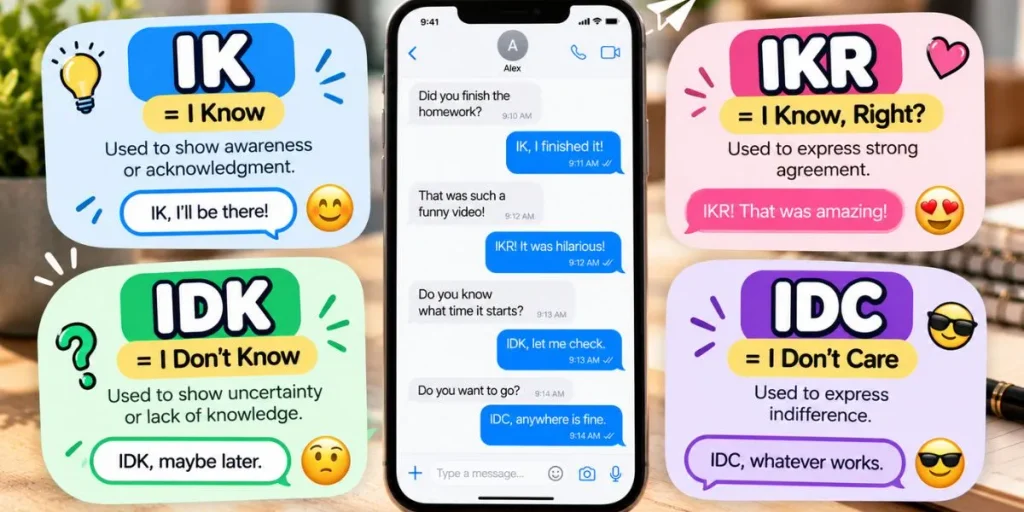
IK is easy to confuse with other texting abbreviations because they contain similar letters. However, each abbreviation has a different meaning.
| Abbreviation | Full form | Meaning |
|---|---|---|
| IK | I Know | Shows awareness or acknowledgment |
| IKR | I Know, Right? | Expresses strong agreement |
| IDK | I Don’t Know | Shows uncertainty or lack of knowledge |
| IDC | I Don’t Care | Expresses indifference |
Let’s look at the differences in more detail.
IK vs. IKR
IK means “I know,” while IKR means “I know, right?”
People use IKR when they strongly agree with someone or feel the same way about something.
Example:
Friend: This movie is incredible!
You: IKR! The ending was amazing.
Here, IKR expresses shared enthusiasm.
By comparison, IK may simply acknowledge what the other person said.
Easy way to remember: IK means you know; IKR usually means you strongly agree.
IK vs. IDK
IK means “I know,” whereas IDK means “I don’t know.”
These abbreviations communicate opposite ideas.
Example:
Friend: Do you know when the shop closes?
You: IK, it closes at 9 PM.
In this example, you already know the answer.
Now compare it with:
You: IDK, maybe we should check online.
Here, you don’t know the answer.
IK vs. IDC
IK means “I know,” while IDC means “I don’t care.”
Although both are common in casual messages, their meanings are completely different.
For example:
Friend: The restaurant changed its menu.
You: IK, I saw the announcement.
This acknowledges information.
By contrast:
Friend: Which restaurant should we choose?
You: IDC, anywhere is fine.
This suggests that you don’t have a strong preference. However, IDC can sound dismissive in some situations, so consider using a warmer phrase if you want to avoid misunderstanding.
How to Reply When Someone Says IK
The best response depends on what the person is acknowledging and whether the conversation needs to continue.
1. Friendly Replies
If someone uses IK casually, you may not need to respond at all. However, if you want to keep the conversation going, you can add a friendly comment.
Examples:
- “Haha, just checking!”
- “Good, we’re on the same page.”
- “Exactly!”
- “Great, just wanted to make sure.”
- “Perfect 😊”
These responses work well when the other person is simply confirming information.
2. Funny Replies
If you’re chatting with a close friend, a playful response may fit.
Examples:
- “Okay, genius 😂”
- “Just making sure you remember!”
- “I had to remind you anyway 😂”
- “Look at you, already knowing everything!”
- “Good, my job here is done.”
Use humor when it matches your relationship and the mood of the conversation.
3. Replies When Someone Sounds Annoyed
If IK seems irritated, avoid immediately assuming the person is angry. Instead, consider responding calmly.
Examples:
- “Sorry, just wanted to make sure.”
- “Got it, I won’t repeat it.”
- “Okay, thanks for confirming.”
- “I was only trying to help.”
If the conversation is already tense, a calm reply may prevent a minor misunderstanding from becoming a bigger argument.
4. Replies When You Want to Continue the Conversation
Sometimes IK acknowledges your message but doesn’t add much to the discussion. If you want to continue chatting, ask a relevant question or introduce another point.
For example:
You: That concert was amazing.
Friend: IK!
You: Which song was your favorite?
This keeps the conversation moving naturally instead of getting stuck on a short response.
5. When You Don’t Understand the Tone
If you’re unsure whether someone is joking, annoyed, or simply being brief, you can ask politely.
For example:
- “Haha, are we agreeing or arguing? 😂”
- “Just checking, did that come across the wrong way?”
- “I wasn’t sure how to read that message.”
A little clarification is often more useful than making assumptions about someone’s mood.
Is IK Appropriate in Professional Messages?
IK is generally best suited to casual communication. While coworkers may use it in informal chats, it can seem too brief in formal emails, client messages, or conversations involving important instructions.
For example, imagine that a manager asks whether you understand a new deadline.
Informal reply: IK.
More professional reply: Understood, thank you for confirming the deadline.
The second response sounds clearer and more considerate.
Similarly, if a client sends important information, you might write:
- “I understand, thank you.”
- “Noted, I’ll proceed accordingly.”
- “Thanks for the update.”
- “Understood. I’ll take care of it.”
These alternatives show acknowledgment without relying on informal shorthand.
Of course, workplace communication styles differ. In a relaxed team chat, IK may be perfectly acceptable. However, when you’re unsure, writing the complete phrase is usually the safer choice.
Frequently Asked Questions About IK Meaning in Text
1. What does IK mean in text exactly?
IK usually means “I know.” People use it to show that they already know something, understand a message, or acknowledge information. Its tone depends on the surrounding conversation.
2. Does IK always mean I know?
In common texting usage, IK generally means “I know.” However, abbreviations can have specialized meanings in particular communities. If the phrase doesn’t make sense in context, ask the sender to clarify.
3. Is IK rude when someone texts it?
Not necessarily. IK can be neutral, friendly, playful, or annoyed depending on the situation. A short reply may seem cold, but it doesn’t automatically mean the sender is upset.
4. What does IK mean from a girl?
It usually means “I know.” It doesn’t automatically indicate flirting, romantic interest, or annoyance. Look at the surrounding conversation to understand her intended tone.
5. What does IK mean from a guy?
It generally means “I know,” just as it does when sent by anyone else. The abbreviation alone cannot tell you whether he is joking, agreeing, flirting, or feeling annoyed.
6. What is the difference between IK and IKR?
IK means “I know,” while IKR means “I know, right?” IK usually acknowledges information, whereas IKR expresses stronger agreement or a shared reaction.
7. What is the difference between IK and IDK?
IK means “I know,” and IDK means “I don’t know.” They communicate opposite ideas: one indicates knowledge, while the other indicates uncertainty.
8. What does IK mean on Snapchat?
On Snapchat, IK generally means “I know.” People use it in private messages, story replies, and casual conversations to acknowledge information or agree with someone.
9. Can IK sound sarcastic?
Yes, IK can sound sarcastic when someone uses it to emphasize that something is obvious or already known. However, sarcasm depends on the situation, wording, and relationship between the people texting.
10. Should I use IK in a professional email?
It’s better to avoid IK in formal emails and important professional communication. Instead, use phrases such as “I understand,” “Understood,” or “Thank you for confirming.”
Final Thoughts on IK Meaning in Text
So, what does IK mean in text? In most casual conversations, IK stands for “I know.” It is a simple abbreviation that helps people acknowledge information, express agreement, and respond quickly to messages.
However, the tone can vary. A friendly “IK 😊” may show agreement, while a short “IK” during a tense conversation may sound impatient or dismissive. Therefore, it’s important to consider the complete message rather than interpreting the abbreviation on its own.
Additionally, remember the difference between IK, IKR, IDK, and IDC. Although they look similar, they communicate different ideas.
Ultimately, IK is a convenient part of everyday texting. Use it naturally with friends and people you know well, and choose clearer, more complete wording when communicating professionally. When you’re unsure what someone means, asking a simple question is always better than guessing.
