what does GMT mean in text Have you ever received a message containing “GMT” and wondered what it means? You are not alone! Texting abbreviations can be confusing because the same combination of letters may have different meanings depending on the conversation.
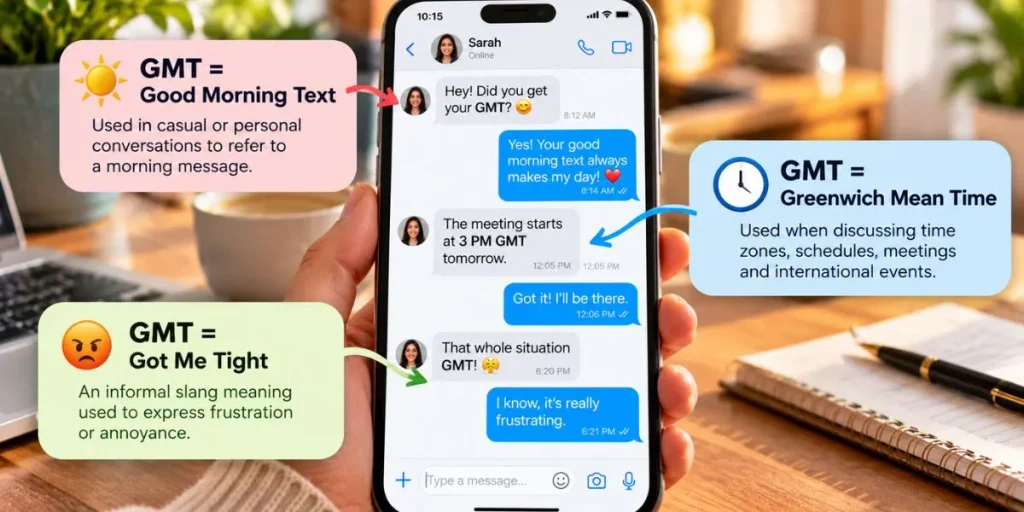
GMT most commonly stands for Greenwich Mean Time, a time standard used when discussing time zones, international schedules, and events. However, in some informal conversations, GMT may be used as slang, including the expression “Got Me Tight.” Some people may also use GMT to refer to a “Good Morning Text,” although this is not a universally recognized texting abbreviation.
So, how can you figure out what someone actually means when they send GMT? The answer depends on the surrounding words, the topic, and the relationship you have with the sender.
In this guide, we will explore the possible meanings of GMT in text messages, provide realistic examples, explain its use on social media, and show you how to reply confidently when someone sends this abbreviation.
What Does GMT Mean in Text?
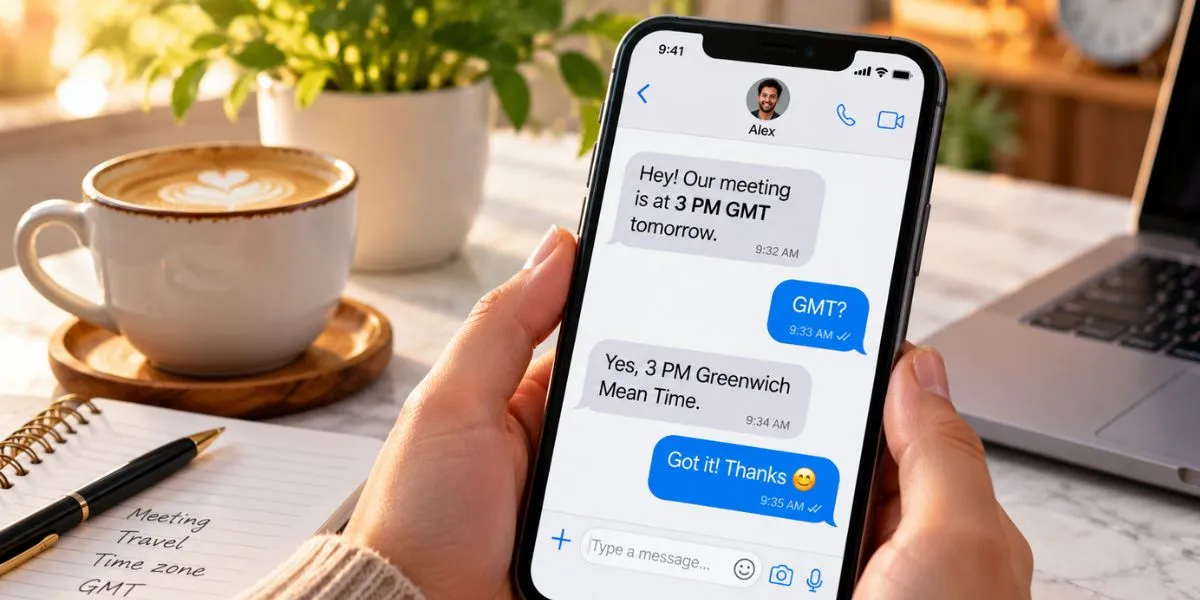
GMT stands for Greenwich Mean Time in its established timekeeping use. It refers to the mean solar time associated with the Prime Meridian at Greenwich, London, and is commonly used as a reference when discussing time around the world.
For example, if someone says, “The meeting starts at 3 PM GMT,” they are referring to a time based on Greenwich Mean Time.
However, GMT can have other interpretations in informal messages. Some slang references use GMT to mean “Got Me Tight,” expressing frustration or annoyance. In certain personal conversations, it may also be used to mean “Good Morning Text.”
Unlike established abbreviations such as LOL (Laughing Out Loud), these informal interpretations are not universal. Therefore, you should not assume that every person uses GMT in the same way.
Here is a quick overview:
- Greenwich Mean Time: A timekeeping reference used in schedules and international communication.
- Got Me Tight: An informal expression that may indicate annoyance or frustration.
- Good Morning Text: A possible personal or community-specific abbreviation for a morning message.
Ultimately, the context of the conversation will help you identify the intended meaning.
What Does GMT Stand For?
GMT can represent different expressions depending on how and where it appears. Let’s look at the most relevant interpretations in more detail.
1. GMT Meaning: Greenwich Mean Time
Greenwich Mean Time is the established meaning of GMT. It is associated with Greenwich, London, and is widely used when communicating times across different regions.
For example, people may use GMT when arranging online meetings, planning international travel, following live events, or discussing broadcast schedules.
Example conversation:
Alex: What time does the online meeting begin?
Sam: It starts at 4 PM GMT.
Alex: Thanks! I’ll convert that to my local time.
In this conversation, GMT clearly refers to a time standard because the participants are discussing a meeting schedule.
Similarly, you might see GMT in flight information, international event announcements, and online calendars. When the abbreviation appears next to a clock time, date, or schedule, its timekeeping meaning is usually the most likely interpretation.
2. GMT Meaning: Got Me Tight
In some informal slang references, GMT stands for “Got Me Tight.” Depending on the speaker and context, this expression can communicate that something has annoyed, frustrated, or upset someone.
For example, a person might use it when talking about a frustrating situation, an argument, or something that did not go as expected.
Example conversation:
Mia: He cancelled our plans at the last minute again.
Zoe: That would have me frustrated too.
Mia: Exactly! The whole situation GMT.
In this illustrative example, GMT is intended to express frustration. However, this usage is less standardized than the timekeeping meaning, and many readers may not recognize it.
Consequently, if you see GMT in a conversation about an argument or an annoying experience, consider whether “Got Me Tight” fits the context. If it does not make sense, ask the sender what they mean rather than guessing.
3. GMT Meaning: Good Morning Text
Some people may use GMT informally to refer to a “Good Morning Text.” This interpretation might appear in personal conversations about morning greetings, romantic messages, or daily texting routines.
For example, someone might use the abbreviation when talking about a message they expect to receive after waking up.
Example conversation:
Lily: Did you get your morning message today?
Emma: Not yet! I was waiting for my GMT.
Here, the intended meaning is “Good Morning Text.” Nevertheless, this is a context-dependent interpretation rather than a universally accepted definition of GMT.
If someone uses GMT this way, they may have learned it from friends, a particular online community, or their own texting habits. Another person might not understand it at all.
Therefore, pay attention to the conversation before deciding that GMT means “Good Morning Text.”
4. Why Does GMT Have Different Meanings?
Texting language changes constantly. People shorten expressions, create their own abbreviations, and adopt slang from friends, social media, and online communities.
As a result, the same abbreviation can mean different things to different people.
For instance, GMT in a business email will probably refer to a time standard. Meanwhile, GMT in a conversation about a frustrating situation could be intended as slang.
Additionally, some abbreviations are widely recognized, while others are only familiar to a small group of people.
The best approach is to consider the topic, the complete sentence, and the sender’s usual communication style before interpreting an unfamiliar abbreviation.
GMT Meaning in Different Contexts
The meaning of GMT becomes easier to understand when you consider the type of conversation in which it appears.
GMT in Casual Text Messages
In everyday texting, GMT may be used in an informal or personal way. However, because its slang interpretations are not standardized, the surrounding message matters.
For example:
Friend: I can’t believe they changed our plans again.
You: What happened?
Friend: It really got me frustrated.
If the sender uses GMT in a similar conversation, “Got Me Tight” may be the intended interpretation.
On the other hand, if your friend sends GMT alongside a time or an appointment, the established timekeeping meaning is much more likely.
GMT in Romantic Conversations
In romantic conversations, some people may use GMT to refer to a “Good Morning Text.” This can describe a sweet message sent at the beginning of the day.
For example:
Person A: I love waking up to your messages.
Person B: I’ll make sure you get a good morning text tomorrow!
If the couple already uses GMT as shorthand for this type of message, the meaning may be clear to both people.
However, GMT does not automatically indicate romance. Someone who uses it in a timekeeping context is not necessarily sending a romantic signal.
Likewise, the abbreviation alone cannot tell you whether someone has romantic feelings for you. Consider the complete message and the broader relationship instead.
GMT in Work Messages
In professional communication, GMT generally refers to Greenwich Mean Time when used alongside a time, deadline, or scheduled event.
For example:
- “The webinar begins at 10 AM GMT.”
- “Please submit your feedback by 5 PM GMT.”
- “The interview is scheduled for 2:30 PM GMT.”
In each example, the abbreviation helps clarify the time reference.
If you work with colleagues in different countries, checking the time zone is especially important. Your local time may differ from the time listed in the message.
Therefore, convert the stated time to your local time before attending a meeting or meeting a deadline.
GMT in Social Media Messages
On social media, abbreviations can appear in direct messages, comments, captions, and posts. Their meanings often depend on the topic.
For instance, a post discussing an international football match may use GMT to specify the start time. Meanwhile, a personal conversation could use an informal interpretation familiar to the people involved.
There is no single universal GMT meaning for Snapchat, Instagram, WhatsApp, or TikTok. A platform’s users may develop community-specific expressions, but that does not mean the abbreviation has one official meaning on that platform.
When in doubt, read the full message and look for clues that point toward timekeeping, a morning greeting, or frustration.
GMT Text Message Examples and Their Meanings
Examples make it easier to see how context changes the interpretation of GMT.
| Example message | Possible meaning | Context |
|---|---|---|
| “The event starts at 7 PM GMT.” | Greenwich Mean Time | Event scheduling |
| “Our call is at 11 AM GMT.” | Greenwich Mean Time | Work or appointments |
| “The deadline is midnight GMT.” | Greenwich Mean Time | Submission deadline |
| “I was waiting for my GMT.” | Good Morning Text | Informal personal conversation, if the sender uses this abbreviation |
| “That whole situation GMT.” | Got Me Tight | Possible slang use expressing frustration |
| “What time is 6 PM GMT here?” | Greenwich Mean Time | Time-zone conversion |
These examples illustrate possible uses rather than a guarantee that every sender uses GMT identically.
Notice that the first three examples include times and scheduling details. Consequently, the timekeeping interpretation is clear.
By contrast, the last two informal examples depend on the sender’s intended slang. If the wording feels unclear or unnatural, ask for clarification instead of assuming the abbreviation has a particular meaning.
How to Tell What GMT Means in a Message
If you receive a message containing GMT, you can usually narrow down its meaning by examining a few details.
1. Read the Entire Sentence
First, look at the words surrounding GMT. The sentence may provide enough information to identify the intended meaning.
For example, “The match starts at 8 PM GMT” clearly relates to a time. However, a message about someone being upset might point toward an informal slang interpretation.
Therefore, avoid interpreting an abbreviation in isolation.
2. Look for Times and Dates
Numbers, dates, deadlines, and meeting details are strong clues that GMT refers to Greenwich Mean Time.
For example, if someone writes, “Join the webinar at 12 PM GMT,” the abbreviation identifies the time reference.
Similarly, an event listing that includes several international start times is almost certainly using GMT in its timekeeping sense.
3. Consider Your Relationship With the Sender
Think about whether the sender is a friend, romantic partner, coworker, or someone you do not know well.
Friends may develop personal abbreviations that outsiders do not recognize. Meanwhile, professional contacts are more likely to use established timekeeping terminology when discussing schedules.
However, your relationship is only one clue. The actual message should remain your main guide.
4. Check the Topic of the Conversation
The subject can help you distinguish between meanings.
- Meetings and events: GMT probably refers to Greenwich Mean Time.
- Morning greetings: “Good Morning Text” may fit if the sender uses that abbreviation.
- Arguments or frustration: “Got Me Tight” may be the intended slang meaning.
- Unrelated conversations: More context may be necessary.
This simple check can prevent unnecessary confusion.
5. Ask for Clarification
If you still cannot work out the meaning, asking a quick question is often the easiest solution.
You could say:
- “What do you mean by GMT?”
- “Do you mean Greenwich Mean Time?”
- “Is GMT your abbreviation for a good morning text?”
- “Can you explain what GMT means here?”
There is nothing wrong with asking. Since informal abbreviations are not always consistent, a direct question is often more reliable than an online guess.
May you like to read more: What Does K Mean in Text? Meaning, Tone & Examples
What Does GMT Mean on Snapchat, Instagram, and WhatsApp?
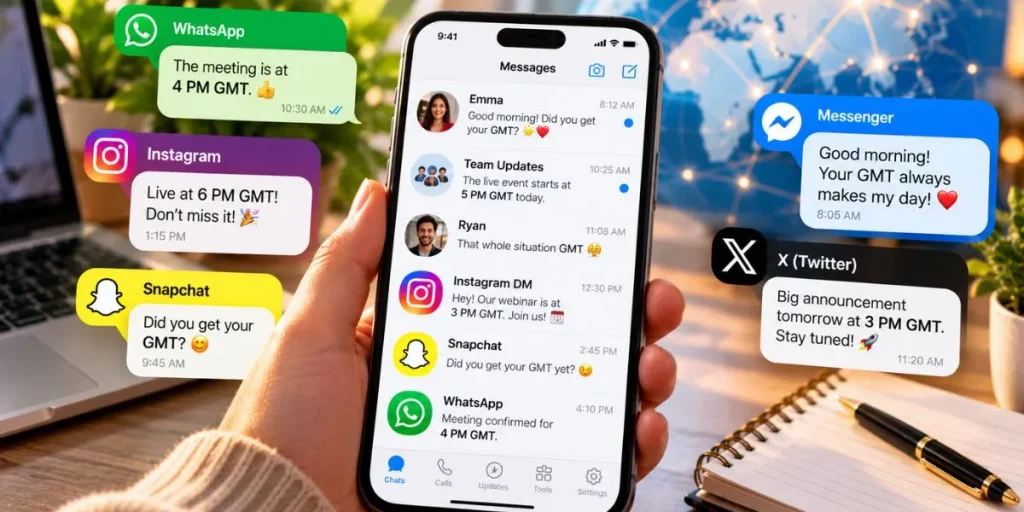
People use abbreviations across messaging apps, but their meanings can vary from one conversation to another.
GMT on Snapchat
On Snapchat, GMT might appear in a private message, a story, or a conversation about an event. If it appears beside a scheduled time, Greenwich Mean Time is the likely interpretation.
If a friend uses it in a personal conversation, the intended meaning could be an informal abbreviation familiar to that person.
Do not assume GMT has an official Snapchat-specific meaning.
GMT on Instagram
Instagram users often communicate through direct messages, comments, and story replies. GMT may appear in a discussion about international events or in a personal exchange.
For example, an event announcement might say, “Live at 6 PM GMT.” In that case, the abbreviation refers to the time standard.
However, if someone uses GMT to describe a personal message, ask for clarification if the intended meaning is unclear.
GMT on WhatsApp
WhatsApp conversations range from family chats to workplace groups. Therefore, GMT may refer to a time zone, a shared slang expression, or a personal abbreviation.
In a work group, a message such as “The meeting begins at 9 AM GMT” clearly relates to scheduling.
In a private chat, the sender may have a different meaning in mind. Ultimately, the conversation itself provides the most useful clues.
GMT vs. UTC: What Is the Difference?
UTC and GMT are closely related, but they are not exactly the same thing.
GMT stands for Greenwich Mean Time, while UTC stands for Coordinated Universal Time. UTC is the principal international time standard used to coordinate clocks and timekeeping around the world.
For many everyday purposes, GMT and UTC display the same time. Nevertheless, they have different technical definitions and should not always be treated as interchangeable in scientific or technical contexts.
Here is a simple comparison:
| Feature | GMT | UTC |
|---|---|---|
| Full name | Greenwich Mean Time | Coordinated Universal Time |
| Main use | Time reference associated with Greenwich | International timekeeping standard |
| Everyday clock time | Commonly aligned with UTC | Commonly aligned with GMT |
| Typical context | Schedules, travel, time zones | Aviation, science, technology, global coordination |
For ordinary messages, the difference may not affect your understanding. For example, if an online event lists its start time in GMT, you can generally use that time reference to work out when to join.
However, if you are working with technical systems, official time records, or precise international coordination, follow the time standard specified by the relevant organization.
How Should You Reply When Someone Says GMT?
Your response should match the intended meaning. Is the abbreviation is unclear, clarify it before replying.
If They Mean a Good Morning Text
If the sender is using GMT to mean “Good Morning Text,” you could respond warmly.
Examples:
- “Good morning! Hope you have a beautiful day.”
- “Your morning message made me smile.”
- “Good morning to you too!”
- “That was a lovely way to start my day.”
These responses work when the conversation clearly involves a morning greeting.
If They Mean Got Me Tight
If the sender is expressing frustration, acknowledge their feelings and invite them to explain.
Examples:
- “That sounds frustrating. What happened?”
- “I can understand why you’re annoyed.”
- “Do you want to talk about it?”
- “Hopefully things work out soon.”
These replies are more helpful than assuming the person is joking or exaggerating.
Remember that the slang interpretation is not universal, so confirm the intended meaning if you are unsure.
If They Mean Greenwich Mean Time
When GMT refers to a time, reply by confirming the schedule or asking about the relevant time zone.
Examples:
- “Thanks! I’ll convert that to my local time.”
- “Got it. Is that 3 PM GMT?”
- “Thanks for sharing the schedule.”
- “I’ll join at the scheduled time.”
If the event involves people in multiple countries, make sure everyone understands the same time reference.
If You Do Not Know What GMT Means
There is no need to guess. Keep your response short and friendly.
For example:
- “What does GMT mean in this message?”
- “Just checking, what do you mean by GMT?”
- “Do you mean the time zone or something else?”
A simple clarification can prevent a misunderstanding and keep the conversation moving.
Frequently Asked Questions About GMT Meaning in Text
1. What does GMT mean in text?
GMT most commonly stands for Greenwich Mean Time, particularly in messages about schedules, events, and time zones. In some informal contexts, it may mean “Got Me Tight” or “Good Morning Text.” The intended meaning depends on the conversation.
2. Does GMT mean Good Morning Text?
It can be used that way by some people, especially in personal conversations about morning greetings. However, “Good Morning Text” is not a universally standardized meaning of GMT. Check the surrounding message to determine whether that interpretation makes sense.
3. Can GMT mean Got Me Tight?
Yes, some slang references use GMT to mean “Got Me Tight,” an expression associated with annoyance or frustration. However, this is an informal and context-dependent interpretation. Not everyone will recognize or use it.
4. Does GMT always refer to time?
No. Although Greenwich Mean Time is the established timekeeping meaning, people sometimes use the same letters informally. In a message containing a time, date, or meeting schedule, the timekeeping interpretation is generally the most likely.
5. What does GMT mean from a girl?
The meaning does not automatically change based on the sender’s gender. A girl might use GMT to refer to Greenwich Mean Time, an informal slang expression, or a personal abbreviation. The surrounding conversation is more useful than the sender’s gender when interpreting the message.
6. What does GMT mean from a guy?
A guy may use GMT in the same ways as anyone else. If he is discussing a meeting, it probably refers to Greenwich Mean Time. If he is discussing a frustrating situation, an informal slang meaning may fit. Do not assume the abbreviation is romantic or emotional without additional context.
7. What does GMT mean on Snapchat?
There is no single official Snapchat-specific meaning of GMT. It may refer to Greenwich Mean Time in a schedule or have an informal meaning within a private conversation. Read the complete message before interpreting it.
8. What is the difference between GMT and UTC?
GMT means Greenwich Mean Time, while UTC means Coordinated Universal Time. Their displayed times are aligned for most everyday uses, but they have different technical definitions. UTC is the principal international time standard.
9. How should I reply when someone sends GMT?
Your reply depends on the intended meaning. If it refers to a morning message, respond with a greeting. If it expresses frustration, acknowledge the person’s feelings. Is it refers to a scheduled time, confirm the details. When in doubt, ask what GMT means.
10. How can I avoid misunderstanding texting abbreviations?
Read the complete message, consider the topic, and think about how the sender normally communicates. If the abbreviation remains unclear, ask for clarification. This is more reliable than assuming every abbreviation has one universal meaning.
Final Thoughts on GMT Meaning in Text
Understanding GMT becomes much easier when you consider the context in which it appears.
In established timekeeping, GMT stands for Greenwich Mean Time and is commonly used when discussing schedules, events, and international timing. In some informal conversations, it may also be used to mean “Got Me Tight” or “Good Morning Text,” but these slang interpretations are not universal.
Therefore, pay attention to the surrounding words, the topic, and the sender’s usual texting habits. If the meaning is still unclear, simply ask what they intended.
As you become more familiar with texting abbreviations, interpreting online conversations will become easier. And remember: a little clarification is always better than a big misunderstanding.
