
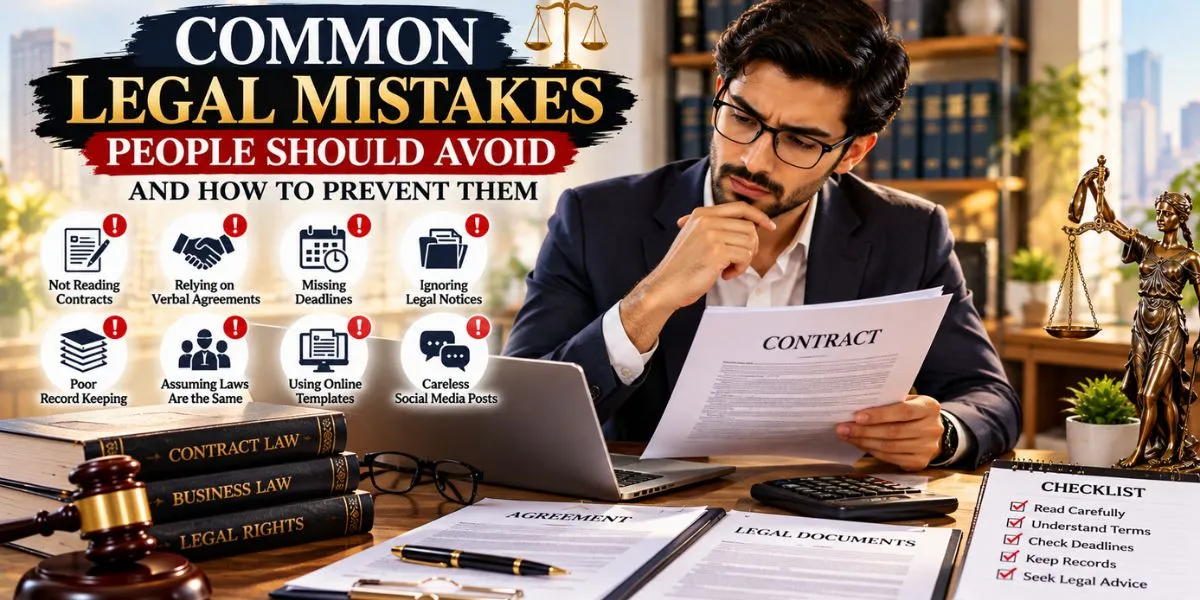
Common legal mistakes Legal problems do not always begin with dramatic disputes or courtroom battles. Instead, many situations start with small decisions that seem harmless at the time. Signing a document without reading it, ignoring an official notice, trusting a verbal promise, or missing a deadline can create unnecessary legal and financial problems.
Therefore, understanding common legal mistakes can help you make better decisions and protect your interests. You do not need to become a legal expert. However, you should know when to slow down, check the facts, keep proper records, and seek professional advice.
Because laws differ between countries, states, provinces, and other jurisdictions, always verify that legal information applies to your specific situation. Contract rules, deadlines, employment laws, property regulations, and other legal requirements can vary significantly by location.
1. Signing Contracts Without Reading Them
One of the most common legal mistakes is signing an agreement without carefully reading the terms.
Contracts can contain important information about payments, cancellation, automatic renewal, responsibilities, penalties, warranties, termination, and dispute procedures. In many situations, a contract creates legally enforceable obligations.
Therefore, never assume that the small print is unimportant.
Before signing, read the entire document and pay special attention to:
- Payment terms and fees
- Cancellation conditions
- Renewal clauses
- Deadlines
- Penalties
- Responsibilities of each party
- Termination rights
- Dispute-resolution procedures
If something is unclear, ask questions before signing. Moreover, if the agreement involves substantial money, property, business interests, or long-term obligations, consider getting qualified legal advice.
2. Relying Only on Verbal Agreements

Verbal promises can create confusion when people later remember the agreement differently. Although oral agreements can sometimes be legally valid, proving exactly what was agreed can become difficult during a dispute.
For that reason, important arrangements should preferably be documented in writing.
This can include agreements involving:
- Loans
- Freelance work
- Property
- Repairs
- Employment
- Business partnerships
- Valuable purchases
- Services
Even an email confirming the main terms can create a useful record. Consequently, written documentation can make it easier to establish what each person agreed to do.
3. Ignoring Legal Notices and Official Documents
Ignoring a legal notice rarely makes the underlying problem disappear.
Official documents may include court papers, government correspondence, tax notices, demand letters, insurance communications, or employment-related documents. Some of these may contain deadlines that affect your available options.
Therefore, check important correspondence promptly. Record when you received it, read the instructions carefully, and determine whether a response is required.
If you do not understand an official document, seek appropriate professional assistance rather than simply putting it aside.
4. Missing Important Legal Deadlines
Another major legal mistake is assuming that a deadline can always be extended.
Depending on the matter and jurisdiction, deadlines may apply to filing claims, responding to legal documents, challenging decisions, renewing licenses, making insurance claims, or completing government paperwork.
Missing a deadline can sometimes affect your ability to pursue a claim or exercise a legal right.
To reduce this risk, create a calendar for important dates. Additionally, keep copies of correspondence that mention deadlines and confirm the date carefully rather than relying on memory.
5. Failing to Keep Important Records
Good documentation can be extremely valuable when a disagreement occurs.
Keep copies of important contracts, invoices, receipts, payment confirmations, emails, warranties, employment documents, property records, notices, and other relevant communications.
Furthermore, organize digital files so that you can find them quickly. Secure backups can also protect important information from accidental loss.
A clear record can help establish what happened, when it happened, and what was communicated between the parties.
Read More: Understanding Your Legal Rights in Everyday Situations
6. Assuming the Law Is the Same Everywhere

One of the most dangerous legal assumptions is believing that a rule found online automatically applies to you.
Legal requirements can vary by country, state, province, municipality, or other jurisdiction. This is particularly important for contracts, employment, property, taxes, business regulations, consumer protection, and family matters.
For example, information that applies in one country may not apply in another.
Therefore, always check the jurisdiction before relying on online legal information. A general article can provide useful background, but it should not replace current local legal guidance when the issue is significant.
7. Using Online Legal Templates Without Reviewing Them
Online templates can save time. However, a template is not automatically suitable for every person or situation.
Generic documents may contain provisions that do not apply to your circumstances. They may also fail to address requirements specific to your location.
This can be particularly important for:
- Rental agreements
- Employment contracts
- Business agreements
- Wills
- Privacy policies
- Partnership documents
- Service agreements
Use templates as starting points rather than assuming they are automatically correct. Most importantly, review every provision before using or signing the document.
8. Mixing Personal and Business Matters
Business owners can create unnecessary complications by mixing personal and business finances.
For example, using personal accounts for business transactions or failing to maintain clear records can make financial management more difficult. Depending on the business structure and jurisdiction, it may also create additional legal or tax concerns.
Instead, maintain organized records and keep personal and business transactions clearly separated where appropriate.
Good documentation also makes it easier to understand expenses, payments, obligations, and business activities.
9. Posting Carelessly on Social Media
Social media can create legal problems when people post without considering the possible consequences.
Public posts, comments, photographs, videos, reviews, and private messages may become relevant in certain disputes. Therefore, avoid posting confidential information, threats, unsupported accusations, or sensitive details about an ongoing legal matter.
Before publishing something, consider whether you would be comfortable seeing the same statement presented in a formal dispute.
In addition, remember that deleting a post later does not necessarily mean that copies or records no longer exist.
10. Failing to Protect Intellectual Property

Creative work and business ideas can have significant value. Copyrights, trademarks, patents, licensing arrangements, and other intellectual-property protections may apply depending on the work and jurisdiction.
Common mistakes include using someone else’s photographs without permission, copying written content, using protected logos, or failing to document ownership of original work.
Therefore, creators and businesses should understand what protections may apply to their work. At the same time, they should check whether permission or licensing is required before using material created by someone else.
11. Not Understanding Employment Documents
Employment documents can contain important information about salary, benefits, responsibilities, confidentiality, working conditions, termination, leave, and company policies.
Unfortunately, some people sign employment documents without reading the details carefully.
Instead, review the agreement before accepting the terms. Keep a copy for your records and ask questions about anything you do not understand.
Employment laws vary considerably by jurisdiction. Consequently, a workplace rule or contractual provision that is valid in one location may not apply in another.
12. Making Important Decisions Based on Assumptions
Assumptions can become expensive when legal issues are involved.
You might assume that something is legal because your friends do it. Alternatively, you might believe that another person’s promise is enough to protect you. However, legal requirements do not always match common expectations.
Contract law, for example, can involve specific requirements concerning agreements and obligations, and the exact rules depend on the applicable legal system.
Therefore, verify important information instead of relying on assumptions, social media comments, or casual advice.
13. Waiting Too Long to Seek Legal Advice
Not every disagreement requires a lawyer. Some simple problems may be resolved through customer-service departments, formal complaints, mediation, government agencies, or direct communication.
Nevertheless, professional legal advice can become particularly important when substantial money, property, business interests, serious injuries, criminal allegations, employment disputes, or court deadlines are involved.
Getting advice early may help you understand your options before the situation becomes more complicated.
How to Avoid Common Legal Mistakes
Fortunately, avoiding many legal mistakes does not require complicated procedures. Start by developing a few simple habits.
Before signing an agreement, read every important section carefully. Next, ask questions about anything unclear. Then, save a complete copy of the signed document.
Likewise, keep important records organized and create reminders for legal or contractual deadlines. When researching online, check whether the information applies to your country or jurisdiction.
Finally, when the consequences could be serious, consider consulting a qualified legal professional.
Simple Legal Safety Checklist
Before making an important legal decision, ask yourself:
- Have I read the entire document?
- Do I understand my responsibilities?
- Are there important fees or penalties?
- Is there a deadline I need to remember?
- Do I have the agreement in writing?
- Have I saved relevant records and evidence?
- Does this information apply to my jurisdiction?
- Am I relying on an online template without reviewing it?
- Could my social media activity create unnecessary problems?
- Would professional legal advice be appropriate?
This simple checklist can help you slow down before making a decision that could have lasting consequences.
Frequently Asked Questions About Common Legal Mistakes
What are the most common legal mistakes people make?
Common mistakes include signing documents without reading them, relying only on verbal agreements, ignoring legal notices, missing deadlines, failing to keep records, and assuming that laws are the same everywhere.
Why is it important to read a contract before signing?
A contract may contain important obligations involving payments, cancellation, renewal, penalties, responsibilities, and dispute procedures. Reading it carefully helps you understand what you are agreeing to before becoming committed to its terms.
Are verbal agreements legally valid?
A verbal agreement can sometimes be legally valid, but the rules vary by jurisdiction and circumstances. The main problem is often proving exactly what was agreed. For important arrangements, written documentation is generally safer.
What should I do if I receive a legal notice?
Do not ignore it. Read the document carefully, record the date you received it, identify any response deadline, and seek appropriate professional advice if you do not understand what it requires.
Can online legal templates be trusted?
Templates can be useful starting points, but they may not fit your specific circumstances or jurisdiction. Review them carefully and consider professional advice for important documents.
When should I seek legal advice?
Consider seeking professional advice when a matter involves significant money, property, business interests, serious employment issues, criminal allegations, court proceedings, or important legal deadlines.
Conclusion
Avoiding common legal mistakes often comes down to being careful, organized, and willing to verify information before acting. Read contracts, document important agreements, keep useful records, respect deadlines, and check which laws apply to your situation.
Most importantly, do not assume that something is legally acceptable simply because other people do it or because information online says it is allowed. Laws can change and can differ significantly between jurisdictions.
With better documentation, careful communication, and timely professional guidance when necessary, you can reduce avoidable legal problems and make more informed decisions.
Legal Disclaimer: This article is provided for general educational and informational purposes only. It is not legal advice and does not create an attorney-client relationship. Laws and legal procedures vary by jurisdiction and may change over time. For advice about a specific legal situation, consult a qualified legal professional familiar with the applicable law.
