
what does TBF mean in text Have you ever received a text message containing TBF and wondered what it means? You are not alone. People use short abbreviations every day in text messages, social media comments, and online conversations. As a result, understanding these expressions can help you communicate more clearly.
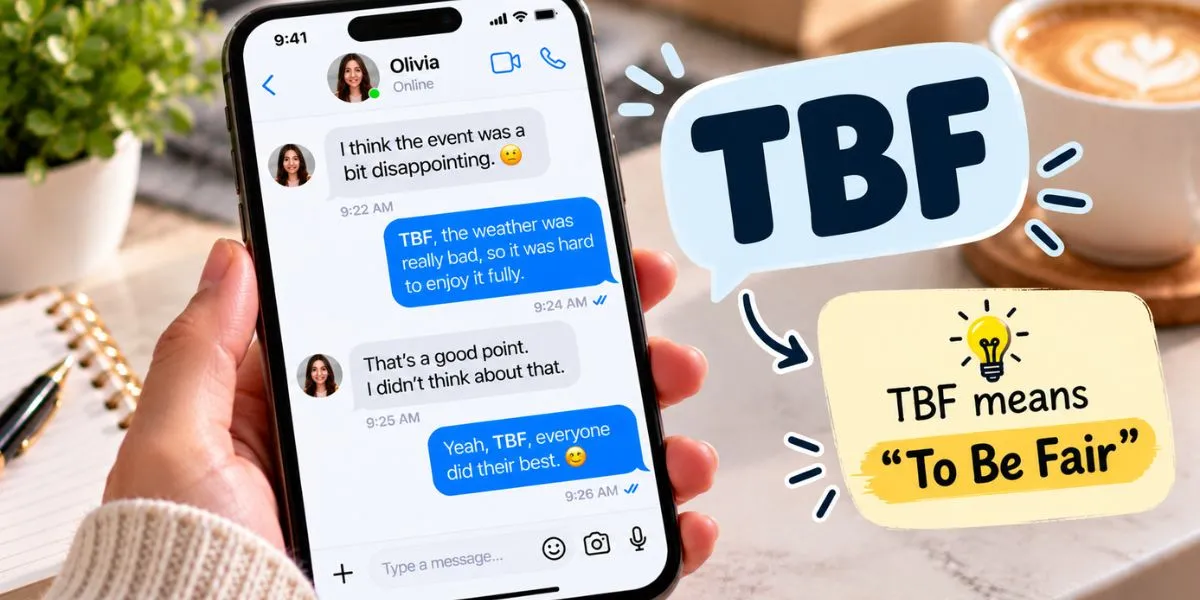
TBF usually means “To Be Fair” in texting. People use it when they want to acknowledge another perspective, explain a situation more objectively, or make a statement sound more balanced. For example, someone might text, “TBF, you did warn me about the traffic.” In this sentence, the person recognizes that the other person had a valid point.
However, the exact tone of TBF depends on the conversation. Sometimes, it sounds thoughtful and understanding. In other situations, it can introduce a disagreement or a slightly sarcastic comment.
In this guide, you will discover what TBF stands for, how people use it in text messages, what it means on social media, and how it differs from similar abbreviations such as TBH and IMO. You will also find practical examples and simple replies you can use in everyday conversations.
What Does TBF Mean in Text?
In text messages, TBF stands for “To Be Fair.” It is an informal abbreviation that people use to introduce a balanced opinion, acknowledge someone else’s point of view, or add information that makes a situation seem fairer.
For instance, imagine that your friend complains about a restaurant because the food arrived late. You might respond:
“TBF, the restaurant was packed tonight.”
Here, you are not necessarily saying that your friend is wrong. Instead, you are explaining another factor that might have contributed to the delay.
Similarly, TBF can help people acknowledge mistakes, defend someone, or recognize circumstances that others may have overlooked. what does TBF mean in text
What Does “To Be Fair” Actually Mean?
The phrase “to be fair” means that you are trying to consider all sides of a situation rather than judging it from only one perspective.
For example:
- “TBF, she finished most of the project herself.”
- “TBF, I forgot to tell you about the change.”
- “TBF, the movie was better than I expected.”
- “TBF, he has been working really hard lately.”
In each example, the speaker adds context or recognizes something important.
Moreover, the abbreviation makes the phrase quicker to type. Instead of writing the full expression, people can simply use three letters.
Is TBF a Common Texting Abbreviation?
Yes, TBF is a familiar abbreviation in informal digital communication, particularly among people who frequently text or use social media.
Nevertheless, not everyone uses it in the same way. Some people prefer writing the complete phrase, while others use TBF naturally in conversations with friends and family.
Because its meaning is relatively straightforward, you can usually understand it from the surrounding sentence.
What Does TBF Stand For in Slang?
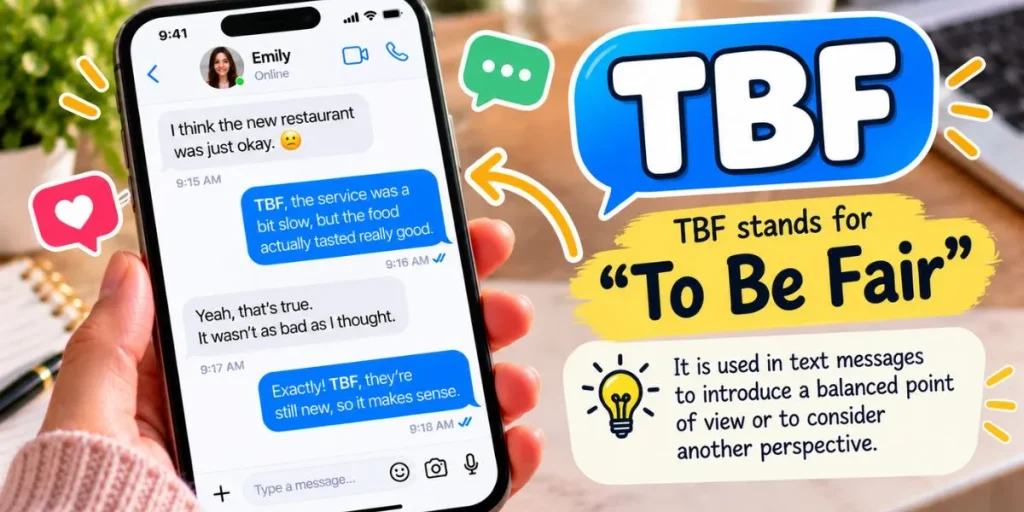
In everyday texting slang, TBF generally stands for “To Be Fair.” Unlike expressions that communicate uncertainty or a personal opinion, TBF often signals that the speaker wants to acknowledge another side of an issue.
For example, consider this conversation:
Alex: “You never help me with the housework.”
Sam: “TBF, I cleaned the kitchen yesterday.”
Sam uses TBF to point out information that may have been overlooked. The response does not necessarily dismiss Alex’s frustration. Instead, it introduces another detail into the discussion.
TBF Meaning in Simple English
In simple English, TBF means something like:
- “To be fair…”
- “Looking at both sides…”
- “You have to admit…”
- “Considering the situation…”
- “To give someone credit…”
These phrases are not exact replacements in every situation. However, they communicate the general idea behind TBF.
For instance, “TBF, she did her best” means that the speaker wants others to consider the person’s effort before judging the result.
Does TBF Have Other Meanings?
TBF can have different meanings in specialized contexts, including abbreviations used by particular organizations, communities, or technical fields. However, in ordinary text messages and casual online conversations, “To Be Fair” is the usual interpretation. what does TBF mean in text
Therefore, consider the surrounding message before deciding what the abbreviation means. If you see TBF in a conversation about a disagreement, someone’s behavior, or an opinion, “To Be Fair” is generally the most likely meaning.
How Is TBF Used in Text Messages?
People use TBF in several ways, depending on what they want to communicate. Most commonly, it introduces a point that makes a judgment or opinion more balanced.
1. To Acknowledge Another Point of View
Sometimes, a conversation begins with a strong opinion. However, after considering the circumstances, someone may recognize that the other person has a valid argument.
For example:
Friend 1: “That teacher gives us too much homework.”
Friend 2: “TBF, we have had fewer assignments this week.”
The second friend uses TBF to introduce another perspective. Although the homework may still feel overwhelming, the response encourages a more balanced view.
2. To Explain a Situation
TBF is also useful when someone wants to explain why an event happened.
For example:
“I was late because the bus never arrived. TBF, the weather was terrible.”
The speaker adds information that helps explain the delay.
Similarly, you might write:
“TBF, the team had only two days to finish everything.”
This statement highlights a circumstance that could affect how people evaluate the team’s performance.
3. To Defend Someone
Another common use is defending someone who is being criticized.
For example:
“Everyone is blaming Sarah, but TBF, she wasn’t the only person responsible.”
In this message, TBF introduces a reason to consider the situation more carefully.
Likewise, someone might say:
“TBF, he apologized as soon as he realized his mistake.”
This response recognizes the person’s effort to make things right.
4. To Admit Someone Has a Point
Sometimes, TBF helps people acknowledge that another person is right about something.
For example:
“Okay, TBF, you did tell me to leave earlier.”
This message shows that the speaker recognizes the other person’s argument.
In addition, it can make a conversation feel less confrontational because the speaker is willing to admit a relevant fact. what does TBF mean in text
5. To Make a Statement Sound Less Harsh
People sometimes use TBF before giving criticism or expressing a disagreement.
For example:
“TBF, your presentation was good, but the introduction was too long.”
The phrase signals that the speaker is trying to recognize the positive aspects while mentioning something that could improve.
However, TBF does not automatically make criticism polite. The words that follow still matter, especially when discussing sensitive subjects.
What Does TBF Mean on Social Media?
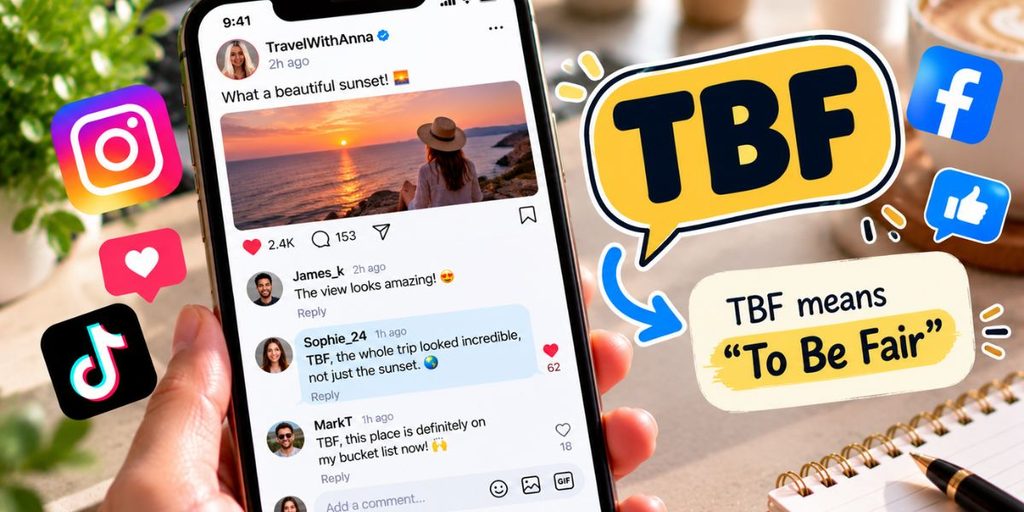
On social media, TBF usually has the same meaning as in private messages: “To Be Fair.” People use it in comments, captions, replies, and discussions to add context or acknowledge a different perspective.
Although the platform may change, the basic meaning usually remains the same.
TBF Meaning on Instagram
On Instagram, people may use TBF in comments, direct messages, or discussions about photos, videos, and personal experiences.
For example:
“TBF, that outfit looks much better in natural light.”
Or:
“TBF, the original photo was already amazing.”
In these situations, TBF introduces a comment that acknowledges an additional detail or gives someone credit. what does TBF mean in text
It can also appear in discussions about celebrities, fashion, travel, food, and lifestyle content.
TBF Meaning on Snapchat
On Snapchat, TBF is generally used in casual conversations between friends.
For example:
“TBF, you did look tired after that long trip 😂.”
The abbreviation keeps the message short while introducing an observation.
Similarly, a friend might write:
“TBF, I forgot about our plan too.”
This response acknowledges shared responsibility instead of blaming just one person.
TBF Meaning on TikTok
TikTok users may include TBF in comments or replies when reacting to videos, trends, opinions, or debates.
For example:
“TBF, the creator explained their side pretty clearly.”
Another example is:
“TBF, that challenge looks much harder than it seems.”
In both cases, the abbreviation introduces a balanced observation.
Additionally, TBF can appear in conversations where viewers disagree about a creator’s actions or interpretation of an event. As always, the surrounding discussion determines the tone.
TBF Meaning on WhatsApp
On WhatsApp, TBF is commonly understood as “To Be Fair.” It can appear in private chats, family groups, friendship groups, or work-related conversations. what does TBF mean in text
For example:
“TBF, everyone contributed something to the project.”
Or:
“TBF, we never confirmed the time.”
The abbreviation can help people explain circumstances without typing the full phrase.
Nevertheless, when communicating with someone who may not know texting slang, writing “to be fair” in full can make your meaning clearer.
May You Like To Read More: What Does IMK Mean in Text? Meaning, Uses, and Examples
TBF Text Message Examples and Their Meanings
The easiest way to understand TBF is to see how people use it in realistic conversations. Below are examples from everyday situations, along with explanations of what each message communicates.
Example 1: Talking About a Friend
Message:
“TBF, she has been really busy this week.”
Meaning:
The speaker is asking others to consider the friend’s schedule before criticizing her for being unavailable.
Example 2: Discussing School
Message:
“TBF, the exam was difficult for everyone.”
Meaning:
The speaker points out that the exam was challenging for the whole class, rather than just one student.
Example 3: Talking About Work
Message:
“TBF, our manager gave us the instructions at the last minute.”
Meaning:
The speaker explains why completing a task may have been difficult.
Example 4: Discussing a Movie
Message:
“TBF, the ending was better than I expected.”
Meaning:
The speaker recognizes a positive aspect of the movie, possibly after criticizing other parts of it.
Example 5: Talking About Relationships
Message:
“TBF, we both made mistakes during that argument.”
Meaning:
The speaker acknowledges that responsibility may be shared rather than belonging to only one person.
Example 6: Making Plans
Message:
“TBF, you never told me the time had changed.”
Meaning:
The speaker explains why they missed or misunderstood the updated plan.
Example 7: Discussing Food
Message:
“TBF, this pizza is pretty good for a place that just opened.”
Meaning:
The speaker gives the restaurant credit while possibly recognizing that it is still new.
Example 8: Responding to Criticism
Message:
“TBF, he did try to fix the problem.”
Meaning:
The speaker wants others to consider the person’s attempt to resolve the issue.
Example 9: Talking About Traffic
Message:
“TBF, nobody could have predicted that much traffic.”
Meaning:
The speaker suggests that the delay was understandable under the circumstances.
Example 10: Admitting a Mistake
Message:
“TBF, I should have checked the details first.”
Meaning:
The speaker accepts some responsibility and acknowledges what they could have done differently.
These examples demonstrate that TBF is flexible. It can introduce an explanation, soften a disagreement, recognize effort, or acknowledge that a situation is more complicated than it first appeared. what does TBF mean in text
TBF vs. TBH, IMO, NGL, and FYI
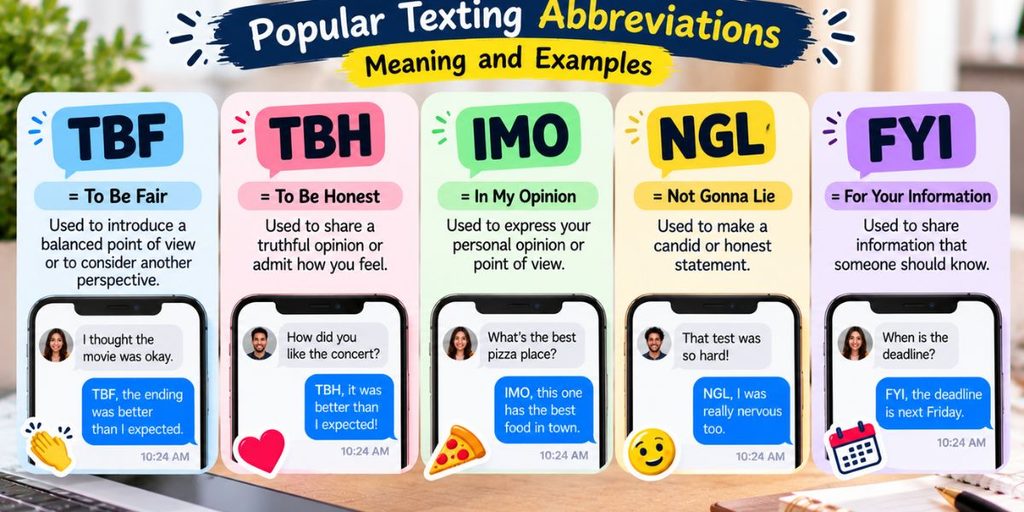
TBF is sometimes confused with other texting abbreviations because they all appear in casual conversations. However, each expression serves a slightly different purpose.
| Abbreviation | Full form | Main purpose |
|---|---|---|
| TBF | To Be Fair | Adds balance or another perspective |
| TBH | To Be Honest | Introduces an honest opinion or admission |
| IMO | In My Opinion | Expresses a personal viewpoint |
| NGL | Not Gonna Lie | Signals a candid statement |
| FYI | For Your Information | Shares information someone may need |
TBF vs. TBH
TBF means “To Be Fair,” while TBH means “To Be Honest.”
For example:
- TBF: “TBF, she did warn us.”
- TBH: “TBH, I didn’t enjoy the movie.”
The first message acknowledges a relevant fact. The second communicates the speaker’s honest opinion.
Although the two expressions can appear in the same conversation, they are not interchangeable in every sentence.
TBF vs. IMO
IMO stands for “In My Opinion.” People use it when they want to express a personal viewpoint.
For example:
- TBF: “TBF, the restaurant was very busy.”
- IMO: “IMO, the restaurant has the best food in town.”
TBF introduces a balancing point, whereas IMO identifies a statement as a personal opinion.
TBF vs. NGL
NGL means “Not Gonna Lie.” It often introduces a candid observation, feeling, or admission.
For example:
- TBF: “TBF, he worked hard on the project.”
- NGL: “NGL, I was nervous before the interview.”
The first considers someone’s effort. The second emphasizes honesty about a feeling.
TBF vs. FYI
FYI means “For Your Information.” It introduces information that may be useful to someone.
For example:
- TBF: “TBF, the deadline changed twice.”
- FYI: “FYI, the deadline is now Friday.”
TBF helps frame a judgment fairly. FYI simply draws attention to information.
Understanding these differences makes it easier to choose the right abbreviation for your message.
Is TBF Rude, Sarcastic, or Polite?
TBF is not inherently rude. In many conversations, it sounds reasonable because the speaker is trying to acknowledge another perspective. However, its tone depends on the words that follow, the relationship between the people chatting, and the context of the discussion.
When TBF Sounds Polite
TBF can sound polite when it recognizes another person’s effort or circumstances.
For example:
“TBF, you handled that situation really well.”
This message gives someone credit and may help them feel appreciated.
Similarly:
“TBF, I understand why you were upset.”
This response recognizes the other person’s feelings instead of dismissing them.
When TBF Sounds Sarcastic
On the other hand, TBF can sound sarcastic when someone uses it to criticize another person indirectly.
For example:
“TBF, you only remembered after everyone else reminded you.”
Depending on the conversation, this statement may sound like a genuine observation or a sarcastic remark. what does TBF mean in text
Emojis, punctuation, previous messages, and the relationship between the people involved can all influence how the message is interpreted.
Can TBF Start an Argument?
Yes, it can, although the abbreviation itself is not necessarily the problem.
For example, imagine that one person is explaining why they feel hurt. Another person responds, “TBF, you’re being too sensitive.”
The reply might sound dismissive because it minimizes the other person’s feelings.
A more considerate alternative could be:
“I understand why that upset you. TBF, I think there may have been a misunderstanding.”
This version acknowledges the person’s feelings before offering another perspective.
Therefore, use TBF thoughtfully when discussing emotional or sensitive subjects.
What Does TBF Mean in Relationships?
In relationships, TBF usually means “To Be Fair,” just as it does in other everyday conversations. However, its emotional meaning depends on the situation.
Someone might use it to acknowledge their partner’s efforts, explain a misunderstanding, or recognize that both people contributed to a disagreement.
For example:
“TBF, you’ve been trying to make more time for us.”
This message acknowledges a positive effort.
Alternatively:
“TBF, we both misunderstood each other.”
Here, the speaker suggests that the disagreement may have resulted from shared misunderstandings.
However, TBF can sound defensive if it is used to dismiss someone’s feelings or avoid taking responsibility. For that reason, it is important to listen carefully and consider the other person’s perspective.
If you receive TBF during a serious conversation, focus on the complete message rather than assuming the abbreviation indicates affection, anger, or sarcasm on its own.
How Do You Reply When Someone Says TBF?
Your response depends on whether you agree with the person’s point, want to clarify something, or have a different perspective.
Here are some natural replies you can use.
If You Agree
- “That’s fair.”
- “Good point!”
- “True, I hadn’t thought of that.”
- “You’re right about that.”
- “Yeah, I see what you mean.”
These responses acknowledge the other person’s perspective without making the conversation unnecessarily complicated.
If You Partly Agree
- “That’s true, but there’s another side to it.”
- “I get your point, although I see it a little differently.”
- “Fair enough, but I still think we should discuss it.”
- “I agree with that part.”
These replies allow you to recognize a valid argument while maintaining your own position.
If You Disagree Politely
- “I understand, but I don’t completely agree.”
- “That’s one way to look at it.”
- “I see your point, but here’s what I meant.”
- “Maybe, although the situation was a little different.”
Such responses can keep the conversation respectful, even when you have different opinions.
If You Are Unsure What They Mean
If the abbreviation or the message is unclear, you can simply ask:
- “What do you mean?”
- “Can you explain that a little more?”
- “Are you saying there’s another side to the story?”
In most everyday conversations, you will not need to ask what TBF means because its meaning is relatively easy to understand from context.
When Should You Use TBF?
TBF works best in informal conversations where you want to acknowledge another perspective or explain why a situation deserves a more balanced judgment.
You can use it when chatting with friends, discussing a movie, talking about plans, responding to criticism, or recognizing someone’s effort. what does TBF mean in text
For example:
“TBF, everyone did their best with the time we had.”
This message introduces a fair consideration without requiring a long explanation.
Is TBF Appropriate in Professional Messages?
TBF can be understood in workplace chats, particularly among colleagues who regularly use informal abbreviations. Nevertheless, writing the complete phrase “to be fair” is often better in formal emails, reports, client communications, or messages to people you do not know well.
For example, instead of writing:
“TBF, the project was delayed because we received the information late.”
You could write:
“To be fair, the project was delayed because we received the information late.”
The second version is clearer and more professional.
Ultimately, choose your wording based on your audience and the level of formality the situation requires.
Frequently Asked Questions About TBF Meaning in Text
1. What does TBF mean in texting?
TBF means “To Be Fair.” It is used to acknowledge another perspective, add context, or recognize that a situation may be more complicated than it first appears.
2. What does TBF stand for in slang?
In everyday texting slang, TBF generally stands for “To Be Fair.” It is commonly used in messages, online comments, and informal conversations.
3. Does TBF mean “To Be Fair” or “To Be Frank”?
In ordinary texting, TBF usually means “To Be Fair.” “To Be Frank” is not the standard expansion of TBF and is more commonly associated with other wording, such as TBH in some contexts.
4. Is TBF the same as TBH?
No. TBF means “To Be Fair,” while TBH means “To Be Honest.” TBF introduces a balancing perspective, whereas TBH often introduces an honest opinion or admission.
5. What does TBF mean from a girl or a guy?
TBF has the same usual meaning regardless of who sends it: “To Be Fair.” The person’s gender does not determine the abbreviation’s meaning. Instead, consider the complete message and the context of your conversation.
6. Is TBF rude?
No, TBF is not inherently rude. It can sound polite, neutral, defensive, or sarcastic depending on how it is used. The wording and context matter more than the abbreviation itself.
7. Can I use TBF in a professional message?
You can use TBF in an informal workplace chat if the audience understands texting abbreviations. However, spelling out “to be fair” is generally a safer choice in formal emails and client communications.
8. What is the difference between TBF and IMO?
TBF means “To Be Fair,” while IMO means “In My Opinion.” TBF adds balance or context to a statement, whereas IMO signals that a statement expresses a personal viewpoint.
9. What does TBF mean on Snapchat or Instagram?
On Snapchat and Instagram, TBF generally means “To Be Fair.” Users may include it in direct messages, comments, and discussions to introduce another perspective or give someone credit.
10. How should I respond to TBF?
If you agree, you can reply with “That’s fair,” “Good point,” or “True.” If you disagree, explain your perspective politely or ask the person to clarify what they mean.
Final Thoughts on TBF Meaning in Text
Understanding texting abbreviations makes everyday online communication easier. TBF usually means “To Be Fair,” and people use it to acknowledge another perspective, explain a situation, or recognize that someone has a valid point.
For example, “TBF, she did her best” gives someone credit for their effort. Similarly, “TBF, we both made mistakes” acknowledges shared responsibility.
Although TBF is common in informal messages and social media conversations, its tone depends on the surrounding words. It can sound thoughtful and polite, but it may also sound defensive or sarcastic in certain situations.
Now that you know what TBF means, you can recognize it more easily in your chats and use it when you want to introduce a fair or balanced point of view. When communicating in formal settings, however, writing “to be fair” in full is often the clearest choice.
