what does IMA mean in text Have you ever received a message containing “IMA” and wondered what it means? Texting abbreviations can sometimes be confusing, especially when people use different spellings of the same expression. Fortunately, understanding this popular slang term is easier than you might think.
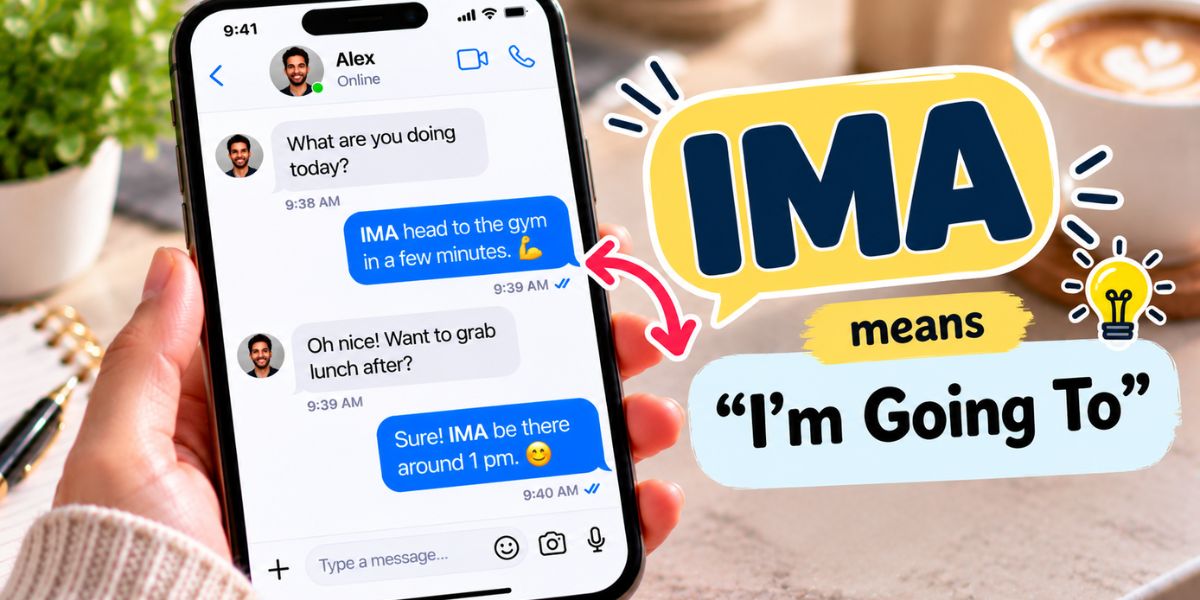
IMA usually represents “I’ma,” an informal way of saying “I’m going to” or “I’m gonna.” People use it in casual text messages to talk about their plans, explain what they intend to do, or tell someone what will happen next. For example, a friend might text, “IMA head home after work,” meaning, “I’m going to head home after work.”
Moreover, IMA is often used in informal conversations on social media, messaging apps, and online platforms. Although the spelling can vary, the intended meaning is generally clear from the surrounding sentence.
In this guide, you will learn what IMA means in text, how people use it in everyday conversations, what it means on social media, and how it differs from similar expressions such as IMMA and GONNA. You will also discover practical examples, possible alternative meanings, and natural ways to reply when someone sends you this abbreviation.
What Does IMA Mean in Text Messages?
In everyday texting, IMA most commonly represents the informal expression “I’ma,” meaning “I’m going to” or “I’m gonna.” It is used when someone wants to describe an intention, plan, or action they expect to take.
For example, consider this message:
“IMA call you when I get home.”
The sender means, “I’m going to call you when I get home.” Rather than typing the complete sentence in a more formal style, they use casual language that feels natural in a conversation with a friend. what does IMA mean in text
Similarly, someone might write:
- “IMA grab some food.”
- “IMA finish my homework tonight.”
- “IMA watch that new movie.”
- “IMA tell you everything later.”
In each example, IMA introduces an action the person intends to do.
However, context matters. Uppercase IMA can also be an acronym in a specialized setting, so you should consider the complete message before deciding what it means.
What Does IMA Mean in Simple English?
In simple English, IMA means “I’m going to.” It usually introduces something a person plans or intends to do.
For example:
Text: “IMA leave in five minutes.”
Simple meaning: “I’m going to leave in five minutes.”
Here is another example:
Text: “IMA help you with that project.”
Simple meaning: “I’m going to help you with that project.”
Therefore, whenever you see IMA before an action, try replacing it with “I’m going to.” If the sentence still makes sense, that is likely the intended meaning.
What Does I’ma Stand For?
I’ma is an informal spelling of a spoken expression that is commonly understood as “I’m going to.” You may also see related spellings such as “ima” and “imma.”
These spellings are used in casual digital communication, although their usage can vary between speakers and communities. what does IMA mean in text
For example:
- “I’ma be there soon.”
- “Imma get some rest.”
- “Ima send you the details later.”
All three messages can communicate a similar intention. Nevertheless, “I’m going to” is the clearest choice when writing formally or communicating with someone who may not understand informal slang.
Is IMA the Same as “I’m Going To”?
In many casual text messages, yes. IMA is generally used as an informal version of “I’m going to.”
For example, “IMA study tonight” communicates the same basic intention as “I’m going to study tonight.”
However, IMA is not a standard formal abbreviation with one universally enforced spelling. People may write it differently depending on their speech patterns, online habits, and personal preferences.
As a result, it is helpful to understand the expression without assuming that every person uses the exact same spelling.
How Is IMA Used in Texting?
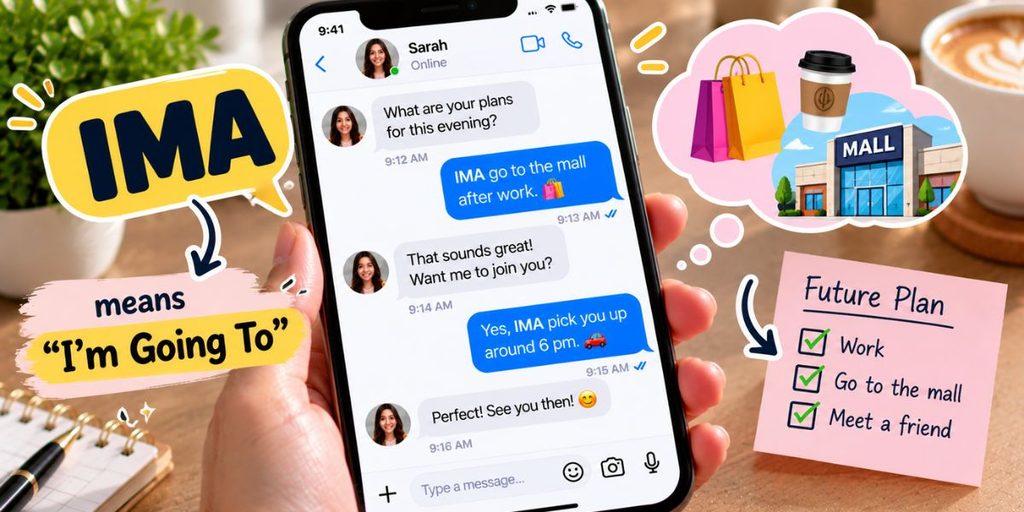
People use IMA in different types of conversations, but the main idea usually involves an intended action or future plan. Here are some of the most common ways it appears in messages.
1. Talking About Future Plans
One of the most common uses of IMA is explaining what someone plans to do.
For example:
“IMA go shopping after lunch.”
This means the person intends to go shopping after lunch.
Similarly, someone might write, “IMA visit my cousin this weekend,” to share their plans with a friend.
Because the expression is short and conversational, it works well in everyday chats about errands, outings, school, and other activities. what does IMA mean in text
2. Making Promises or Giving Updates
IMA can also introduce something a person intends to do for someone else.
For example:
“IMA send you the pictures tonight.”
The sender is saying they intend to send the pictures later.
Another example is:
“IMA check the details and let you know.”
Here, the person is explaining their next step.
However, remember that using IMA does not automatically make something a promise. The exact meaning depends on the words and the situation.
3. Expressing Excitement
Sometimes, people use IMA when they are excited about an upcoming activity.
For example:
“IMA finally watch that movie tonight!”
This message suggests enthusiasm about doing something the person has been waiting for.
Likewise, a friend might text, “IMA try that new restaurant this weekend.” The expression makes the message sound casual and energetic.
4. Giving Someone a Heads-Up
IMA can help someone communicate an action before it happens.
For example:
“IMA leave now, so I’ll be there in 20 minutes.”
The sender is letting the other person know that they are leaving.
Similarly, “IMA turn off my phone for a while” informs someone about what the sender intends to do.
In these situations, IMA makes the message feel direct and informal.
5. Sharing Personal Decisions
People also use IMA when discussing decisions or personal goals.
For example:
“IMA start exercising every morning.”
This message communicates an intention to begin a new habit.
Another example is:
“IMA save money this month instead of buying new clothes.”
The speaker is explaining a decision they plan to follow.
Nevertheless, if the decision is important or requires a formal commitment, writing the complete phrase may communicate the message more clearly.
What Does IMA Mean on Social Media?
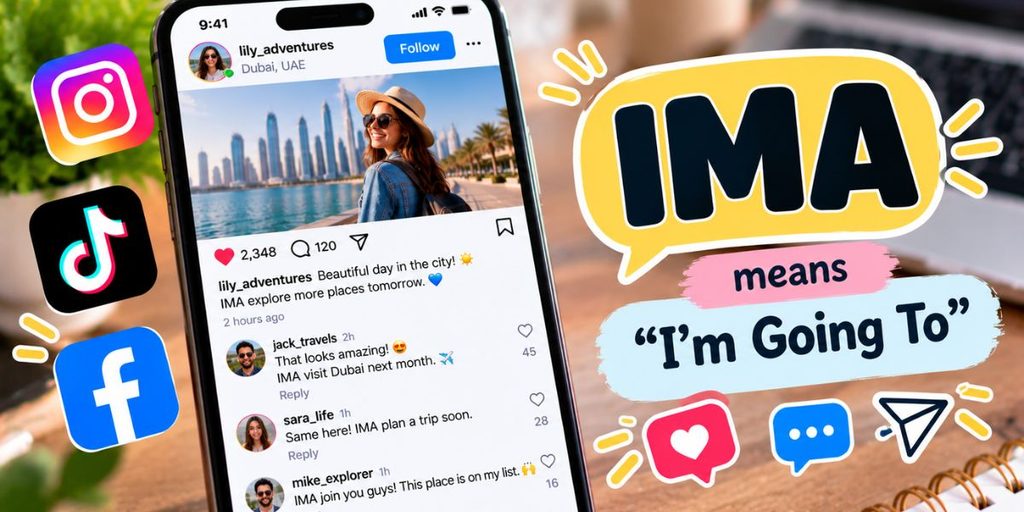
On social media, IMA usually carries the same informal meaning as it does in private text messages: “I’m going to.” People may use it in captions, comments, direct messages, and short videos when talking about their plans or intended actions.
The platform does not necessarily change the meaning. Instead, the surrounding words help readers understand what the person intends to do.
IMA Meaning on Snapchat
On Snapchat, people often use casual expressions when chatting with friends or sending quick updates.
For example:
“IMA get ready, then I’ll call you.”
The sender means they are going to get ready before calling.
Another example is:
“IMA post the pictures later.”
This tells the recipient that the sender intends to post pictures in the future.
Because Snapchat conversations are often informal, you may encounter different spellings, including ima, I’ma, and imma.
IMA Meaning on Instagram
On Instagram, IMA may appear in direct messages, comments, captions, or replies to stories.
For example:
“IMA try this recipe tomorrow.”
The person is explaining what they plan to do.
Similarly, someone might comment, “IMA visit this place one day,” when responding to a travel photograph.
In these examples, IMA expresses an intention rather than a special Instagram-specific meaning.
IMA Meaning on TikTok
TikTok users may use IMA in comments, video captions, or conversations about trends and activities.
For example:
“IMA try this challenge later.”
This means the person plans to attempt the challenge.
Another example is:
“IMA watch the full series this weekend.”
The sender is sharing a plan in casual language.
However, online slang changes over time. Therefore, if IMA appears in an unusual sentence, read the surrounding context rather than automatically assuming the standard texting meaning.
IMA Meaning in WhatsApp Messages
On WhatsApp, IMA can appear in private conversations, group chats, and everyday updates.
For example:
“IMA reach home in 10 minutes.”
Or:
“IMA send the documents after lunch.”
Both messages communicate an intended action.
Although IMA is suitable for many informal chats, it may be less appropriate in formal business messages. In those situations, spelling out “I’m going to” usually sounds clearer and more professional.
Read More: What Does TBF Mean in Text? Meaning, Uses, and Examples
IMA Text Message Examples and Their Meanings
The best way to understand IMA is to see how it works in realistic conversations. Below are examples from everyday situations, along with explanations of what each message means.
Example 1: Making Plans With a Friend
Text message: “IMA meet you at the café at 6.”
Meaning: The sender plans to meet their friend at the café at 6 o’clock.
Example 2: Talking About Food
Text message: “IMA grab something to eat.”
Meaning: The person intends to get food.
Example 3: Discussing School
Text message: “IMA finish this assignment tonight.”
Meaning: The sender plans to complete the assignment that evening.
Example 4: Talking About Work
Text message: “IMA check the report and send it over.”
Meaning: The person intends to review the report and send it to someone.
Example 5: Making a Phone Call
Text message: “IMA call you after dinner.”
Meaning: The sender plans to call the recipient after eating dinner.
Example 6: Expressing Excitement
Text message: “IMA finally see my favorite band live!”
Meaning: The person is excited about attending a live performance.
Example 7: Sharing a Personal Goal
Text message: “IMA start waking up earlier from tomorrow.”
Meaning: The sender intends to begin waking up earlier the next day.
Example 8: Giving an Update
Text message: “IMA head out now. See you soon!”
Meaning: The sender is leaving and expects to see the other person soon.
Example 9: Talking About a Movie
Text message: “IMA watch that movie everyone keeps recommending.”
Meaning: The person intends to watch the movie.
Example 10: Offering Help
Text message: “IMA help you move those boxes.”
Meaning: The sender intends to help the recipient move the boxes.
Example 11: Talking About Travel
Text message: “IMA book my tickets this weekend.”
Meaning: The person plans to book their tickets during the weekend.
Example 12: Making a Casual Announcement
Text message: “IMA take a break from social media for a few days.”
Meaning: The sender intends to stop using social media temporarily.
These examples show that IMA is flexible. It can describe plans, decisions, updates, and intentions. In most cases, you can understand its meaning by looking at the action that follows it.
IMA vs. IMMA, GONNA, OMW, and BRB
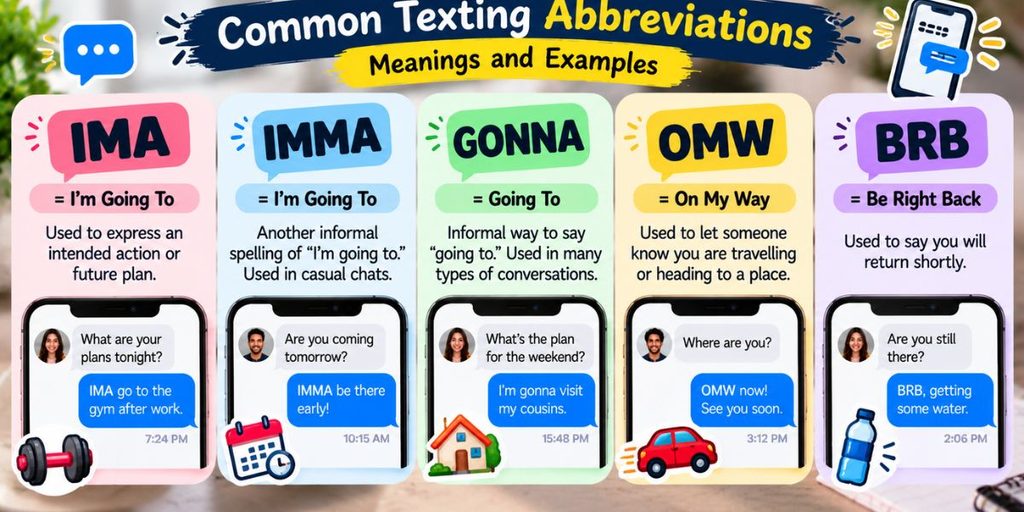
IMA is often confused with other informal expressions because they all appear in casual digital conversations. However, each term has its own usage and meaning.
| Term | Meaning | Typical use |
|---|---|---|
| IMA / I’ma | I’m going to | Describing an intended action |
| IMMA / Imma | I’m going to | Informal alternative spelling |
| GONNA | Going to | Describing a future action |
| OMW | On My Way | Saying you are travelling or heading somewhere |
| BRB | Be Right Back | Saying you will return shortly |
| IDK | I Don’t Know | Expressing uncertainty |
IMA vs. IMMA
IMA and IMMA are often used to communicate the same basic expression: “I’m going to.”
For example:
- “IMA call you later.”
- “IMMA call you later.”
Both messages can mean that the sender intends to call later.
The main difference is spelling and personal writing style. Neither spelling should be treated as a universally required form. what does IMA mean in text
IMA vs. GONNA
GONNA is an informal version of “going to.” It can also express a future intention.
For example:
- IMA: “IMA study tonight.”
- GONNA: “I’m gonna study tonight.”
Both sentences describe a plan to study.
However, IMA generally functions as a casual first-person expression, whereas gonna is used within a wider range of sentence structures.
IMA vs. OMW
OMW stands for “On My Way.” It typically tells someone that you are travelling or heading toward a destination.
For example:
- IMA: “IMA leave in five minutes.”
- OMW: “OMW now.”
The first message communicates an intention to leave. The second usually indicates that the person is already on the way.
Therefore, although the expressions can appear in conversations about meeting up, they do not mean exactly the same thing.
IMA vs. BRB
BRB stands for “Be Right Back.” People use it when they are temporarily leaving a conversation and expect to return soon.
For example:
- IMA: “IMA grab some water.”
- BRB: “BRB, getting some water.”
The first message emphasizes what the person intends to do. The second tells the recipient that the sender will briefly step away.
IMA vs. IDK
IDK means “I Don’t Know.” Unlike IMA, it expresses uncertainty rather than an intention to take action.
For example:
- IMA: “IMA ask her tomorrow.”
- IDK: “IDK what she will say.”
Understanding these differences helps you interpret texting slang more accurately.
Can IMA Have Other Meanings?
Yes. Although IMA commonly represents “I’ma” in informal texting, uppercase IMA can also function as an acronym in professional, organizational, or technical contexts.
For example, an organization might use IMA as part of its official name. In another setting, the letters might have a specialized meaning understood by members of a particular group.
The phrase “In My Area” may also be used as an interpretation in some contexts, but it should not automatically be assumed to be the standard meaning of IMA in everyday texting.
How Can You Identify the Correct Meaning?
To understand IMA accurately, consider three things:
1. Look at the words around it. If IMA appears before an action, such as “IMA call you,” it likely means “I’m going to.”
2. Consider the conversation. A message about plans, errands, or future activities usually supports the informal slang interpretation. what does IMA mean in text
3. Check whether the setting is specialized. If you see IMA in a workplace document, an official organization name, or technical material, it may be an acronym rather than texting slang.
Ultimately, context is the best way to determine what someone means.
Is IMA Appropriate for Professional Messages?
IMA is generally better suited to casual conversations than formal communication. It can work when messaging friends, family members, or colleagues who regularly use informal slang. However, writing “I’m going to” is usually clearer in professional emails, reports, and client communications.
For example, instead of writing:
“IMA send the report this afternoon.”
You could write:
“I’m going to send the report this afternoon.”
The second version sounds more professional and is easier for a wider audience to understand.
Similarly, in an academic assignment, formal letter, or business proposal, avoid using IMA unless you are directly discussing the slang term itself.
The best approach is to adapt your language to your audience. Informal expressions can make casual conversations feel natural, while standard English helps maintain clarity in professional settings.
How Do You Reply When Someone Texts IMA?
Your response depends on what the person says they intend to do. In most cases, you can reply naturally without mentioning the abbreviation itself. what does IMA mean in text
If Someone Shares a Plan
Message: “IMA go shopping after work.”
Possible replies:
- “Sounds good!”
- “Enjoy your shopping.”
- “What time are you going?”
- “Can I come with you?”
If Someone Says They Will Call You
Message: “IMA call you tonight.”
Possible replies:
- “Okay, talk to you then!”
- “Sounds good. I’ll be available.”
- “No problem, call whenever you’re free.”
If Someone Says They Will Help You
Message: “IMA help you with the assignment.”
Possible replies:
- “Thank you, I appreciate it!”
- “That would be great.”
- “Let me know when you’re free.”
If You Are Unsure What They Mean
If the message is confusing, ask for clarification rather than guessing.
For example:
- “Do you mean you’re going to do that now?”
- “When are you planning to do it?”
- “Can you explain what you mean?”
In everyday texting, however, the intended meaning is often clear from the action described in the sentence.
Frequently Asked Questions About IMA Meaning in Text
1. What does IMA mean in a text message?
IMA usually represents “I’ma,” an informal way of saying “I’m going to” or “I’m gonna.” People use it to talk about plans, intentions, and actions they expect to take.
2. Does IMA mean “I’m going to”?
Yes, in many casual text messages, IMA means “I’m going to.” For example, “IMA call you later” means “I’m going to call you later.”
3. What is the difference between IMA and IMMA?
IMA and IMMA are informal spellings often used for the same expression, “I’m going to.” Their spelling differs, but their intended meaning is usually similar.
4. What does IMA mean on Snapchat?
On Snapchat, IMA generally means “I’m going to.” People use it in casual messages to share plans or explain what they intend to do.
5. What does IMA mean on Instagram or TikTok?
On Instagram and TikTok, IMA commonly expresses an intention or future action. The meaning is generally the same as in ordinary text messages, although the surrounding context should always be considered.
6. What does IMA mean from a girl or a guy?
The abbreviation generally has the same meaning regardless of who sends it. IMA usually represents “I’m going to,” and the sender’s gender does not determine its meaning.
7. Is IMA considered slang?
Yes. When used to mean “I’m going to,” IMA is an informal slang spelling associated with casual speech and digital communication. It is not generally appropriate for formal writing.
8. Can I use IMA in professional communication?
You can use it in relaxed workplace chats if everyone understands the expression. However, “I’m going to” is usually a better choice for formal emails, reports, and business documents.
9. Does IMA mean “In My Area”?
That interpretation may appear in particular contexts, but it is not the main meaning of IMA in ordinary texting slang. If someone writes IMA before an action, “I’m going to” is generally the more likely interpretation.
10. How should I respond when someone texts IMA?
Respond to the person’s actual message. If they share a plan, you can say “Sounds good!” or ask a follow-up question. If their meaning is unclear, politely ask them to explain.
Final Thoughts on IMA Meaning in Text
Understanding texting slang makes everyday online communication easier. IMA usually represents “I’ma,” an informal way to say “I’m going to” or “I’m gonna.” People use it to share plans, express intentions, give updates, and describe actions they expect to take.
For example, “IMA call you later” means the sender plans to call later. Similarly, “IMA finish my work tonight” communicates an intention to complete the work that evening.
Although IMA is common in casual messages and social media conversations, its meaning can depend on context. It may also appear as a specialized acronym in professional or organizational settings. Therefore, consider the complete message before deciding what the letters mean.
Now that you know what IMA means in text, you can recognize it more easily in your chats and understand how people use it. When communicating in formal settings, however, writing “I’m going to” in full is usually the clearest option.
