You sent a message. You got back IDEK. And now you are here 😅.
That reaction alone tells you something about how this abbreviation works. IDEK lands in conversations like a verbal shrug — honest, a little chaotic, and surprisingly expressive for four letters. Once you understand it, you will realize you have probably felt the exact feeling it describes dozens of times without having the word for it.
This article covers everything about what does IDEK mean in text — from the clear definition to emotional layers, real conversation examples, and all the ways people use it across different platforms in 2026. By the end you will not just know what it means. You will know exactly how it feels 🔥📚.
What Does IDEK Mean in Text? 💬
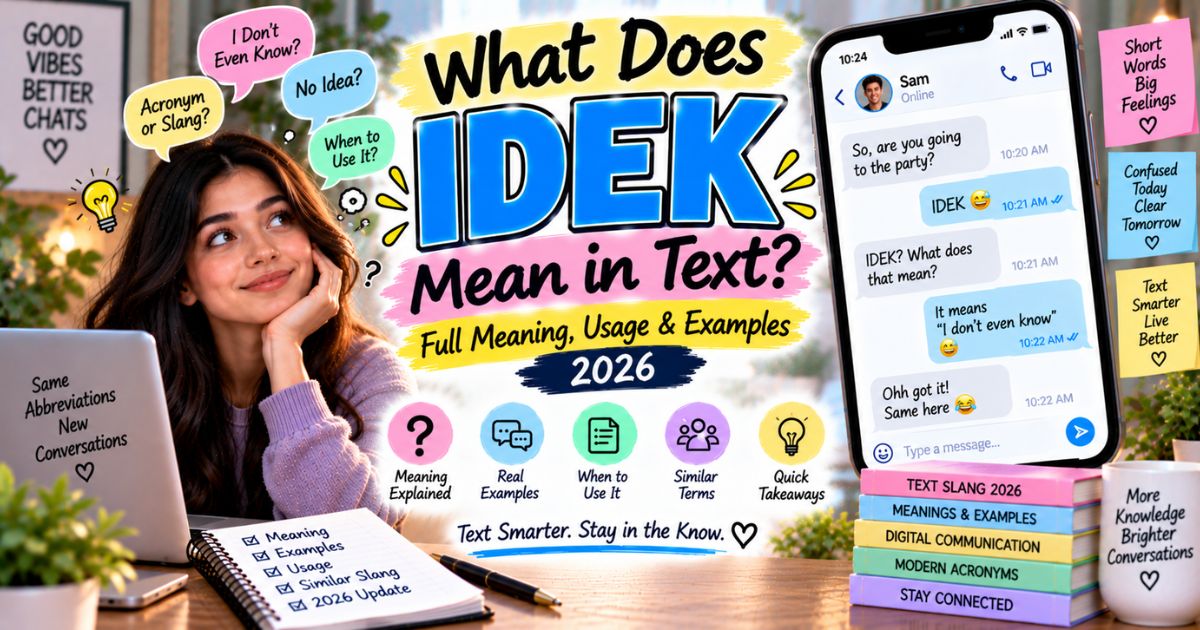
IDEK stands for “I Don’t Even Know.”
When someone sends IDEK they are expressing a level of confusion, disbelief, or emotional overwhelm that goes beyond a simple “I don’t know.” The word “even” is doing crucial work here — it signals that the situation is so confusing, bizarre, or complicated that forming a clear response feels almost impossible.
| Meaning | Full Phrase | Emotional Register |
|---|---|---|
| IDEK | I Don’t Even Know | Confusion, disbelief, overwhelm |
In everyday casual texting, this is the only meaning IDEK carries — but the emotional flavor behind it shifts dramatically depending on context. 👌
What IDEK Really Means in Text 🔑
On the surface, what does IDEK mean in text is simple. But what it really communicates goes deeper than the words.
When someone says IDEK they are not just saying they lack information. They are saying the situation has exceeded their ability to process it cleanly. It is the verbal equivalent of throwing your hands up — not in defeat exactly, but in honest acknowledgment that what just happened defies easy categorization.
So when someone texts: “IDEK why I even agreed to this 😭” They are not just confused. They are emotionally somewhere between amused and exhausted at their own choices.
That nuance is what makes IDEK so expressive for something so short. 😊
Why People Use IDEK in Modern Texting ⚡
1. It Shows Emotional Confusion
Sometimes life presents situations that do not fit neatly into any existing category. IDEK is the honest response to those moments — acknowledging confusion without pretending to have more clarity than you actually do.
2. It’s Fast and Convenient
Four letters. One complete emotional state. In fast-moving digital conversations, IDEK keeps the honesty without requiring a paragraph of explanation that might still not fully capture the feeling anyway.
3. It Sounds Modern and Casual
IDEK fits the tone of current casual digital communication perfectly. It does not sound rehearsed or performed. It sounds exactly like how people actually feel in the moment.
4. It Softens the Tone
In situations where someone might otherwise sound frustrated or overwhelmed, IDEK adds a layer of self-aware humor that keeps things light even when the underlying feeling is not entirely light.
5. It Adds Humor
Sometimes the most honest response to something absurd is to admit you have no idea what to make of it — and IDEK does that with just enough comedic self-awareness to make the whole thing land as funny rather than distressing. 😂
How to Pronounce IDEK 🗣️
In casual spoken conversation, IDEK is usually spelled out letter by letter — I-D-E-K — rather than pronounced as a single word.
Some people say it as a rapid run-on: “eye-deck” in very casual spoken moments. But in most contexts it appears in text rather than speech, so pronunciation matters less than recognizing it on sight.
When someone reads it in their head the feeling of the full phrase “I don’t even know” is what registers — and that feeling is exactly what the abbreviation is designed to deliver. 😊
Common Situations Where People Use IDEK 📍
When someone is confused
The most natural home for what does IDEK mean in text is genuine confusion. Something happened that does not make logical sense and IDEK is the honest acknowledgment of that.
Example: “IDEK how that ended up working out 😅”
When the situation is ridiculous
When something crosses from merely confusing into genuinely absurd, IDEK becomes almost comedic — a disbelieving response to chaos that has gone beyond normal levels.
Example: “He showed up with a llama. IDEK 💀”
When someone asks something impossible
When someone poses a question that has no good answer — about feelings, about complicated situations, about things that resist easy explanation — IDEK is the most honest available response.
Example: “Why do people do that?” → “IDEK honestly, never understood it 😭”
When emotions are mixed
Some situations produce feelings that contradict each other — happy and sad simultaneously, relieved but guilty, excited but terrified. IDEK captures that emotional complexity without trying to resolve it prematurely.
Example: “IDEK how I feel about all of this honestly 💙”
When someone gives up thinking
Sometimes you have been circling a problem long enough that you simply need to acknowledge you have no more clarity than when you started. IDEK is the graceful exit from an overthinking spiral.
Example: “I have been thinking about it for three days. IDEK anymore 😔”
Read More: What Does NBD Mean in Text? Complete Guide 2026
Emotional Meaning Behind IDEK 🎭
Frustration 😤
When something keeps happening in a way that defies understanding and patience is wearing thin. IDEK here carries genuine exasperation.
Example: “IDEK why this keeps going wrong every single time 😤”
Humor 😂
When something is so absurd that confusion becomes comedy. This is IDEK at its most playful — genuine bewilderment worn lightly.
Example: “The cat knocked the entire cake off the table. IDEK 😂”
Embarrassment 😬
When someone cannot explain their own choices or behavior and admitting that is both vulnerable and slightly comedic.
Example: “IDEK why I sent that. I panicked 😬”
Confusion 🤔
Pure genuine uncertainty about a situation, a feeling, or a person’s behavior. No humor, just honest not-knowing.
Example: “IDEK what they meant by that honestly 😔”
Curiosity 👀
When something is confusing in a way that is actually interesting — IDEK here carries wonder alongside bewilderment.
Example: “IDEK how they do it but I want to find out 👀”
Exhaustion 😴
When someone has been processing something so long that their mental resources have simply run out. IDEK becomes a white flag to the overthinking.
Example: “IDEK anymore. I need sleep 😴”
Real-Life Examples of IDEK in Conversations 💬
Example 1
Person A: “Why did you stay up until 4am again?” Person B: “IDEK honestly. One video led to another and suddenly the sun was coming up 😭”
Meaning: Self-aware confession with amused resignation about their own choices.
Example 2
Person A: “How are you feeling about everything?” Person B: “IDEK is the most honest answer I can give you right now 💙”
Meaning: Genuine emotional complexity that cannot be reduced to a simple answer.
Example 3
Person A: “What did she mean when she said that?” Person B: “IDEK 😭 I have been trying to figure it out for two days”
Meaning: Real confusion about someone’s communication that has resisted all attempts at interpretation.
Example 4
Person A: “That plot twist though. What did you think?” Person B: “IDEK what I watched. My brain is still catching up 💀”
Meaning: Overwhelmed in the best possible way — the kind of confused that feels good.
Example 5
Person A: “You should have just said no.” Person B: “IDEK why I didn’t. I froze completely 😬”
Meaning: Honest embarrassment about a choice that made no sense even to the person who made it.
Variations and Related Slang to IDEK 🔄
| Variation | Full Meaning | Difference From IDEK |
|---|---|---|
| IDK | I Don’t Know | Simpler, less emotionally loaded |
| IDKW | I Don’t Know Why | More specific — focused on cause |
| IDKH | I Don’t Know How | Focused on method rather than situation |
| NGL IDEK | Not Gonna Lie I Don’t Even Know | Added honesty layer |
| IDEK fr | I Don’t Even Know For Real | Extra emphasis on genuine confusion |
| IHY | I Honestly Yield | Rare, similar white-flag energy |
IDEK vs. IDK — What’s the Difference? 🆚
This is one of the most important questions around what does IDEK mean in text and the answer matters more than people initially realize.
| Feature | IDK | IDEK |
|---|---|---|
| Full phrase | I Don’t Know | I Don’t Even Know |
| Emotional intensity | Mild | Stronger |
| What it signals | Simple uncertainty | Bewildered, overwhelmed uncertainty |
| Tone | Neutral | More expressive |
| Humor potential | Low | High |
| Common context | Quick answer | Emotionally loaded response |
IDK answers a question. IDEK responds to a whole feeling. The word “even” is everything — it signals that the confusion has exceeded normal levels and entered something closer to genuine bewilderment. 😊
Is IDEK Formal or Informal? 🤔
Completely informal. There is no professional or formal context where IDEK belongs.
This is casual digital communication at its most unfiltered — honest, expressive, and deliberately unbothered about grammatical completeness. The moment you put IDEK in a professional email or formal document it immediately undermines whatever follows it.
Keep what does IDEK mean in text knowledge in personal casual spaces where it was born and where it thrives. 😊
Cultural Meaning of IDEK in Internet Language 🌍
What does IDEK mean in text culturally reflects something important about how internet language has evolved around emotional honesty.
The early internet rewarded confidence and certainty. Current digital communication — particularly among Gen Z — rewards honesty about uncertainty. Saying “I don’t even know” is not a failure to have answers. It is a refusal to perform false clarity about genuinely complex situations.
IDEK is part of a broader cultural shift toward emotional authenticity in online spaces. It is saying: I will not pretend to understand what I genuinely do not understand. And that honesty is increasingly valued. 💙
Why IDEK Has Become So Popular 🌐
What does IDEK mean in text became popular because it fills a specific emotional gap that IDK alone cannot reach.
Life regularly produces situations that exceed easy categorization — feelings that contradict each other, events that defy explanation, moments where no clean answer exists. IDK handles simple uncertainty. IDEK handles the bigger, messier, more human kind.
Once people discovered that IDEK captured that specific overwhelmed-confusion feeling so efficiently, it spread naturally through the communities where that kind of emotional honesty is valued and practiced. 📱
Examples of IDEK in Different Contexts 💬
1. When You’re Annoyed
“They changed the plans again without telling anyone. IDEK 😤”
2. When You’re Laughing
“He tried to explain and somehow made it more confusing. IDEK 😂💀”
3. When You’re Nervous
“Job interview in an hour. IDEK if I am ready. Just hoping for the best 😬”
4. When You’re Shocked
“She actually said that out loud. IDEK what to do with that information 😭”
5. When You’re Giving Up
“I have read the instructions four times. IDEK anymore. Calling for help 😔”
Grammar and Positioning of IDEK in Sentences 📝
At the beginning
“IDEK how that happened but I am glad it did 😊”
Opens the statement by acknowledging uncertainty before sharing the feeling — surprise-first structure.
In the middle
“The ending made me cry but IDEK if I was sad or happy honestly 😭”
Inserts the uncertainty at the emotional pivot point of the sentence.
At the end
“He said something that stuck with me and I have been thinking about it ever since. IDEK.”
Places IDEK as a closing admission — everything I just said, and still no resolution.
As a standalone
“IDEK 💀”
Complete emotional state in four letters. The emoji carries the rest.
As a caption
Photo of a chaotic situation with caption: “IDEK anymore 😭”
The image provides context. IDEK provides the emotional response to all of it at once.
Is IDEK Rude or Offensive? 🤝
Not in standard use. IDEK is honest and self-aware rather than directed at anyone.
The only version that could read as dismissive is if IDEK is used to shut down a question that genuinely deserved engagement — where the confusion being expressed is performed rather than real. Even then, the rudeness comes from the dismissal rather than the word itself. 😊
Is IDEK Used by All Age Groups? 👥
What does IDEK mean in text is most naturally at home with Gen Z and younger Millennials who grew up with this kind of digital emotional vocabulary as their native communication style.
Older users who engage actively with digital culture increasingly recognize and occasionally use IDEK — but it is not yet universally fluent across all age groups. Always consider your audience before deploying it in conversation. 😊
IDEK in Modern Online Humor 😂
IDEK has a strong presence in meme culture precisely because confusion and overwhelm are universally relatable and genuinely funny when presented with the right self-aware energy.
Common formats:
- A chaotic image with the sole caption “IDEK“
- Reaction memes where the text is “brain: IDEK anymore”
- Before-and-after formats showing a situation spiraling and ending in “IDEK 😭”
The humor works because IDEK validates the feeling of being completely lost without making it feel like a failure. 🌟
The Psychology Behind IDEK 🧠
From a communication psychology perspective, what does IDEK mean in text serves a genuine emotional function. Naming and expressing confusion — even in abbreviated form — reduces the anxious quality of that confusion.
Research in emotional regulation consistently shows that labeling an emotional state reduces its intensity. IDEK does exactly this — it names the bewilderment, places it into shared language, and by doing so makes it slightly less overwhelming than it was before the word existed for it.
There is also a social bonding element. Sending IDEK invites the other person into the confusion alongside you — creating shared experience out of individual overwhelm. That invitation is quietly generous. 💙
As a cultural observation: “The most honest things people say are often the shortest. IDEK is proof that admitting you don’t know is sometimes the most intelligent thing you can say.”
Is IDEK Going Out of Style? 📊
No. If anything, what does IDEK mean in text is in a stable and settled tier of digital vocabulary precisely because the feeling it describes — overwhelmed authentic confusion — is timeless.
Trends come and go in internet slang. Abbreviations that describe enduring human experiences stay. Confusion is not going anywhere. IDEK will stay with it. 😊
Long Examples of Dialogue Using IDEK 💬
Conversation 1 — Friendship Chat
Person A: “You okay? You’ve been quiet all day.” Person B: “IDEK honestly. Just a weird day.” Person A: “Weird how?” Person B: “Everything was fine and then suddenly it just wasn’t and IDEK what changed 😔” Person A: “That sounds exhausting 💙” Person B: “It is. IDEK if I need to talk about it or just sleep it off” Person A: “Both valid. I’m here either way 🥺”
Conversation 2 — School Context
Person A: “Did you understand what the professor was saying about the third chapter?” Person B: “IDEK what chapter we were on honestly 😭” Person A: “Same. The whole lecture just spiraled” Person B: “IDEK how this exam is going to go 😬” Person A: “Study session tonight? Maybe together we make one full person who understands this” Person B: “IDEK if that math works but yes 😂”
Conversation 3 — Relationship Chat
Person A: “What did you think when I said that earlier?” Person B: “IDEK if I’m being honest. I had a lot of feelings at once 😔” Person A: “Good feelings or bad ones?” Person B: “IDEK 💙 both maybe? It’s complicated” Person A: “Take your time. I’m not going anywhere” Person B: “That somehow makes it better and more complicated. IDEK 😭”
Conversation 4 — Work Context
Person A: “Did leadership explain why they changed the whole direction?” Person B: “There was a meeting. There were slides. IDEK more than I did before it started 😂” Person A: “Classic” Person B: “IDEK what we are doing next week honestly” Person A: “Same. Let’s just wait and see at this point” Person B: “IDEK why I expected clarity but here we are 💀”
Conversation 5 — Family Group Chat
Parent: “Does anyone know what happened to the leftovers from last night?” Sibling 1: “IDEK I just got home” Sibling 2: “IDEK either but they were there this morning” Parent: “They are completely gone” Sibling 1: “IDEK how that happened 😂” Sibling 2: “IDEK but I have a theory involving the dog 👀”
FAQs About IDEK ❓
What does IDEK mean in text?
IDEK stands for “I Don’t Even Know.” It expresses confusion, overwhelm, or disbelief that goes beyond simple uncertainty — the word “even” signals that the situation has exceeded normal levels of explainability.
Is IDEK appropriate for formal communication?
Absolutely not. IDEK is casual digital slang that belongs exclusively in personal informal conversations. Professional and formal communication requires complete standard language in every context.
What’s the difference between IDK and IDEK?
IDK is simpler uncertainty. IDEK is emotionally loaded bewilderment — the “even” makes it significantly more expressive than a plain “I don’t know” and signals that the confusion is genuine and deeper than surface-level.
Who uses IDEK the most?
Gen Z and younger Millennials use IDEK most naturally as it is part of their native digital communication vocabulary. It is increasingly recognized across older age groups but remains most fluent in younger digital communities.
Can IDEK be used sarcastically?
Yes, definitely. When someone sarcastically says IDEK about something they clearly do understand — it signals exasperated disbelief at the situation or the person rather than genuine confusion. Context and tone make the sarcastic version obvious immediately. 😊
Conclusion 🎯
What does IDEK mean in text is one of those questions with a simple answer that opens into something richer once you look closer.
IDEK is “I Don’t Even Know.” But more than that it is the honest admission that some situations, some feelings, and some moments simply resist easy explanation. And rather than performing clarity you do not have — IDEK lets you say exactly that.
In a world that often rewards having answers, there is something quietly courageous about four letters that say: I genuinely do not know, and I am okay with that for now.
That is worth understanding. 💙
