
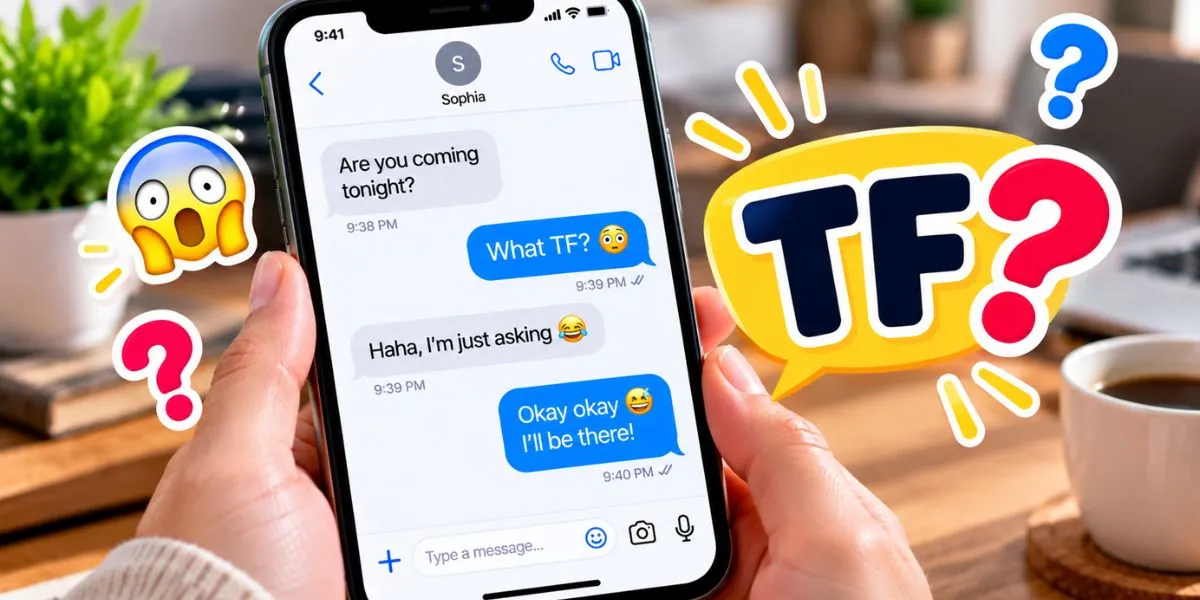
what does TF mean in text Have you ever received a message saying “What TF happened?” or seen someone comment “TF is going on here?” If so, you might wonder what those two letters mean. Internet slang can sometimes be confusing, especially when people use abbreviations to express strong emotions.
What does TF mean in text? In texting and online conversations, TF most commonly stands for “the f***.” It is an informal abbreviation that adds emphasis to a question or statement. Depending on the situation, people use it to express surprise, confusion, disbelief, frustration, or even playful humor.
For example, “What TF is that?” expresses a stronger reaction than simply asking, “What is that?” Although TF is common in casual messaging, it implies profanity and may sound rude in certain situations.
In this guide, you will learn what TF means in text, how people use it on Snapchat and Instagram, whether it is offensive, and how it differs from WTF and other popular abbreviations. You will also discover practical examples to help you understand its meaning in everyday conversations.
What Does TF Mean in Text?
The most common meaning of TF in text messages is “the f*.”** People use it as a shortened form of a profane expression to make their messages sound more emotional or emphatic.
Rather than changing the basic meaning of a sentence, TF adds intensity to it. Consequently, the same question can sound neutral or strongly emotional depending on whether the abbreviation is included.
Consider these examples:
- “What happened?” — A straightforward question.
- “What TF happened?” — A stronger reaction expressing surprise or confusion.
- “Where are you?” — A normal question.
- “Where TF are you?” — A more forceful question that may express urgency or frustration.
As you can see, TF makes the message more expressive. However, it does not always mean the sender is angry. Friends may use it jokingly when something unexpected happens or when they cannot believe what they have just seen.
The abbreviation is especially common in informal text messages, social media comments, memes, gaming chats, and online discussions.
Quick answer: TF usually means “the f***” in texting. It is informal slang used to emphasize surprise, confusion, disbelief, or frustration. Because it implies profanity, its tone depends on the conversation and the relationship between the people communicating.
What Does TF Mean in Slang?
In internet slang, TF works as an intensifier. In other words, it makes a question, reaction, or statement sound stronger.
However, its exact emotional tone depends on the words around it. Let’s explore the most common ways people use TF.
1. TF to Express Surprise
People often use TF when something unexpected happens. It can communicate that they are shocked or struggling to believe what they have just witnessed.
For example:
Friend: “I just won the competition!”
You: “TF?! That’s amazing!”
Here, the abbreviation expresses surprise rather than anger. The positive message makes it clear that the reaction is enthusiastic.
Similarly, someone watching an unbelievable video might comment, “What TF did I just watch?” This suggests that the content was unexpected, strange, or difficult to understand.
2. TF to Show Confusion
Another common use of TF is to express confusion. Someone might use it when a situation does not make sense or when they cannot understand another person’s actions. what does TF mean in text
For example:
Friend: “He cancelled the trip five minutes before we left.”
You: “Why TF would he do that?”
The reply shows confusion and disbelief. The sender wants to understand why the person made that decision.
Likewise, “How TF does this work?” communicates that someone is struggling to understand a process.
3. TF to Express Frustration or Anger
TF can also communicate annoyance. In this situation, it makes a question sound more confrontational or emotionally charged.
For example:
Person A: “You deleted the entire project?”
Person B: “I didn’t mean to!”
A Person: “Why TF didn’t you make a backup?”
Here, TF emphasizes frustration. Depending on the relationship between the speakers, the message might sound angry or accusatory.
Therefore, consider the surrounding words before deciding whether someone is joking or genuinely upset.
4. TF for Humor and Sarcasm
Friends sometimes use TF to exaggerate a reaction for comedic effect. Emojis, memes, and playful wording can make the expression seem less serious.
For example:
Friend: “I ate an entire pizza by myself.”
You: “How TF did you manage that? 😂”
In this conversation, the question is probably playful rather than hostile.
Likewise, someone might write “TF is my life right now 😭” when describing a chaotic or embarrassing moment.
Although the abbreviation can be humorous, it still implies profanity. As a result, it may not be appropriate for every audience.
What Does TF Mean on Snapchat?
On Snapchat, TF generally carries the same slang meaning it has in ordinary texting: “the f***.” People use it in private messages, group chats, and reactions to unexpected situations.
For example:
Example 1: Surprise
You: “I accidentally sent the message to the wrong person.”
Friend: “TF 😭 Are you serious?”
The friend is expressing shock, possibly with a humorous tone.
Example 2: Confusion
Friend: “Why did everyone leave the group chat?”
You: “IDK. What TF happened?”
Here, TF emphasizes the sender’s confusion.
Example 3: Frustration
Friend: “You forgot our plans again.”
You: “Wait, what TF? I thought we changed the time.”
In this example, the phrase might sound defensive because of the disagreement.
Remember that TF does not have a separate universal meaning on Snapchat. The tone depends on the message, the sender’s personality, and the relationship between both people.
If someone sends you only “TF?” it may mean they are confused, surprised, or asking for an explanation. If you are unsure, ask them what they mean instead of assuming they are angry.
What Does TF Mean on Instagram?
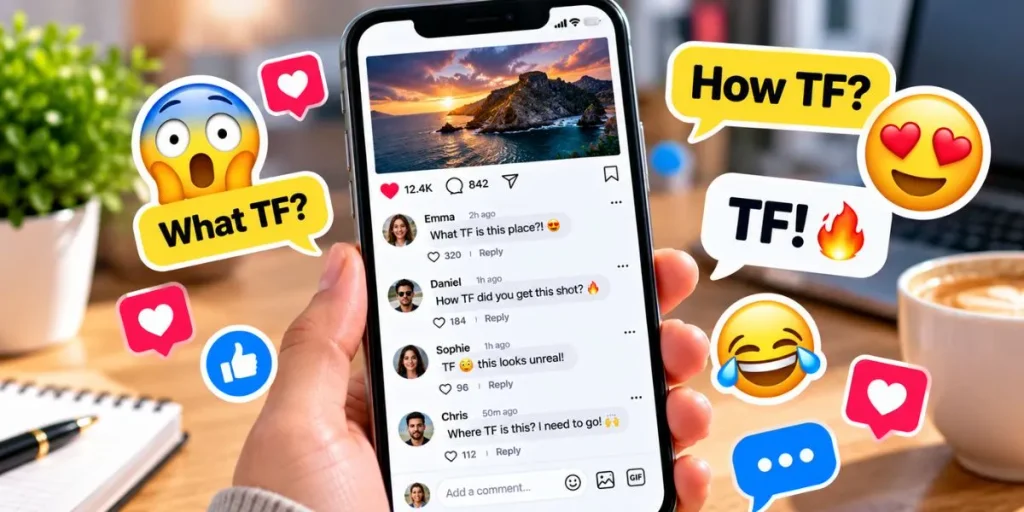
Instagram users frequently use abbreviations in direct messages, comments, captions, and replies to Stories. TF is one of the informal expressions that can make a reaction more emphatic.
For example, someone might comment “What TF is this?” under a confusing video. Another person might write “How TF did you take this picture?” when reacting to an impressive photograph.
Here are a few examples:
- Instagram comment: “What TF did I just watch? 😂”
- Direct message: “Who TF told you that?”
- Story reply: “Where TF is this place? It looks beautiful!”
- Funny post: “TF is happening in this video 😭”
In the first and fourth examples, the abbreviation may express amusement or disbelief. In the second, however, it could sound confrontational.
Consequently, TF is not automatically rude or friendly. Its meaning depends on the situation.
If you use TF in a comment or direct message, consider how the recipient might interpret it. A close friend may understand your humor, while someone who does not know you well might find the same words offensive. what does TF mean in text
What Does TF Mean on TikTok and WhatsApp?
TF is also used on TikTok and WhatsApp, although neither platform gives the abbreviation a special, universally accepted definition.
TF on TikTok
TikTok users may include TF in comments, video captions, and replies. It often appears when a video is surprising, confusing, funny, or unbelievable.
For example:
- “What TF did I just watch? 😂”
- “How TF did they do that?”
- “Who TF came up with this idea?”
- “TF is going on in these comments?”
The first example might express amusement, while the second communicates amazement. The third could sound critical, depending on the video.
TF on WhatsApp
On WhatsApp, people often use TF in one-to-one conversations and group chats. The intended tone depends on the relationship between the participants.
For example:
Friend 1: “I missed the bus again.”
Friend 2: “How TF does that keep happening? 😂”
This message sounds playful because the laughing emoji and familiar relationship suggest a joking reaction.
However, a message such as “What TF is wrong with you?” may sound insulting, particularly during an argument.
The main takeaway: TF has essentially the same common slang meaning across Snapchat, Instagram, TikTok, and WhatsApp. The platform does not determine the tone; the conversation does.
What Does TF Mean From a Girl or Guy?
If a girl or guy sends you TF, the abbreviation itself does not reveal their romantic feelings or intentions. It usually expresses emphasis, surprise, confusion, disbelief, or frustration.
The surrounding conversation is much more useful than the abbreviation alone.
When a Girl Uses TF
A girl might use TF while joking with a friend, reacting to surprising news, asking a question, or expressing annoyance.
For example:
You: “I forgot my own birthday plans.”
Her: “How TF did you forget? 😂”
This response may be playful teasing rather than genuine anger.
On the other hand, if she writes “What TF are you talking about?” during a disagreement, she may be frustrated or confused. what does TF mean in text
When a Guy Uses TF
A guy may use TF in the same ways. The abbreviation does not have a separate meaning based on gender.
For example:
You: “I finished the whole assignment in twenty minutes.”
Him: “How TF did you do that?”
He may be expressing surprise or admiration.
Alternatively, “Why TF didn’t you tell me?” could communicate frustration about missing information.
Ultimately, do not assume someone likes you, dislikes you, or is angry simply because they use TF. Consider the complete message, the conversation history, and the way they normally communicate.
Is TF Rude or a Bad Word?
TF is an abbreviation, but its common slang meaning contains profanity. Therefore, it can be considered rude or inappropriate in certain situations.
However, the level of offense depends on context, audience, and tone.
When TF May Be Acceptable
Among friends who regularly use informal slang, TF may be a normal part of casual conversation.
For example:
Friend: “I got tickets to the concert!”
You: “How TF did you get them so quickly?”
In this context, the expression communicates surprise and excitement.
When TF May Sound Rude
TF can sound aggressive when used to challenge someone or criticize their actions.
For example:
“What TF is your problem?”
This wording may come across as insulting because it questions the other person’s behavior in a hostile way.
Similarly, using TF in an argument can make an already tense conversation worse.
Is TF Appropriate at Work?
In most professional situations, it is safer to avoid TF. It may be inappropriate in workplace emails, formal presentations, customer messages, school assignments, and conversations with people you do not know well.
Instead, choose a neutral expression.
| Informal phrase | More polite alternative |
|---|---|
| What TF happened? | What happened? |
| Why TF did you do that? | Why did you do that? |
| How TF does this work? | How does this work? |
| Where TF are you? | Where are you? |
| Who TF sent this? | Who sent this? |
These alternatives communicate the same basic questions without the implied profanity.
TF vs. WTF, OMG, and FR: What’s the Difference?
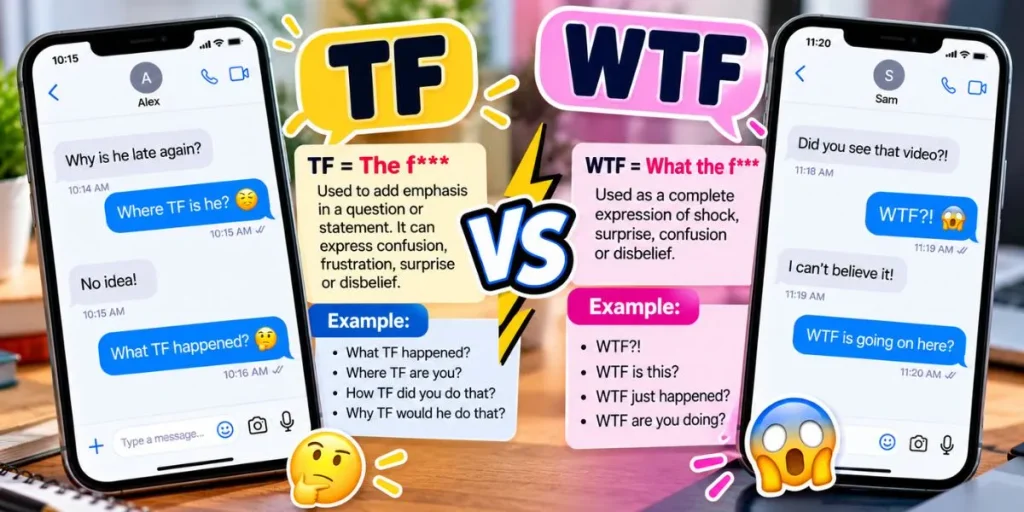
TF is often confused with other texting abbreviations because they can appear in similar conversations. Nevertheless, each expression has a different meaning.
| Abbreviation | Meaning | Typical use |
|---|---|---|
| TF | “The f***” | Adds emphasis within a question or statement |
| WTF | “What the f***” | Expresses shock, confusion, or disbelief |
| OMG | “Oh my God” | Shows surprise, excitement, or concern |
| FR | “For real” | Expresses agreement or asks whether something is true |
| IDK | “I don’t know” | Communicates uncertainty |
| TBH | “To be honest” | Introduces an honest opinion |
| ISTG | “I swear to God” | Emphasizes sincerity, frustration, or disbelief |
TF vs. WTF
The main difference is how the expressions function in a sentence.
TF commonly appears inside phrases such as “What TF happened?” or “How TF did you do that?”
WTF stands for “what the f***” and can work as a complete reaction.
For example:
Person A: “I just found out the concert was cancelled.”
Person B: “WTF?!”
Here, WTF expresses a strong reaction to unexpected news.
TF vs. OMG
OMG is generally less profane than TF. It can express excitement, shock, happiness, or concern without implying a swear word.
For example:
“OMG, that’s amazing!”
This sounds enthusiastic and is suitable for a wider range of casual audiences.
In contrast, TF generally has a stronger or more confrontational edge.
TF vs. FR
FR means “for real.” People use it to show agreement or check whether someone is serious.
For example:
Person A: “The exam was incredibly difficult.”
Person B: “FR, I wasn’t ready for those questions.”
Here, FR indicates agreement rather than shock or frustration.
Understanding these differences can help you interpret online conversations more accurately.
Examples of TF in Text Messages
The following conversations show how TF can communicate different emotions. Notice how the words and circumstances change the tone.
Example 1: Expressing Surprise
Alex: “I won two free concert tickets!”
Sam: “How TF did you get so lucky?”
Meaning: Sam is surprised and curious. The expression adds emphasis to the question.
Example 2: Showing Confusion
Mia: “The teacher changed the deadline without telling anyone.”
Noah: “What TF? When did that happen?”
Meaning: Noah is confused and wants more information.
Example 3: Reacting to Something Funny
Emma: “I accidentally wore two different shoes today.”
Liam: “How TF did you not notice? 😂”
Meaning: Liam is teasing Emma in a playful way.
Example 4: Expressing Frustration
Ava: “You sent me the wrong document again.”
Ben: “What TF? I thought I sent the updated one.”
Meaning: Ben sounds surprised and possibly frustrated. The exact tone depends on the relationship and the previous conversation. what does TF mean in text
Example 5: Showing Disbelief
Olivia: “He ran the entire marathon without stopping.”
James: “How TF is that even possible?”
Meaning: James finds the achievement difficult to believe.
Example 6: Reacting to a Strange Video
Ella: “Have you seen this video?”
Ryan: “TF did I just watch? 😭”
Meaning: Ryan is reacting with confusion or amusement.
Example 7: Asking About Someone’s Actions
Daniel: “I deleted all my old photos.”
Sophie: “Why TF would you do that?”
Meaning: Sophie is questioning Daniel’s decision. Depending on the context, she may sound concerned, surprised, or annoyed.
Example 8: Responding During an Argument
Person A: “You never listen to what I say.”
Person B: “What TF are you talking about?”
Meaning: The reply sounds defensive and confrontational. In a tense conversation, TF can make the message feel more aggressive.
These examples demonstrate that TF does not communicate only one emotion. The abbreviation intensifies the message, while the surrounding words and situation help determine what the sender means.
How to Reply When Someone Says TF
If someone sends you a message containing TF, choose your response based on the context rather than focusing only on the abbreviation.
1. When They Are Surprised
If the sender appears shocked by unexpected news, provide more information.
Example:
Friend: “What TF happened?”
You: “The power went out, so the event was delayed.”
This answers the question without escalating the conversation.
2. When They Are Confused
If someone uses TF because they do not understand something, explain the situation clearly.
Example:
Friend: “How TF does this app work?”
You: “Let me show you. First, open the settings.”
3. When They Are Joking
If a close friend is using TF humorously, you can reply in a similarly lighthearted way.
Example:
Friend: “How TF did you eat all that food? 😂”
You: “Talent, obviously!”
Make sure the other person is joking before responding sarcastically.
4. When They Sound Angry
If the message appears hostile, remain calm and ask what is bothering them.
For example:
Person: “What TF is going on?”
You: “Something seems wrong. Can you tell me what happened?”
This response invites clarification without matching the aggressive tone.
5. When You Don’t Understand the Message
Sometimes, the best reply is simply a question.
You could write:
- “What do you mean?”
- “Can you explain?”
- “Are you surprised, or is something wrong?”
- “I’m not sure I understand. What happened?”
These responses work because they focus on understanding the sender rather than guessing their emotions.
May you like to read more: What Does ISK Mean in Text? Full Meaning and Examples
When Should You Avoid Using TF?
Although TF is common in casual internet communication, it is not appropriate for every situation.
First, avoid using it in formal emails or professional messages. The implied profanity can make you appear unprofessional, even if you do not intend to offend anyone.
Second, be careful when messaging someone you do not know well. They may interpret the abbreviation as aggressive or disrespectful.
Third, consider the subject of the conversation. If someone is sharing upsetting news or discussing a sensitive issue, a strong slang expression may seem dismissive.
Finally, remember that written messages do not always communicate tone clearly. Without facial expressions or vocal cues, a playful message can be mistaken for anger.
When in doubt, use straightforward language. You can still express surprise, confusion, or frustration without using profanity.
Frequently Asked Questions About TF Meaning in Text
1. What does TF stand for in texting?
TF most commonly stands for “the f***” in texting and internet slang. It is used to emphasize a question or statement and can express surprise, confusion, disbelief, or frustration.
2. Is TF the same as WTF?
No. TF commonly means “the f***,” while WTF means “what the f***.” Both expressions can communicate strong emotions, but WTF is often used as a complete reaction to something surprising or confusing.
3. Is TF a bad word?
TF itself is an abbreviation, but its common meaning implies profanity. It is often accepted in casual conversations among friends, although it may be considered rude or inappropriate in professional or formal situations.
4. What does TF mean on Snapchat?
On Snapchat, TF generally has the same slang meaning as in ordinary texting. It is used to express surprise, confusion, disbelief, or frustration. The precise tone depends on the message and the relationship between the sender and recipient.
5. What does TF mean on Instagram?
TF commonly stands for “the f***” in Instagram comments and direct messages. Users employ it to emphasize reactions to posts, videos, or conversations. Depending on the wording, it may sound playful, shocked, frustrated, or rude.
6. What does TF mean from a girl?
When a girl uses TF, she is generally emphasizing a reaction or question. She might be surprised, confused, joking, or frustrated. The abbreviation alone does not indicate romantic interest or prove that she is angry.
7. What does TF mean from a guy?
A guy generally uses TF in the same way: to add emphasis or communicate surprise, confusion, disbelief, or frustration. The intended tone depends on the surrounding conversation rather than the sender’s gender.
8. How do you respond when someone texts TF?
Read the complete message first. If the sender is confused, explain what happened. If they are joking, a playful reply may work. However, if they seem angry, respond calmly and ask what is bothering them.
9. Can TF be used jokingly?
Yes. Friends often use TF to exaggerate reactions to funny or unexpected situations. Emojis and playful wording may suggest humor. Nevertheless, because the abbreviation implies profanity, not everyone will find it appropriate.
10. Is TF appropriate for professional communication?
Generally, no. TF is informal slang with an implied swear word. In work emails, customer messages, school assignments, and formal discussions, it is better to use neutral expressions such as “What happened?” or “Could you explain?”
Final Thoughts on TF Meaning in Text
So, what does TF mean in text? In most informal online conversations, TF stands for “the f***.” It adds emphasis to a question or statement and can communicate surprise, confusion, disbelief, frustration, or humor.
However, the abbreviation does not always indicate anger. For example, friends may use it playfully when reacting to a funny video or surprising piece of news. On the other hand, the same expression can sound rude during an argument.
TF is commonly seen in text messages, Snapchat chats, Instagram comments, TikTok discussions, and other online conversations. Nevertheless, it is best avoided in formal or professional communication because it implies profanity.
Ultimately, context is the key to understanding TF. Pay attention to the complete message, the relationship between the people communicating, and the situation being discussed. That way, you can interpret the abbreviation more accurately and choose an appropriate response.
