
Every day, reliable news sources people encounter an enormous amount of information through websites, social media, television, video platforms, smartphones, newsletters, podcasts, search engines, and AI-powered tools. As a result, staying informed has become easier than ever. However, knowing which information deserves our trust has become more challenging.
This is why reliable news sources matter.
A trustworthy news source can help readers understand current events through reporting, evidence, attribution, context, and corrections. On the other hand, misleading headlines, unverified claims, manipulated images, and misinformation can make it difficult to understand what is actually happening.
The challenge has become particularly important as more people discover news through third-party platforms. The Reuters Institute’s 2026 Digital News Report found that social media and video networks had become, on average across its 48 markets, the most popular route to online news. At the same time, overall trust in news fell to 37%, while 62% of respondents said they were concerned about fake or misleading information online.
Therefore, learning how to recognize and evaluate reliable news sources is an essential part of responsible digital news consumption.
This guide explains why reliable news matters, what makes a news source credible, how to verify information, how social media and AI affect news consumption, and how you can build a healthier and more informed news routine.
What Are Reliable News Sources?
Reliable news sources are publications, organizations, journalists, broadcasters, or other information providers that follow credible reporting practices and make reasonable efforts to provide accurate, transparent, and properly sourced information.
Reliability does not mean that every report will be perfect. Even established news organizations can make mistakes. What matters is how they gather information, verify claims, identify sources, provide context, distinguish reporting from opinion, and correct errors when necessary.
In other words, a reliable news source should give readers enough information to understand where important claims came from and how those claims were established.
What Makes a News Source Trustworthy?
Several characteristics can help readers evaluate a news source.
These include:
- Accurate and carefully checked reporting
- Identifiable sources
- Evidence supporting important claims
- Clear publication dates
- Transparent corrections
- Distinction between news and opinion
- Appropriate context
- Professional editorial standards
- Accountability for mistakes
- Clear attribution
However, no single characteristic proves that a source is reliable. Instead, readers should consider the overall quality and transparency of the reporting.
The Difference Between News, Opinion, and Commentary
One important part of evaluating information is understanding what type of content you are reading.
News reporting generally focuses on reporting events, statements, evidence, and developments.
Opinion expresses a person’s interpretation, argument, or viewpoint.
Analysis attempts to explain the significance or possible implications of an event.
Commentary may combine information with personal interpretation.
These forms of content can all have value. Nevertheless, readers should know which one they are consuming.
Pew Research Center’s research into how Americans define news found that factual information and newness are important factors in whether people consider something to be news. The study also highlighted concerns about distinguishing factual news from unverified information.
Why Are Reliable News Sources Important?
Reliable news sources play an important role because people use information to understand events, make decisions, communicate with others, and participate in their communities.
When information is inaccurate or misleading, readers can develop an incomplete or incorrect understanding of what happened.
They Help Provide Accurate Information
The most obvious benefit of reliable journalism is accuracy.
Good reporting involves checking information before presenting it as fact. Depending on the story, this may involve speaking with sources, reviewing documents, examining data, contacting relevant organizations, or independently confirming claims.
Accuracy is particularly important for breaking news because early reports may change as additional facts become available.
They Provide Context
A headline rarely tells the entire story.
Reliable reporting can explain what happened, why it happened, what is known, what remains uncertain, and what happened previously.
Context is especially valuable when a story involves complicated scientific, economic, technological, legal, or international issues.
Without context, even a technically accurate statement can create a misleading impression.
They Help Reduce the Risk of Misinformation
Misinformation can spread rapidly online.
People may share an inaccurate claim because they believe it is true, while other false information may be deliberately created or manipulated.
Reliable reporting cannot eliminate misinformation from the internet. However, careful journalism can provide verified information that readers can use to evaluate competing claims.
The Reuters Institute reported in 2026 that concern about fake or misleading information online had risen to 62% across its surveyed markets.
They Help People Understand Complex Events
Modern news stories can involve multiple factors and competing claims.
For example, a technology story may involve scientific research, business decisions, regulations, consumer behavior, and privacy concerns.
Similarly, an economic story may require an understanding of inflation, employment, interest rates, trade, and other factors.
Reliable reporting can organize these details and make complicated subjects easier to understand.
They Encourage Responsible Information Sharing
When readers rely on trustworthy information, they are less likely to pass along unsupported claims.
Therefore, reliable news sources can contribute to a healthier information environment by giving people information they can examine and verify before sharing.
Read More: How Digital Media Is Changing the Way We Follow News
What Makes a News Source Reliable?
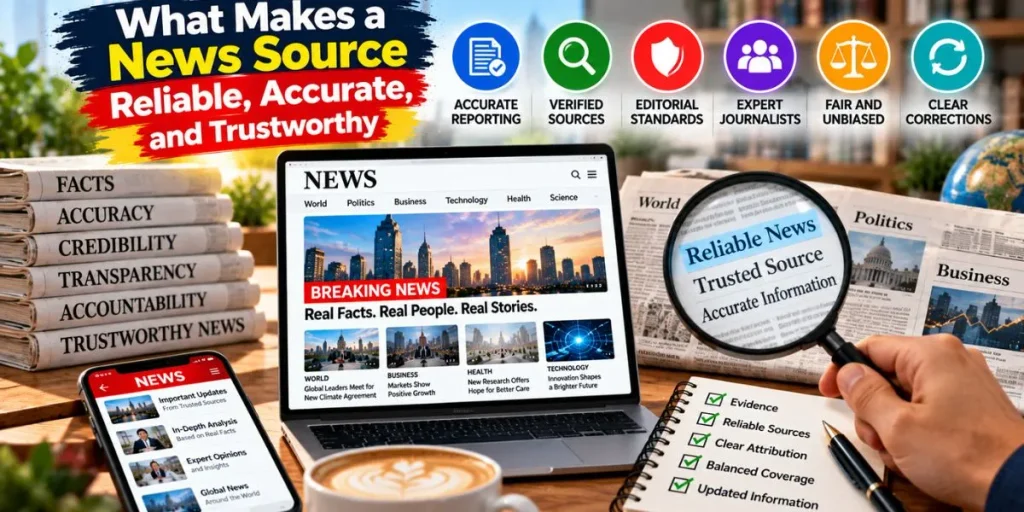
Understanding the characteristics of reliable news sources can make online information much easier to evaluate.
Accurate Reporting
Accuracy should be a fundamental goal of journalism.
Readers should look for reports that distinguish verified facts from claims, rumors, assumptions, and speculation.
When a story is developing, responsible reporting should also acknowledge uncertainty rather than presenting incomplete information as settled fact.
Transparent Sources and Attribution
Reliable reporting generally makes it clear where significant information came from.
For example, an article might attribute information to an official document, researcher, interviewee, company statement, court filing, public record, or other source.
Attribution allows readers to understand the basis of a claim.
Evidence-Based Journalism
Strong reporting supports important claims with appropriate evidence.
Depending on the topic, evidence might include:
- Documents
- Public records
- Research
- Data
- Interviews
- Direct observations
- Official statements
- Expert explanations
- Photographs or video
However, evidence should also be interpreted in context.
Clear Corrections Policies
Even experienced journalists make mistakes.
A trustworthy publication should have a mechanism for correcting significant errors rather than quietly leaving inaccurate information unaddressed.
Corrections demonstrate accountability and help readers understand when previously published information has changed.
Separation of News and Opinion
Readers should be able to distinguish reporting from commentary.
A publication can contain both news and opinion while maintaining clear labeling and appropriate editorial boundaries.
Therefore, don’t automatically treat an opinion column as though it were a straight news report.
Qualified Journalists and Editors
Professional journalism involves editorial processes that can include reporting, editing, fact-checking, legal review, source evaluation, and other forms of quality control.
The exact process varies by organization and story.
Nevertheless, transparent editorial practices can provide useful evidence when evaluating a source.
How to Identify Reliable News Sources
Knowing what makes a source credible is useful, but readers also need practical methods for evaluating individual articles.
Check Who Published the Story
Start by identifying the publication or organization.
Ask:
- Is the publisher clearly identified?
- Does the publication have an established website?
- Is there information about its editorial operation?
- Can you find contact or ownership information?
- Does it explain its reporting standards?
This does not prove that every article is accurate. However, transparency provides useful context.
Look for Named Sources
Be cautious when an article makes major claims without explaining where the information came from.
Anonymous sources can sometimes play a legitimate role in journalism. However, important claims should generally have enough attribution or supporting information for readers to understand their basis.
Examine the Evidence
Ask what evidence supports the central claim.
Is there a document? A study? An interview? A direct statement? Data? Multiple sources?
If a dramatic claim contains no supporting evidence, it deserves additional scrutiny.
Check the Publication Date
Information can become outdated quickly.
An old article may continue circulating on social media even though circumstances have changed.
Therefore, always check the date before treating an article as current.
Look for Supporting Documents or Links
Some stories provide links to original reports, studies, documents, or official statements.
Following those links can help you evaluate whether the source accurately represented the underlying information.
Compare With Other Reputable Sources
For important stories, compare coverage from multiple credible sources.
You do not necessarily need to read ten articles. Even checking two or three independent reports can reveal differences in evidence, context, or interpretation.
Pew Research Center’s News Media Tracker illustrates how audiences use and evaluate multiple news sources across television, print, radio, and digital platforms.
Look Beyond the Headline
Headlines are designed to attract attention and summarize stories quickly.
However, they cannot contain every detail.
Read the article before deciding what happened, particularly when a headline produces a strong emotional reaction.
Why Fact-Checking Matters
Fact-checking is an important part of responsible news consumption.
It involves examining whether a claim is supported by available evidence and whether it accurately represents the underlying information.
What Is Fact-Checking?
Fact-checking can involve comparing claims against reliable documents, data, direct statements, research, or other credible sources.
Professional fact-checkers may investigate specific claims in considerable detail.
However, ordinary readers can also develop basic verification habits.
Why Verification Is Important
Online information can move much faster than traditional editorial processes.
A false claim can be shared thousands of times before someone has an opportunity to examine it carefully.
Therefore, verification becomes particularly important when information is surprising, emotionally charged, or difficult to believe.
Checking Claims Against Primary Sources
Primary sources can sometimes provide valuable evidence.
Examples include:
- Official documents
- Research papers
- Court records
- Company filings
- Direct interviews
- Government publications
- Original datasets
However, primary sources also require interpretation. A document can be authentic while still being misunderstood or presented without important context.
Comparing Independent Reports
If several independent organizations report the same basic facts, that can provide additional confidence.
However, simply seeing the same claim repeated does not prove it is correct if every report is relying on the same unverified source.
The quality and independence of the underlying evidence matter.
Reliable News Sources vs. Unreliable Information
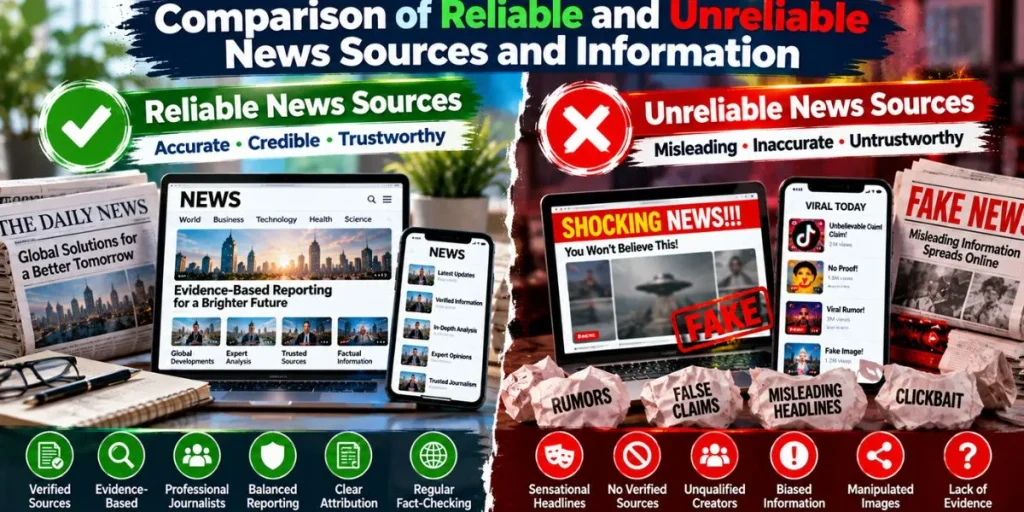
It can be helpful to compare common characteristics.
| Reliable News Characteristics | Warning Signs |
|---|---|
| Identifiable publisher | Unclear or hidden publisher |
| Named or appropriately attributed sources | Unsupported claims |
| Evidence provided | Little or no evidence |
| Clear publication date | Missing or unclear date |
| Context included | Important context omitted |
| Corrections are acknowledged | Errors remain unaddressed |
| News and opinion are distinguishable | Opinion presented as fact |
| Claims can be investigated | Claims are difficult to verify |
| Professional presentation | Excessive sensationalism |
| Clear sourcing | Vague references to “experts” or “reports” |
This table should be treated as a guide rather than a scoring system. A source can have one weaker characteristic without being automatically unreliable.
The Role of Reliable News Sources in the Digital Age
The internet has transformed the news environment.
People now encounter information through websites, mobile apps, social media, online video, podcasts, newsletters, search engines, and AI-powered services.
The Reuters Institute’s 2026 report describes this shift as the increasing “platformisation” of news consumption. It found that social media and video networks were, on average across its 48 markets, more popular than television and news organizations’ own websites and apps as sources of news.
The Growth of Online News
Digital publishing allows news organizations to update stories continuously.
Readers can follow developments without waiting for the next newspaper edition or scheduled broadcast.
This creates tremendous convenience.
However, it also creates pressure to publish quickly, making careful verification especially important.
Social Media as a News Discovery Tool
Social media can help people discover breaking stories, eyewitness content, expert commentary, and reporting from news organizations.
At the same time, social feeds combine journalism with entertainment, advertising, personal posts, commentary, and user-generated content.
Consequently, users must pay attention to the source of individual claims rather than assuming everything appearing in a news feed has undergone the same editorial process.
News Apps and Notifications
News applications can make reliable reporting easier to access.
However, users may receive information from multiple sources through the same device.
Therefore, the presence of a news notification alone does not establish credibility. Readers should still consider who published the story and what evidence supports it.
Online Video and News Creators
Video platforms have expanded the range of voices discussing current events.
Some creators provide valuable reporting, interviews, explanations, or specialist knowledge.
Others may primarily offer commentary or entertainment.
Reuters Institute’s 2026 report notes the growing importance of creators and other emerging news producers while also finding that audiences generally trust news on social platforms less than news overall.
Therefore, evaluate the content itself rather than relying solely on follower counts, views, or popularity.
How Social Media Can Make News Verification More Difficult
Social media is neither automatically reliable nor automatically unreliable.
Instead, it creates an environment where information can spread extremely quickly and where different types of content appear side by side.
Rapid Sharing
A user can share an article, video, photograph, or claim within seconds.
This speed is useful when information is accurate. However, it can also accelerate the spread of mistakes.
Viral Headlines
A headline that creates anger, fear, surprise, or excitement may attract more attention.
Therefore, emotional intensity should be a reason to investigate a claim rather than automatically believe it.
Misleading Images and Videos
Images and videos can be authentic but still misleading.
For example, an old photograph may be presented as a recent event, or a short video clip may remove important context.
Always consider when, where, and why the material was created.
Context Collapse
A statement made in one situation can be reposted in a completely different context.
Therefore, look for the original interview, document, video, or statement whenever possible.
Algorithmic Recommendations
Algorithms can influence which stories users encounter.
If someone repeatedly interacts with a particular type of content, recommendations may increasingly reflect those interests.
This can be convenient, but it can also create a narrower information environment.
News Creators and Influencers
Creators can make complicated subjects easier to understand and can introduce audiences to stories they might otherwise miss.
Nevertheless, influence should not be confused with verification.
A large audience does not automatically mean that every claim is well sourced.
How to Avoid Misinformation and Fake News
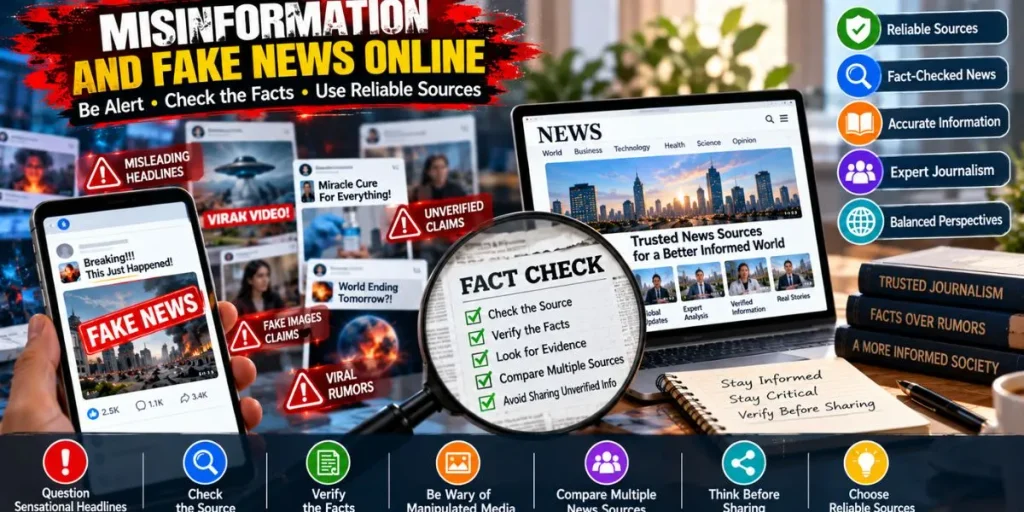
A few simple habits can significantly improve digital news literacy.
Pause Before Sharing
Before sharing a surprising claim, stop for a moment.
Ask yourself whether you have actually checked it.
Check the Original Source
Trace the claim back to the earliest credible source you can find.
A screenshot of a headline is not the same as reading the original report.
Verify the Date
Make sure the information is current and relevant to the event being discussed.
Search for Independent Confirmation
Look for reporting from other credible organizations.
If an extraordinary claim appears nowhere except one obscure account, additional verification is warranted.
Check Images and Videos
Ask:
- Is this actually from the claimed event?
- When was it recorded?
- Where was it recorded?
- Has it been edited?
- Is the caption accurate?
Watch for Sensational Headlines
Phrases designed to provoke an immediate emotional reaction deserve additional scrutiny.
A strong headline does not automatically mean the underlying information is false. However, emotional language should encourage readers to examine the evidence carefully.
Distinguish Facts From Claims
A news article may report that someone claimed something without establishing that the claim itself is true.
Pay attention to verbs such as “said,” “claimed,” “alleged,” “reported,” and “confirmed.”
They can communicate important differences in certainty.
How to Evaluate a News Article Before Trusting It
You can use a simple seven-step process whenever an important claim appears online.
Step 1: Identify the Publisher
Who published the information?
Step 2: Identify the Author
Is there a named journalist or contributor?
Step 3: Examine the Evidence
What supports the central claim?
Step 4: Check the Date
Is the information current?
Step 5: Examine the Sources
Who was interviewed or cited?
Step 6: Look for Independent Confirmation
Are other credible organizations reporting the same core facts?
Step 7: Read the Full Article
Does the article support the headline, or does the headline exaggerate what the article actually says?
This process does not guarantee that you will always reach the correct conclusion. Nevertheless, it can greatly improve the quality of your information decisions.
The Importance of Media and News Literacy
Reliable news sources are only part of the solution.
Readers also need the ability to evaluate information.
UNESCO describes media and information literacy as increasingly important in a digital environment where information can be used for communication, influence, manipulation, and other purposes.
What Is Media Literacy?
Media literacy means having the ability to understand, evaluate, and engage with media content thoughtfully.
It involves asking questions about:
- Who created the content?
- Why was it created?
- Who is the intended audience?
- What evidence is provided?
- What information may be missing?
- Is the content news, opinion, advertising, entertainment, or satire?
What Is Digital News Literacy?
Digital news literacy applies these skills to online information.
It is particularly important because online environments combine professional journalism with user-generated content, advertising, entertainment, commentary, and algorithmically recommended material.
Learning to Question Information
Being skeptical does not mean rejecting everything.
Instead, healthy skepticism means asking reasonable questions before accepting or sharing important information.
Pew Research Center’s recent work on misinformation identifies skepticism or discernment as a common characteristic people associate with being a good news consumer.
Distinguishing Facts From Opinions
A statement can be confidently expressed and still be an opinion.
Therefore, look for evidence supporting factual claims and recognize when a writer is interpreting events rather than simply reporting them.
How Bias Can Affect News Coverage
Different news organizations may emphasize different aspects of the same event.
This can happen because of editorial priorities, audience interests, available information, reporting choices, or differences in interpretation.
What Is Editorial Bias?
Editorial bias can refer to patterns in how a publication selects, frames, emphasizes, or interprets information.
However, readers should avoid assuming that disagreement with a story automatically proves bias.
Instead, examine the evidence, wording, sourcing, and context.
Why Different Sources May Frame Stories Differently
Two reputable organizations can report the same event while emphasizing different facts.
For example, one may focus on economic consequences while another focuses on social effects.
Comparing coverage can help readers identify what information is shared and where interpretations differ.
How to Recognize Sensational Language
Words designed primarily to create fear, anger, outrage, or excitement deserve closer examination.
Ask whether the language is supported by evidence or whether it is mainly intended to attract attention.
Why Transparency Matters in Journalism
Transparency helps readers understand how information was obtained and how an organization handles mistakes.
Identifying Sources
Clear attribution allows readers to evaluate where important claims originated.
Explaining How Information Was Obtained
Good reporting may explain whether information came from interviews, documents, public records, research, direct observation, or other sources.
Publishing Corrections
Corrections can demonstrate accountability.
Rather than expecting perfection, readers should look for evidence that a publication takes accuracy seriously when mistakes occur.
Being Clear About Uncertainty
Reliable journalism should not pretend to know what is not yet known.
This is especially important during breaking news events.
Acknowledging uncertainty can be a sign of careful reporting rather than weakness.
The Role of Primary Sources in Verifying News
Primary sources can provide valuable information directly connected to an event or claim.
What Is a Primary Source?
A primary source is an original source of information rather than a later report about that information.
Examples include:
- Official documents
- Court records
- Research papers
- Original datasets
- Direct interviews
- Company filings
- Government publications
Why Primary Sources Matter
Primary documents can help readers move beyond summaries and examine information more directly.
However, they should still be interpreted carefully.
A document may be genuine while a social media post or article misrepresents what it actually says.
Primary Sources Still Need Context
A primary source rarely tells the entire story by itself.
For example, a research paper has methods and limitations. A government document may describe a policy without explaining every consequence. A direct statement tells you what someone said, not necessarily whether the statement is accurate.
Therefore, primary sources work best when combined with appropriate context and independent reporting.
How AI Is Changing the Way People Evaluate News
Artificial intelligence is becoming another way people search for and interact with information.
AI tools can summarize articles, answer questions, organize information, translate text, and help users explore unfamiliar topics.
AI-Generated Summaries
Summaries can save time.
However, a summary may omit important qualifications, disagreements, or context.
Therefore, when a subject matters, use the summary as a starting point and consult original reporting.
AI Search and News Discovery
People increasingly use conversational tools to ask questions instead of searching through traditional lists of websites.
This can make information discovery easier.
However, the quality of the answer depends on the underlying information and the system’s ability to interpret it correctly.
AI-Generated Images and Videos
AI can make realistic-looking images, audio, and video.
As a result, visual evidence may require more careful verification than in the past.
Don’t assume that an impressive photograph or realistic video is genuine simply because it looks convincing.
Why Original Sources Still Matter
AI can help people navigate information, but it should not replace source evaluation.
The Reuters Institute’s 2026 research found that only 20% of respondents globally said they trusted news obtained through AI chatbots most of the time, compared with 37% for news overall.
Therefore, when accuracy matters, go back to original reporting, documents, research, and other appropriate sources.
Benefits of Following Reliable News Sources
Following reliable news sources can provide several practical benefits.
Better Understanding of Current Events
Good reporting can help readers understand what happened and why it matters.
More Context
Detailed reporting can explain background information that short social posts may omit.
Stronger Critical Thinking
Comparing sources encourages readers to examine evidence and distinguish facts from interpretation.
More Responsible Information Sharing
Verified information is generally a better foundation for sharing than an unverified viral post.
Better Digital News Habits
Regularly evaluating sources can help people become more intentional about where they get information.
Common Mistakes People Make When Choosing News Sources
Even careful readers can fall into common traps.
Trusting a Headline Without Reading the Article
A headline is a summary, not the entire story.
Assuming Viral Content Is Accurate
Popularity is not evidence.
Relying on One Source for Everything
Different organizations may have different strengths and areas of expertise.
Confusing Opinion With Reporting
Always check whether an article is presented as news, analysis, commentary, or opinion.
Ignoring Publication Dates
Old stories can become misleading when shared as though they are current.
Sharing Before Verifying
Take a moment to check important claims before forwarding or reposting them.
Trusting AI Summaries Without Checking Sources
AI can be useful, but important information should still be verified against appropriate original sources.
How to Build a Reliable News Routine
A healthy news routine does not require reading everything.
Instead, focus on quality, variety, and verification.
Follow Several Credible Sources
Choose a small group of reputable publications that provide different types of coverage.
Include Different Formats
You might combine:
- News websites
- News apps
- Television
- Radio
- Podcasts
- Newsletters
- Long-form reporting
Different formats can provide different levels of detail.
Read Beyond Headlines
Whenever possible, read the full story before sharing or forming strong conclusions.
Verify Important Claims
For significant or surprising information, check supporting evidence and independent reporting.
Take Breaks From Constant News Updates
Following news continuously can become exhausting.
A scheduled news routine can help you stay informed without feeling overwhelmed.
Review Your Sources Regularly
The digital information environment changes.
Therefore, occasionally review which sources you follow and whether they continue to provide useful, transparent, and well-supported reporting.
Reliable News Sources Checklist
Before trusting or sharing an important news story, ask:
- Is the publisher clearly identified?
- Is the author identified?
- Is the publication date visible?
- Are important claims attributed?
- Is supporting evidence provided?
- Does the article distinguish facts from opinion?
- Can important claims be independently verified?
- Does the publication acknowledge corrections?
- Does the headline accurately represent the article?
- Have I compared important claims with other credible sources?
- Am I reacting to evidence or simply reacting emotionally?
If several answers raise questions, pause before sharing the information.
Frequently Asked Questions About Reliable News Sources
What are reliable news sources?
Reliable news sources are publications or information providers that use credible reporting practices, identify sources appropriately, provide evidence and context, and take responsibility for correcting significant errors.
Why are reliable news sources important?
Reliable news sources help people access accurate information, understand complex events, evaluate claims, and make better-informed decisions about what information to share or act upon.
How can I tell if a news source is reliable?
Check who publishes the information, who wrote it, what evidence is provided, whether sources are identified, when it was published, whether corrections are acknowledged, and whether other credible sources independently confirm important claims.
What makes a news website trustworthy?
Transparency, accurate reporting, appropriate sourcing, evidence, clear editorial standards, corrections, and a distinction between news and opinion can all contribute to a trustworthy news website.
How can I verify information online?
Start with the original source, check the publication date, examine supporting evidence, look for independent confirmation, and compare the claim with reporting from other credible sources.
How can I avoid fake news?
Don’t rely solely on headlines or viral posts. Check the source, investigate the evidence, look for independent reporting, verify images and videos, and avoid sharing information before checking it.
Is social media a reliable source of news?
Social media can be a useful way to discover news and access reporting, but the reliability of individual posts varies considerably. Readers should evaluate the original source and evidence rather than treating every social media post as verified journalism.
Can AI provide reliable news information?
AI can help summarize and explain information, but its answers should not automatically be treated as authoritative. Important claims should be checked against reliable reporting and original sources.
Why is fact-checking important?
Fact-checking helps determine whether a claim is supported by evidence. It is particularly valuable when information is surprising, emotionally charged, widely shared, or difficult to verify.
What is the difference between news and opinion?
News reporting generally focuses on reporting verified events and information, while opinion expresses an argument or viewpoint. Analysis and commentary may combine factual information with interpretation. Readers should understand which type of content they are consuming.
Final Thoughts on the Importance of Reliable News Sources
In today’s information-rich world, finding news is easy. Determining whether that news is reliable is the harder task.
Social media, smartphones, online video, search engines, podcasts, newsletters, and AI tools have created more ways than ever to discover information. At the same time, these technologies have increased the speed at which misinformation, incomplete claims, and misleading content can spread.
That is why reliable news sources remain important.
Reliable journalism can provide evidence, context, attribution, verification, and accountability. However, readers also have an important role to play.
Instead of automatically trusting or rejecting information, develop a habit of asking questions.
Who published this?
What evidence supports it?
When was it published?
Who is being quoted?
Can I verify the claim elsewhere?
Is this reporting, opinion, analysis, or commentary?
These simple questions can make a significant difference.
Ultimately, responsible news consumption is not about finding one source that answers every question. It is about developing the ability to evaluate information carefully, compare credible sources, recognize uncertainty, and avoid sharing claims before they have been checked.
In an increasingly digital world, media literacy, critical thinking, and source verification are just as important as access to information itself.
The goal is not to consume more news. Instead, it is to develop better habits for understanding the news we consume.
