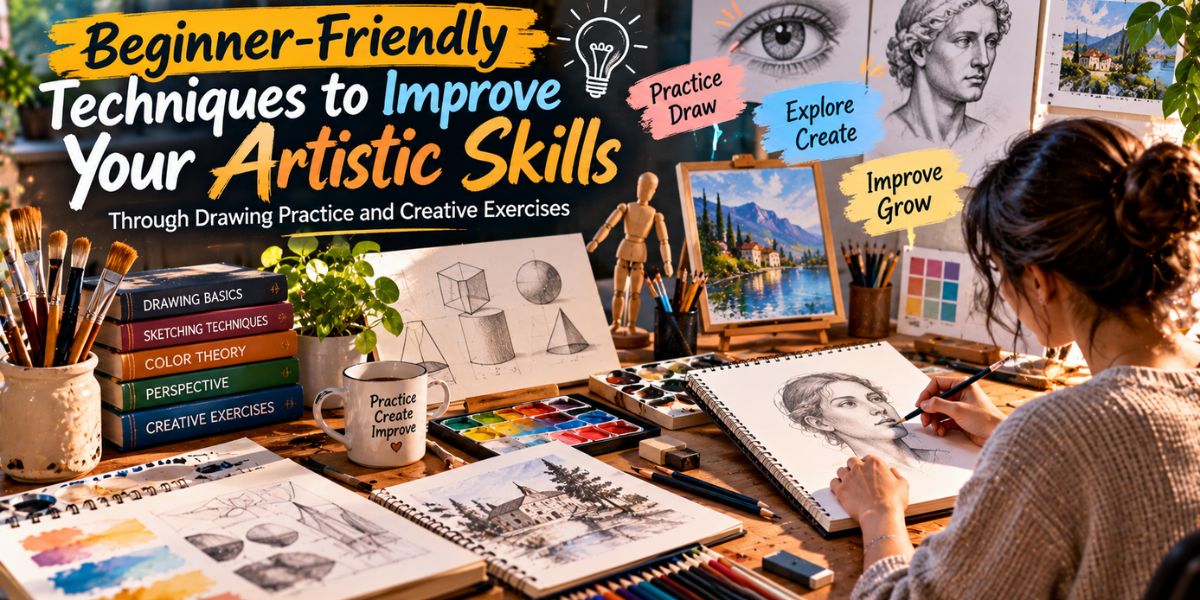
beginner-friendly techniques to improve your artistic skills, Learning art can be an exciting and rewarding journey. However, many beginners believe that artistic ability depends entirely on natural talent. In reality, drawing and other creative skills can improve through practice, observation, experimentation, and patience.
Whether you want to learn drawing, painting, sketching, or digital art, developing strong fundamentals can make a noticeable difference. Therefore, understanding the right techniques can help you practice with greater confidence and purpose.
In this guide, we explore beginner-friendly techniques to improve your artistic skills, from basic shapes and observation to shading, perspective, color, composition, and developing a consistent practice routine.
What Are Artistic Skills?
Artistic skills include the abilities artists use to create and communicate visual ideas. These skills can involve drawing, painting, observation, composition, color, perspective, proportion, shading, and visual storytelling.
For beginners, these abilities may seem difficult at first. However, they can be developed gradually.
The key is to focus on one fundamental skill at a time instead of trying to master everything immediately.
1. Start With Basic Shapes
One of the easiest ways to improve drawing skills is to practice basic shapes.
Circles, squares, rectangles, triangles, cylinders, cones, and cubes can be used to construct many complicated objects. For example, a face can be simplified into basic shapes before adding features.
Similarly, a chair, building, plant, or household object can often be broken into simpler forms.
Therefore, spend a few minutes each day drawing basic shapes from different angles. This simple exercise can improve your control, proportions, and understanding of form.
2. Practice Drawing What You See
Observation is one of the most important artistic skills for beginners.
Instead of drawing what you think an object looks like, carefully study what is actually in front of you. Look at its proportions, angles, curves, spaces, shadows, and relationships with surrounding objects. beginner-friendly techniques to improve your artistic skills
Museums and art educators frequently use observational exercises to encourage students to study line, shape, color, proportion, value, texture, and composition.
Try drawing simple objects around your home, such as a cup, plant, shoe, book, or bottle. With regular practice, you can gradually become better at noticing visual details.
3. Learn Basic Perspective
Perspective helps artists create the illusion of depth and distance.
For beginners, start with one-point perspective. Practice drawing simple rooms, roads, buildings, or hallways using a horizon line and vanishing point.
Once you become comfortable, move on to two-point perspective.
Perspective can initially feel confusing. Nevertheless, consistent practice makes it easier to understand how objects change in size and position as they move farther away.
The Metropolitan Museum of Art’s educational material describes one-point perspective as a system in which converging lines meet at a single vanishing point.
Read More: How Software Solutions Improve Business Productivity
4. Improve Your Light and Shadow Skills
Learning how light affects objects can make drawings appear more three-dimensional.
Start with a simple sphere or cube and imagine a single light source. Identify the highlight, midtone, shadow, and cast shadow. beginner-friendly techniques to improve your artistic skills
Then create a basic value scale ranging from light to dark.
Practice gradually moving between different tones rather than jumping immediately from white to black. This will help you understand form, depth, and contrast.
5. Practice Different Drawing Techniques
Experimenting with different marks can improve your control and expand your artistic vocabulary.
Try techniques such as:
- Hatching
- Cross-hatching
- Stippling
- Contour drawing
- Gesture drawing
- Blending
- Layering
- Varied line weight
For example, hatching can create shadows through repeated lines, while stippling uses dots to create tonal variation.
Moreover, experimenting with different marks can help you discover which techniques suit your preferred artistic style.
6. Use Reference Images Effectively
Reference images can be extremely useful when learning art.
You can use references to study anatomy, animals, landscapes, architecture, clothing, lighting, or everyday objects. beginner-friendly techniques to improve your artistic skills
However, don’t simply copy every visible detail. Instead, ask yourself questions:
- What shapes make up the subject?
- Where is the light coming from?
- What are the main proportions?
- Which areas are darker?
- How does the subject relate to its surroundings?
This approach turns reference material into a learning tool rather than merely something to reproduce.
7. Keep a Sketchbook
A sketchbook is one of the simplest tools for artistic improvement.
Use it to record quick drawings, ideas, observations, experiments, and unfinished sketches. Your sketchbook does not need to contain perfect artwork.
In fact, imperfect drawings can be valuable because they show what you are learning.
Try creating a small sketch every day. Over time, comparing older pages with newer ones can help you see progress that may otherwise be difficult to notice.
MoMA educational programming also emphasizes slowing down, looking closely, and experimenting with different drawing materials and techniques.
8. Learn Basic Color Theory
If you want to improve your painting skills, learning color theory is essential.
Start with primary colors and gradually explore secondary and complementary colors. Then study warm and cool colors and how they influence the mood of an artwork.
You can also experiment with limited color palettes.
Instead of using every available color, choose three or four colors and explore how many variations you can create.
This exercise can improve your understanding of color relationships, harmony, contrast, and visual balance.
9. Experiment With Different Art Mediums
Don’t feel that you must immediately choose one medium.
Experiment with pencils, charcoal, ink, colored pencils, watercolor, acrylic paint, or digital tools.
Each medium teaches something different. Pencil can help with precision and shading, while watercolor encourages sensitivity to transparency and color. Digital art, meanwhile, introduces layers, editing, and flexible experimentation.
Therefore, trying different mediums can help you discover which materials best match your creative interests.
10. Practice Anatomy and Gesture Drawing
If you are interested in drawing people, anatomy and gesture practice can be extremely useful.
Start with simple body proportions rather than complicated anatomical details.
Gesture drawing focuses on movement, posture, balance, and the overall action of a figure. Begin with quick sketches and gradually increase the amount of detail.
You can also practice individual features such as eyes, noses, hands, and feet.
With consistent practice, these exercises can improve your understanding of proportion and human form.
11. Study Composition
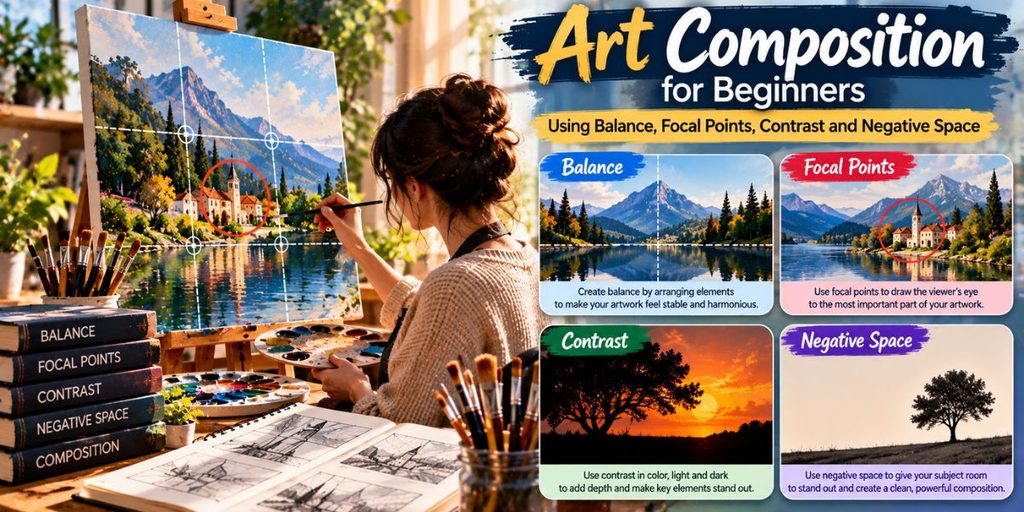
Good artwork is not only about drawing individual objects accurately. It is also about how those objects work together.
Composition involves elements such as balance, focal points, contrast, scale, negative space, and visual hierarchy.
Before creating a detailed artwork, make several small thumbnail sketches. These quick studies allow you to test different arrangements before committing to a final composition.
Consequently, you can solve visual problems earlier and spend less time correcting them later.
12. Create a Consistent Art Practice Routine
Consistency is more useful than occasional long practice sessions.
For example, a beginner could create a simple one-hour routine:
15 minutes: Lines and basic shapes
15 minutes: Observation drawing
15 minutes: Shading or color
15 minutes: Personal artwork
Of course, you can adjust the schedule according to your available time.
The important thing is to practice regularly.
13. Learn From Your Mistakes
Mistakes are a normal part of artistic development.
Instead of immediately throwing away a drawing you dislike, examine it carefully. Ask what went wrong.
Was the proportion incorrect? Was the perspective confusing? Did the lighting feel inconsistent? Was the composition unbalanced?
Then try drawing the subject again.
Comparing the two versions can reveal exactly what improved and what still needs attention.
14. Avoid Constant Comparison
Social media can make artistic improvement feel frustrating because you often see other artists’ best finished work.
Remember that a polished artwork may represent years of practice.
Instead of constantly comparing yourself with other artists, compare your current work with your older work.
This creates a healthier way to measure artistic growth.
15. Develop Your Own Artistic Style
You do not need to force yourself to develop a unique style immediately.
First, learn the fundamentals. Then experiment with different subjects, techniques, colors, materials, and compositions.
Over time, repeated creative choices may naturally become part of your visual identity.
Your artistic style should develop through exploration rather than pressure.
Digital Art Techniques for Beginners
Digital art provides another way to practice artistic skills.
Beginners can experiment with drawing tablets, digital brushes, layers, color tools, and editing features. Digital software also makes it easy to test different compositions without permanently changing the original artwork.
However, the same fundamentals still matter. Drawing, perspective, proportion, light, color, and composition remain important whether you work on paper or a digital screen.
Common Mistakes Beginner Artists Should Avoid
Some common mistakes can slow artistic development:
- Trying to create perfect artwork immediately
- Skipping basic fundamentals
- Practicing only when inspired
- Using too many materials at once
- Ignoring proportions
- Adding details too early
- Avoiding difficult subjects
- Comparing progress with other artists
Instead, focus on steady improvement.
How Long Does It Take to Improve Artistic Skills?
There is no universal timeline for artistic improvement.
Everyone begins with different experience levels, available time, interests, and learning methods.
However, consistent practice generally gives you more opportunities to identify weaknesses and develop stronger skills.
Rather than asking how quickly you can become an expert, focus on what you can improve during your next practice session.
Frequently Asked Questions
How can beginners improve their artistic skills?
Beginners can improve through regular practice, observation, basic shapes, perspective exercises, shading, color studies, reference drawing, and experimentation with different mediums.
How can I improve my drawing skills?
Practice basic shapes, observation, proportion, perspective, shading, gesture drawing, and line control. Regular sketching can also help build confidence.
How often should I practice drawing?
Try to practice consistently, even if you only have a short amount of time. A regular 20- to 60-minute practice routine can be easier to maintain than occasional long sessions.
Should beginners use reference images?
Yes. References can help beginners understand proportions, lighting, anatomy, texture, and perspective. The key is to study the reference rather than relying on mindless copying.
How can I develop my own artistic style?
Learn the fundamentals first, then experiment with different subjects, techniques, colors, and mediums. Your style can gradually emerge from the creative choices you make repeatedly.
Can digital art improve traditional art skills?
Yes. Digital art can provide useful practice with composition, color, drawing, perspective, and visual experimentation. However, traditional practice can also strengthen skills that transfer to digital work.
Final Thoughts
Improving your artistic skills does not require perfect talent or expensive equipment. Instead, it requires curiosity, observation, practice, and patience.
Start with basic shapes. Then gradually explore perspective, proportions, shading, color, composition, anatomy, and different artistic mediums. Most importantly, keep experimenting.
Every sketch gives you another opportunity to learn something.
With consistent practice and a willingness to study your mistakes, these beginner-friendly techniques to improve your artistic skills can help you become a more confident and capable artist over time.
