IDC meaning in text Have you ever received a message containing “IDC” and wondered what the sender really meant? You are not alone! Texting abbreviations can make online conversations confusing, especially when a short expression has different tones depending on the situation.
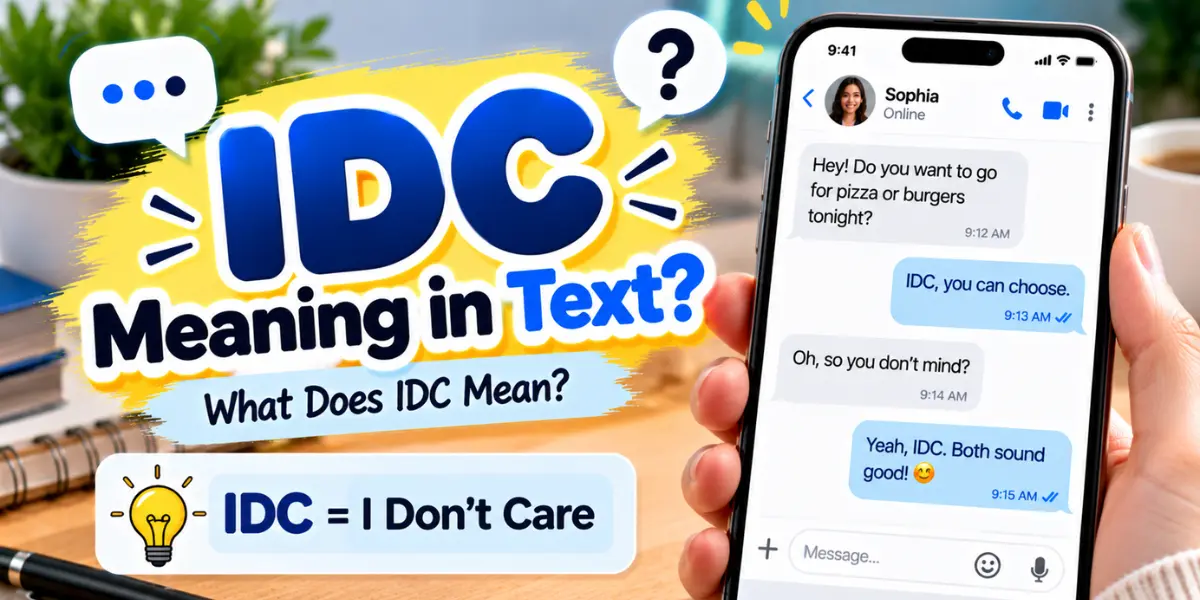
IDC stands for “I Don’t Care.” People commonly use it in text messages, social media comments, and online chats to express indifference, show that they have no preference, or indicate that something does not matter to them.
However, the meaning is not always negative. For example, someone might text “IDC where we eat” simply because they are happy to let you choose the restaurant. On the other hand, replying “IDC” during an argument may sound dismissive or rude.
Therefore, understanding the context is essential. In this guide, you will discover what IDC means in texting, how people use it on social media, whether it is rude, and how to respond naturally. You will also find real-life examples and learn the difference between IDC, IDK, IDRC, and IDGAF.
Let’s explore this popular texting abbreviation!
What Does IDC Mean in Text?
IDC means “I Don’t Care.” It is a common internet abbreviation that people use when they want to express indifference, communicate that they have no particular preference, or show that something is not important to them.IDC meaning in text
Instead of typing the full phrase, people use IDC to make their messages shorter and quicker.
For example:
Friend 1: “Do you want pizza or burgers tonight?”
Friend 2: “IDC, you can choose.”
In this conversation, IDC means that the person is happy to let their friend decide. It does not necessarily suggest anger or a lack of interest in the friendship.
However, the same abbreviation can sound different in another situation.
Person 1: “Why didn’t you tell me what happened?”
Person 2: “IDC anymore.”
Here, the response may sound frustrated, dismissive, or emotionally distant, depending on the conversation.
Consequently, the meaning of IDC depends on the topic, the relationship between the people, and the tone of the surrounding messages.IDC meaning in text
What Does IDC Stand For?
IDC stands for “I Don’t Care.” It is an informal abbreviation commonly used in digital communication.
People use it in:
- Text messages between friends.
- Instagram comments and direct messages.
- Snapchat conversations.
- TikTok comments.
- WhatsApp and group chats.
- Online gaming chats and internet forums.
Because IDC is informal, it is generally more suitable for casual conversations than professional emails or formal communication.
Why Do People Use IDC Instead of I Don’t Care?
People often prefer abbreviations because they make messaging faster. In addition, short expressions fit naturally into casual conversations where people exchange quick replies.
For instance, typing “IDC which movie we watch” is quicker than writing “I don’t care which movie we watch.”
Nevertheless, shorter messages can sometimes sound colder than intended. Therefore, if you want to express flexibility without sounding dismissive, you can add a friendly phrase, such as “IDC, anything sounds good!” IDC meaning in text
What Does IDC Mean in Different Situations?
Although IDC always expands to “I Don’t Care” in its common texting usage, the emotion behind it can vary. Understanding these differences helps you interpret the sender’s intention more accurately.
1. IDC When Someone Has No Preference
Sometimes, IDC simply means that a person is flexible and does not mind which option you choose.
For example:
You: “Should we meet at the café or the park?”
Friend: “IDC, both sound good.”
In this situation, the person is not expressing anger. Instead, they are allowing you to make the decision.
Similarly, someone might use IDC when choosing a movie, restaurant, meeting time, or weekend activity.
If the conversation is friendly and the sender offers no other signs of frustration, the abbreviation may be completely harmless.IDC meaning in text
2. IDC When Someone Is Annoyed
On the other hand, IDC can express frustration when someone feels tired of discussing a subject.
For example:
Person A: “Can we talk about this problem again?”
Person B: “IDC anymore.”
This response may suggest that the person is frustrated or does not want to continue the conversation.
However, you should not automatically assume that they are angry. They may be tired, distracted, or simply unwilling to discuss the topic at that moment.IDC meaning in text
Therefore, consider the earlier messages before deciding how to respond.
3. IDC as a Confident or Playful Response
Friends sometimes use IDC jokingly when discussing harmless preferences or teasing one another.
For example:
Friend A: “Everyone says this song is terrible.”
Friend B: “IDC, I love it!”
Here, the person is expressing confidence in their own taste. They are saying that other people’s opinions do not change what they enjoy.
Similarly, IDC may appear in playful conversations about fashion, music, movies, hobbies, or popular trends.
In this context, it does not necessarily sound rude. Instead, it communicates that the person is comfortable with their preference.
4. IDC When Someone Wants to End a Discussion
Sometimes, IDC indicates that a person no longer wants to debate a subject.
For example:
Person A: “You should change your opinion.”
Person B: “IDC what you think.”
This response sounds more dismissive because it directly rejects the other person’s opinion.
Nevertheless, the sender’s intention still depends on the relationship and conversation. They might be setting a boundary, expressing frustration, or responding emotionally.
If the discussion matters to you, it may be better to pause and talk later rather than continuing an argument through short messages.IDC meaning in text
Is IDC Rude in Texting?
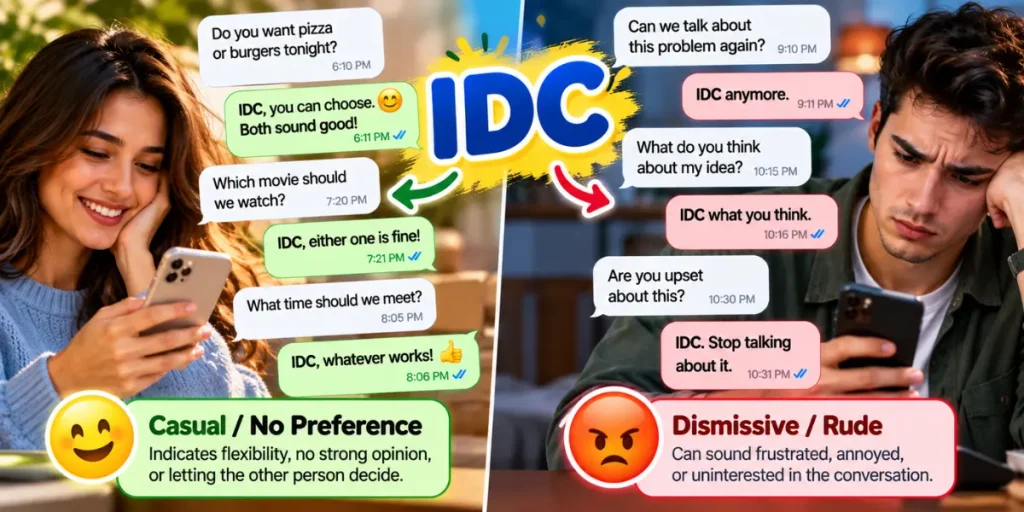
IDC can sound rude, but it is not always rude. Its tone depends on the situation, the wording, and the relationship between the people communicating.
For example, “IDC, you choose!” may sound relaxed and friendly. In contrast, “IDC about your problems” may sound insensitive or dismissive.
The difference is not the abbreviation itself. Instead, it is the meaning conveyed by the complete message.
When IDC Is Not Rude
IDC is often harmless when someone is discussing preferences or showing flexibility.
Examples include:
- “IDC which restaurant we visit.”
- “IDC what color you choose.”
- “IDC, both options look great.”
- “IDC which movie we watch tonight.”
In these examples, the sender is communicating that they do not have a strong preference.
When IDC Can Sound Rude
IDC may sound rude when someone uses it to dismiss another person’s feelings, concerns, or opinions. IDC meaning in text
Examples include:
- “IDC what you think.”
- “IDC about your explanation.”
- “IDC, stop talking about it.”
- “IDC if you are upset.”
These messages may sound cold because they appear to reject the other person’s perspective.
However, remember that text messages lack many communication cues, such as facial expressions and voice tone. Consequently, a message can sound harsher than the sender intended.
How Can You Tell the Difference?
Before interpreting IDC negatively, consider three things.
First, look at the subject. If the person is choosing between two restaurants, they may genuinely have no preference.
Second, consider your relationship. Close friends often use blunt language casually, while the same words may sound uncomfortable in a serious conversation.
Finally, look at the surrounding messages. If the person has been arguing or expressing frustration, IDC may indicate annoyance.
If you are still unsure, asking a calm question is often the best approach.
What Does IDC Mean on Social Media?
On social media, IDC generally carries the same meaning as in texting: “I Don’t Care.” People use it in comments, captions, direct messages, and discussions to express opinions, indifference, or frustration.IDC meaning in text
However, its tone depends on the content being discussed.
What Does IDC Mean on Instagram?
On Instagram, IDC may appear in direct messages, comments, or story replies.
For example:
Friend: “Do you like this outfit?”
You: “IDC what others think. I love it!”
Here, IDC communicates confidence and independence.
Alternatively, someone might comment “IDC about this trend” to express that they are not interested in a popular style or topic.
Therefore, read the full comment rather than judging the abbreviation alone.
What Does IDC Mean on Snapchat?
On Snapchat, users often send short, informal messages. As a result, IDC can be used as a quick way to express indifference or a lack of preference. IDC meaning in text
For example:
Friend: “Should I send the funny picture?”
You: “IDC 😂”
Depending on your friendship, this may sound casual or playful.
However, if someone sends IDC during a serious conversation, it may suggest that they are upset or do not want to continue discussing the subject.
What Does IDC Mean on TikTok?
On TikTok, IDC is frequently understandable as “I Don’t Care” when it appears in comments or captions.
For example:
“IDC if this trend is unpopular. I’m doing it anyway!”
The creator is expressing confidence and showing that other people’s opinions will not change their decision. IDC meaning in text
Similarly, a commenter might use IDC to show that they are not interested in a particular trend, debate, or opinion.
The surrounding video and discussion help clarify the tone.
What Does IDC Mean in WhatsApp and Group Chats?
In WhatsApp conversations and group chats, IDC is often used for quick decisions or informal discussions.
For example:
Group member 1: “Are we meeting at 6 or 7?”
Group member 2: “IDC, either time works for me.”
This means the person is flexible about the meeting time.
Nevertheless, in a serious discussion, IDC can sound dismissive. Therefore, consider the subject and the way the message is written before deciding what the sender intended.
Read More: What Does OMP Meaning in Text? Meaning, Slang & Examples
What Does IDC Mean From a Girl or a Guy?
IDC has the same basic meaning regardless of who sends it. Whether it comes from a girl, a guy, a friend, or a romantic partner, the abbreviation commonly stands for “I Don’t Care.”
However, the emotional meaning depends on the situation.
What Does IDC Mean From a Girl?
If a girl texts IDC, she may be expressing that she has no preference, does not mind a particular choice, or is frustrated with the discussion.
For example:
You: “Should we watch a comedy or an action movie?”
Her: “IDC, you choose.”
This probably means she is happy to let you decide.
On the other hand, if she writes “IDC anymore” during an argument, she may be expressing frustration or emotional distance.
Still, you cannot reliably determine someone’s feelings from one abbreviation alone. Consider the full conversation and ask if clarification is needed.
What Does IDC Mean From a Guy?
Similarly, if a guy texts IDC, he may be expressing indifference, flexibility, confidence, or annoyance.
For example:
You: “Do you want to eat outside or order food?”
Him: “IDC, whatever is easier.”
This suggests that he has no strong preference.
However, a response such as “IDC what you do” may sound dismissive, depending on the circumstances.
Ultimately, IDC does not have a special meaning based on gender. The sender’s words, tone, and behavior provide much more useful information.
IDC vs. IDK vs. IDRC vs. IDGAF
IDC looks similar to several other texting abbreviations. However, each expression communicates something different.
| Abbreviation | Full form | Meaning |
|---|---|---|
| IDC | I Don’t Care | Something does not matter to the sender |
| IDK | I Don’t Know | The sender does not have the answer |
| IDRC | I Don’t Really Care | The sender has little interest or concern |
| IDGAF | I Don’t Give a F*** | A stronger, vulgar expression of indifference |
IDC vs. IDK
IDC means “I Don’t Care,” while IDK means “I Don’t Know.”
For example:
Question: “Which restaurant should we visit?”
Reply: “IDC, you choose.”
The sender has no preference.
However:
Question: “Which restaurant is open until midnight?”
Reply: “IDK.”
The sender does not know the answer.
Therefore, IDC expresses a lack of concern or preference, whereas IDK expresses a lack of knowledge.
IDC vs. IDRC
IDRC means “I Don’t Really Care.” It is similar to IDC, but the word “really” can soften or slightly change the emphasis.
For example:
“IDRC which song we play next.”
This suggests that the choice is not especially important to the sender.
Nevertheless, both expressions can sound casual or dismissive depending on the conversation.
IDC vs. IDGAF
IDGAF stands for “I Don’t Give a F***.” It is a stronger and more vulgar way of expressing indifference.
For example:
“IDGAF what people say about my style.”
This communicates a forceful disregard for other people’s opinions.
By comparison, IDC is generally less explicit and may sound more neutral. However, it can still be rude when used to dismiss someone’s feelings.
IDC Meaning in Real Text Message Examples
Here are eight practical examples showing how people use IDC in different situations.
Example 1: Choosing a Restaurant
Friend A: “Pizza or burgers tonight?”
Friend B: “IDC, both sound good.”
Meaning: The sender has no preference and is happy with either option.
Example 2: Choosing a Movie
Person A: “Which movie do you want to watch?”
Person B: “IDC, you can pick.”
Meaning: The sender is letting the other person decide.
Example 3: Expressing Confidence
Person A: “People might laugh at your new style.”
Person B: “IDC, I like it.”
Meaning: The sender is confident and does not want other people’s opinions to influence their choice.
Example 4: Showing Frustration
Person A: “Can you explain why you did that?”
Person B: “IDC anymore.”
Meaning: The sender may be frustrated or unwilling to continue the discussion.
Example 5: Responding to Gossip
Friend A: “Did you hear what they said about you?”
Friend B: “IDC about their opinions.”
Meaning: The sender is indicating that the gossip does not matter to them.
Example 6: Planning a Trip
Person A: “Should we leave on Friday or Saturday?”
Person B: “IDC, whatever works best for everyone.”
Meaning: The sender is flexible about the travel date.
Example 7: A Social Media Trend
Person A: “Not everyone likes this trend.”
Person B: “IDC, I’m having fun!”
Meaning: The sender is enjoying the trend despite other people’s opinions.
Example 8: A Serious Conversation
Person A: “Your words really hurt me.”
Person B: “IDC.”
Meaning: This response may sound dismissive or insensitive because it appears to ignore the other person’s feelings.
These examples show that IDC can be neutral, playful, confident, or rude. Consequently, always consider the full conversation before interpreting the sender’s intention.
How Should You Respond When Someone Says IDC?
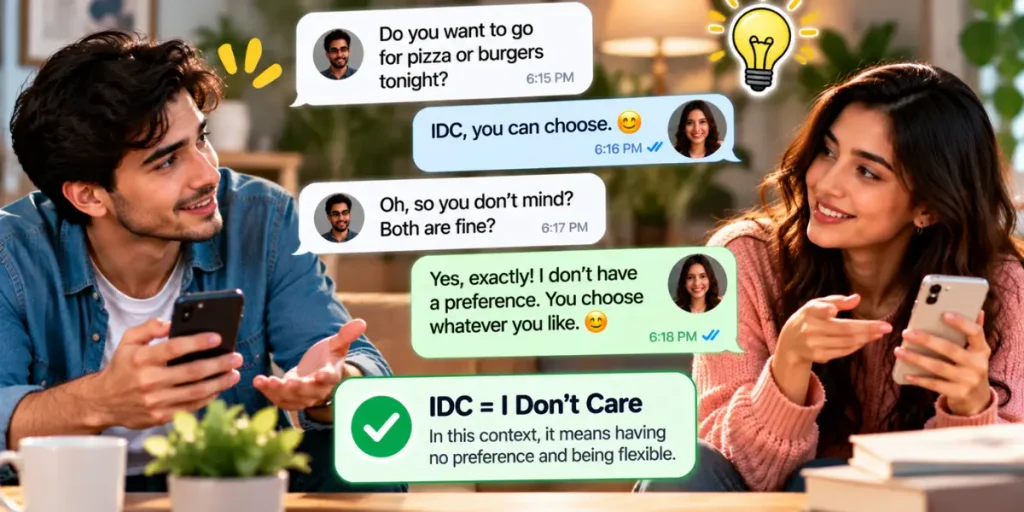
Your response depends on what the person means. If they are simply expressing a preference, you can make the decision yourself. However, if they seem annoyed, a calm response may help prevent an argument.
1. When They Have No Preference
If someone says IDC while choosing a restaurant, movie, or activity, you can respond naturally.
Examples:
- “Okay, I’ll choose!”
- “Great, let’s go with pizza.”
- “Perfect, both options work for me too.”
- “Alright, I’ll make the decision.”
These responses work because the sender is communicating flexibility rather than frustration.
2. When They Sound Annoyed
If someone uses IDC during a serious conversation, avoid responding aggressively.
Instead, you could say:
- “Okay, we can talk about it later.”
- “Are you upset, or do you genuinely not mind?”
- “I don’t want to argue. Let’s take a break.”
- “I understand. Let me know if you want to talk.”
These responses give the other person space while keeping communication respectful.
3. When You Are Unsure What They Mean
Sometimes, the message is too short to interpret confidently. In that case, ask for clarification.
For example:
“Do you mean you don’t mind, or are you upset about something?”
This question is useful because IDC can communicate different emotions. Rather than making assumptions, you give the sender an opportunity to explain.
Common Mistakes People Make About IDC
Although IDC is easy to understand, people sometimes misinterpret it.
1. Assuming IDC Always Means Anger
IDC does not automatically mean that someone is angry. They may simply have no preference about a choice.
2. Assuming IDC Means Someone Doesn’t Care About You
The abbreviation usually refers to the subject being discussed. For example, someone might not care which movie you watch but still care deeply about your friendship.
Therefore, do not judge a relationship based on one short message.
3. Confusing IDC With IDK
IDC means “I Don’t Care,” while IDK means “I Don’t Know.” These abbreviations express different ideas and should not be used interchangeably.
4. Ignoring Tone and Context
A friendly conversation can make IDC sound harmless, while an argument can make the same abbreviation feel hurtful.
5. Using IDC in Formal Communication
Because IDC is informal, it may be inappropriate for workplace emails, professional discussions, or serious conversations. In these situations, writing the full phrase or choosing more respectful wording is usually better.
Frequently Asked Questions About IDC
1. What does IDC mean in text messages?
IDC stands for “I Don’t Care.” People use it to express indifference, show that they have no preference, or communicate that something does not matter to them. Its tone depends on the situation.
2. What does IDC stand for?
IDC stands for “I Don’t Care.” It is a common abbreviation used in text messages, social media comments, and online chats.
3. Is IDC rude to say?
IDC can sound rude when it dismisses someone’s feelings or opinions. However, it can also be neutral when someone is simply expressing that they have no preference. Context and tone matter.
4. What does IDC mean from a girl?
When a girl texts IDC, she may mean that she has no preference or that something does not matter to her. Depending on the conversation, it can also express frustration. The abbreviation alone does not reveal her feelings.
5. What does IDC mean from a guy?
When a guy texts IDC, it generally means “I Don’t Care.” He may be expressing flexibility, indifference, confidence, or annoyance, depending on the situation.
6. What does IDC mean on Instagram?
On Instagram, IDC commonly means “I Don’t Care.” Users may include it in comments, captions, or direct messages to express an opinion, indifference, or confidence.
7. What does IDC mean on Snapchat?
On Snapchat, IDC stands for “I Don’t Care.” It is often used as a quick reply when someone has no preference or does not want to discuss something further.
8. What is the difference between IDC and IDK?
IDC means “I Don’t Care,” while IDK means “I Don’t Know.” IDC expresses indifference or a lack of preference; IDK indicates that someone does not know the answer.
9. What does IDRC mean?
IDRC stands for “I Don’t Really Care.” It is similar to IDC, although it may communicate a slightly softer or more qualified form of indifference.
10. How do you respond when someone says IDC?
If the person has no preference, you can say, “Okay, I’ll choose.” If they sound annoyed, respond calmly or ask whether something is wrong. The best reply depends on the conversation.
11. Does IDC mean someone doesn’t care about you?
Not necessarily. IDC usually refers to the subject being discussed, such as a choice or an opinion. However, if someone repeatedly dismisses your feelings, consider the wider pattern of communication rather than relying on one abbreviation.
Final Thoughts on IDC Meaning in Text
So, what does IDC mean in text? IDC stands for “I Don’t Care.” It is a common texting abbreviation used to express indifference, show that someone has no preference, or indicate that something does not matter to them.
However, IDC is not always rude. In a friendly conversation, it may simply mean “You choose.” During an argument, the same abbreviation can sound dismissive or frustrated.
Therefore, context is essential when interpreting the message. Consider the subject, the relationship, and the surrounding words before deciding what the sender means.
Ultimately, understanding IDC can help you communicate more clearly online. When in doubt, ask a simple question instead of making assumptions. A little clarification can make a big difference in any conversation.
