what does emphasize mean in text Have you ever received a text message that says someone “Emphasized” your message and wondered what it means? Or perhaps you want to understand how people emphasize words in everyday conversations. Either way, you are in the right place!
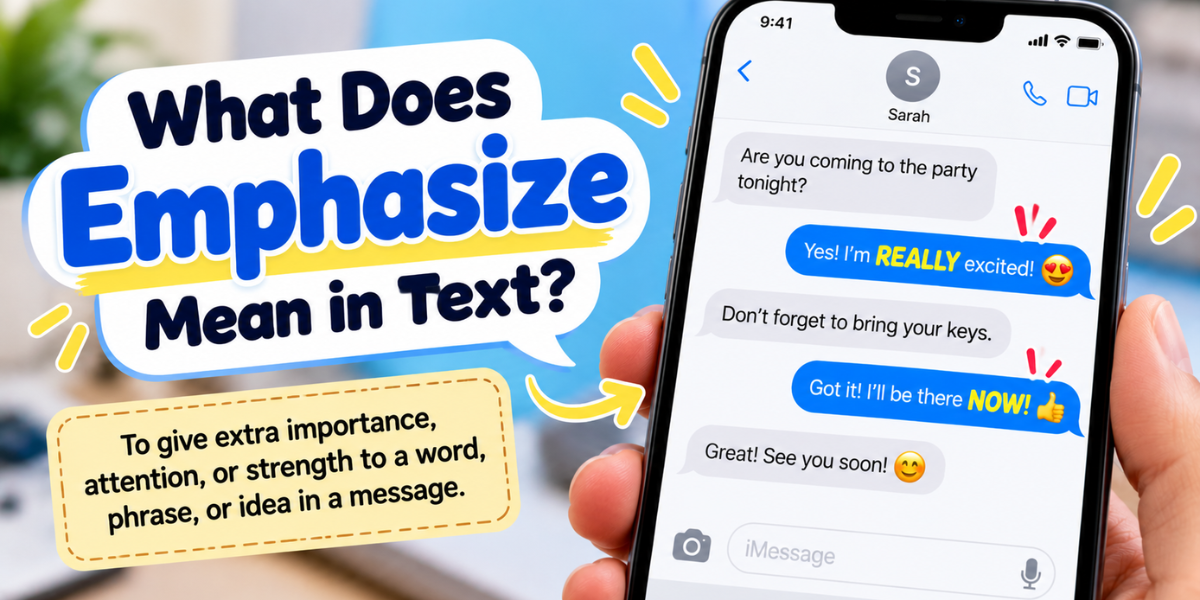
Emphasize in text means to give extra importance, attention, or strength to a word, phrase, feeling, or idea. People often use capital letters, punctuation, emojis, repeated words, and text formatting to emphasize something in a message. For example, writing “I REALLY need your help” puts extra attention on the word “really.”
However, the word can have a more specific meaning on an iPhone. When you see an “Emphasized” notification in Apple’s Messages app, it usually refers to a Tapback reaction that someone added to a message. This reaction commonly uses the double-exclamation-mark symbol to show emphasis or a strong response.
In this guide, you will learn what emphasize means in text messages, how the iPhone reaction works, and how to emphasize your words naturally. Additionally, we will explore real-life examples, common synonyms, and frequently asked questions to help you understand this expression confidently.
What Does Emphasize Mean in Text?
To emphasize something means to make it stand out or show that it deserves special attention. In texting, people emphasize words to communicate feelings, highlight important information, or make their messages easier to understand.
For example, consider these two messages:
- “That movie was good.”
- “That movie was REALLY good!”
Both messages express a positive opinion. However, the second message communicates a stronger feeling because the word “REALLY” receives extra attention.
Similarly, someone might write, “Please call me NOW!” when they want to communicate urgency. The capital letters and exclamation mark make the request feel more immediate.
Therefore, emphasis is an important part of digital communication. Since text messages do not always include facial expressions, gestures, or vocal tone, people often use written techniques to show what they mean.
Emphasize Meaning in Simple English
In simple English, emphasize means to stress something, highlight it, or make it more noticeable.
Here are a few examples:
- “I want to emphasize one important point.” This means the speaker wants people to pay special attention to that point.
- “She emphasized the word ‘never.’” This means she gave that word extra importance.
- “He emphasized how much he appreciated the help.” This means he made his appreciation especially clear.
In everyday texting, the same idea applies. You can emphasize a word by capitalizing it, repeating it, or adding punctuation.
For instance, “I’m so happy!” sounds more expressive than “I’m happy.” Likewise, “I’m SO happy!” places even greater emphasis on the feeling.
What Does It Mean to Emphasize a Message?
When someone emphasizes a message, they want a particular part of the message to stand out. They might be expressing excitement, frustration, surprise, urgency, or strong agreement.
Imagine your friend writes:
“Don’t forget to bring your keys!”
The exclamation mark emphasizes the reminder. However, it does not automatically mean your friend is angry. They may simply want to make sure you remember.
Similarly, a message such as “I absolutely LOVE this song” emphasizes the person’s enthusiasm. The capitalized word makes the emotion more noticeable.
Ultimately, the meaning depends on the words, punctuation, and relationship between the people communicating.
Everyday Examples of Emphasis
Here are some common examples that show how emphasis works in text messages.
| Ordinary message | Emphasized message | Effect |
|---|---|---|
| I like it. | I REALLY like it! | Shows stronger approval |
| Call me soon. | Call me NOW, please! | Communicates urgency |
| That was funny. | That was SO funny! | Expresses stronger amusement |
| I am tired. | I am EXHAUSTED. | Highlights the feeling |
| Thank you. | THANK YOU SO MUCH! | Shows extra gratitude |
As you can see, emphasis changes the strength or tone of a message without necessarily changing its basic meaning.
What Does “Emphasized” Mean on iPhone and iMessage?
If you use an iPhone, you may have seen a notification saying that someone “Emphasized” a message. In this situation, the word has a specific meaning related to Apple’s Messages app.
An “Emphasized” notification generally means that someone reacted to your message using the double-exclamation-mark Tapback reaction (!!).
Tapbacks allow users to react to individual messages without typing a separate reply. Depending on the device and software version, these reactions may appear as small symbols attached to the message.
What Is the Emphasize Reaction in iMessage?
Apple Messages includes reactions that let people respond quickly to a message. One of these reactions uses two exclamation marks, which are commonly associated with emphasis.
For example, imagine you send your friend this message:
“I finally passed my driving test!”
Your friend reacts with “!!”. You may see a notification indicating that your friend emphasized your message.
In this context, the reaction can communicate excitement, strong agreement, surprise, or enthusiasm. Nevertheless, its exact meaning depends on the conversation.
The reaction does not necessarily mean that the sender is shouting or criticizing you. Instead, it generally indicates that they want to respond with extra emphasis.
What Does It Mean When Someone Emphasizes Your Text?
When someone emphasizes your text, they may be highlighting something they found important, exciting, surprising, or worthy of a strong reaction.
For example:
You: “We are going on vacation next week!”
Friend: Reacts with “!!”
Your friend may be expressing excitement about your plans. Likewise, if you share important news, the reaction may communicate surprise or strong interest.
Here are a few other possibilities:
- Excitement: They are enthusiastic about your news.
- Surprise: They did not expect what you shared.
- Agreement: They strongly agree with your statement.
- Importance: They want to highlight a particular message.
- Urgency: They consider the information especially significant.
However, you should not assume that every reaction has exactly the same emotional meaning. Consider the conversation before deciding what the sender intended.
Does the Emphasize Reaction Mean Someone Is Angry?
No. An emphasize reaction does not automatically mean that someone is angry.
For example, if you tell a friend that you won a competition, their “!!” reaction will probably express excitement or surprise. On the other hand, if you send a message about a disagreement, the same reaction could communicate strong emphasis or frustration.
Therefore, context matters more than the symbol alone.
If you are uncertain about the sender’s tone, you can ask a simple follow-up question. A quick clarification is often better than assuming that a reaction has a negative meaning.
Also, remember that reactions and notifications can look different across Apple devices, software versions, and messaging platforms. The exact appearance may vary depending on the conversation and device compatibility.
How Do People Emphasize Words in Text Messages?
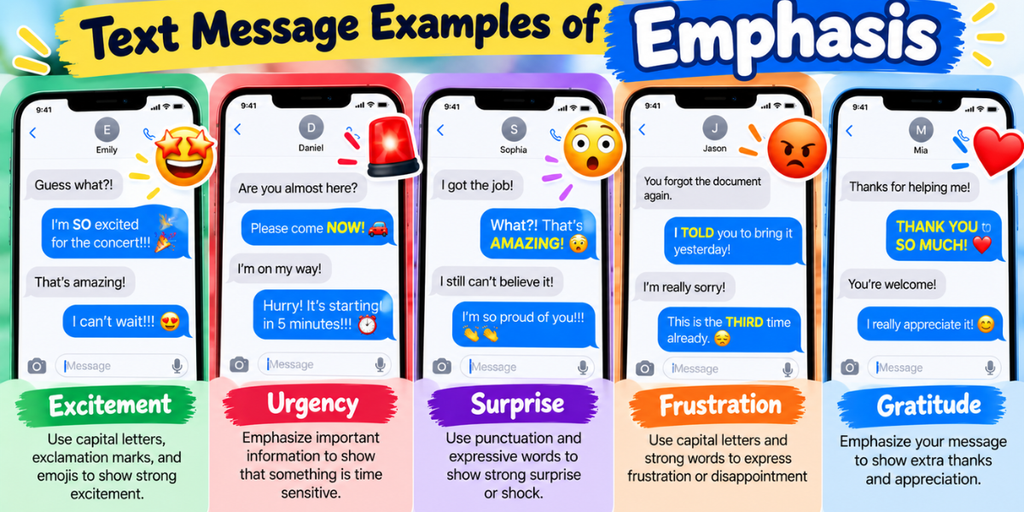
There are several ways to emphasize words in a text message. The best method depends on the feeling you want to communicate and the app you are using.
1. Using Capital Letters
Capital letters are one of the easiest ways to emphasize a word. They draw attention to the selected word and make it stand out visually.
For example:
- “I am SO excited!”
- “Please remember to bring your ID.”
- “That was AMAZING!”
- “I REALLY appreciate your help.”
However, using too many capital letters can make a message look aggressive. In online conversations, writing an entire sentence in capitals is sometimes interpreted as shouting.
Therefore, capitalize only the words that genuinely need extra attention.
2. Repeating Words and Letters
Repeating a word or extending its letters can make a message feel more emotional or playful.
For instance:
- “Thank you so, so much!”
- “I’m sooo happy!”
- “That was really, really good.”
- “Nooooo, I missed the bus!”
These expressions often appear in casual conversations because they communicate feelings that are difficult to express through plain text alone.
Nevertheless, repeated letters are usually informal. They may work well when texting friends, but they are generally unsuitable for professional emails or formal documents.
3. Using Bold and Italic Formatting
Some messaging apps and platforms support bold or italic text. These formatting options can emphasize specific words without relying on capital letters.
For example:
- “I really need your help.”
- “That is exactly what I meant.”
- “Please read this important information.”
Bold text makes a word stand out, while italics can suggest stress or a particular tone. However, the available formatting options depend on the app.
For instance, a platform may support formatted text in messages or posts, while another may offer only plain text and emoji reactions.
Therefore, check the features available in your messaging app before trying to apply formatting.
4. Using Emojis and Punctuation
Emojis and punctuation can also emphasize a message. They add visual cues that help communicate excitement, disappointment, urgency, or humor.
Consider these examples:
- “That was amazing!!! 😍”
- “Really?! 😲”
- “I can’t wait!!! 🎉”
- “Please help me! 🙏”
- “I finally did it! 🥳”
In these examples, punctuation and emojis strengthen the emotional tone.
However, excessive exclamation marks or emojis can make a message look overwhelming. Use them naturally so that the main point remains clear.
5. Using Strong Words
You can also emphasize an idea by choosing more descriptive words.
For example, instead of writing “The food was good,” you could say “The food was absolutely delicious.”
Similarly, “I’m a little worried” communicates a different level of concern than “I’m extremely worried.”
Words such as absolutely, definitely, especially, incredibly, and completely can add emphasis without requiring unusual formatting.
This approach is especially useful when you want your message to sound clear and natural.
Emphasize Meaning in Chat and on Social Media
The general meaning of emphasize remains similar across social media platforms. However, each app has its own features, and users may express emphasis differently depending on the conversation.
Emphasize Meaning on WhatsApp
On WhatsApp, people often emphasize words through punctuation, emojis, repeated letters, and supported text formatting.
For example:
“I’m really excited about tomorrow!”
The bold word gives extra attention to the speaker’s excitement.
Likewise, someone might send, “Call me ASAP!!!” to communicate urgency. The punctuation strengthens the message, although the precise tone depends on the relationship between the people involved.
WhatsApp also supports formatting options in many versions, allowing users to highlight selected words more clearly.
Emphasize Meaning on Instagram
Instagram users frequently emphasize words in captions, comments, and direct messages.
For example:
- “This outfit is AMAZING!”
- “I absolutely love this picture 😍”
- “That sunset was unreal!”
These expressions make the user’s reaction stronger and more expressive.
Additionally, creators may capitalize certain words in captions to draw attention to an announcement, important detail, or call to action.
Nevertheless, emphasis should support the message rather than distract from it. A few well-chosen words are often more effective than an entire caption written in capital letters.
Emphasize Meaning on Snapchat and TikTok
On Snapchat and TikTok, emphasis often appears through short phrases, expressive punctuation, emojis, and stylized text.
For example:
- “This video is SO funny 😂”
- “Wait for the ending!!!”
- “I can’t believe this happened!”
- “That transition was PERFECT.”
These expressions communicate a strong reaction in a small amount of space.
Moreover, creators can use on-screen text, captions, and visual effects to make important parts of a video stand out. Although these techniques are not identical to emphasizing a word in a private text, they serve a similar purpose: directing attention toward something important.
Emphasis in Online Group Chats
In group chats, emphasis can help prevent important information from getting lost among multiple messages.
For instance, someone organizing an event might write:
“Meeting starts at 6 PM. Please arrive on time!”
The formatting and punctuation draw attention to the time and request.
However, excessive emphasis can sometimes create misunderstandings. A message written in capital letters may appear angry even when the sender simply wants to highlight information.
Therefore, choose formatting carefully and consider how other people might interpret your words.
Read More: BTC Meaning in Text: What Does BTC Mean in Chat & Social Media?
Examples of Emphasize in Text Messages
The following examples show how emphasis can communicate different emotions and intentions.
1. Emphasis to Show Excitement
Message: “I’m SO excited for the concert!”
The capitalized word communicates strong enthusiasm. The sender is not merely interested in the concert; they are looking forward to it a great deal.
2. Emphasis to Express Urgency
Message: “Please call me as soon as possible!”
The phrase “as soon as possible” highlights the importance of a quick response. Depending on the situation, the message may indicate that something needs immediate attention.
3. Emphasis to Show Frustration
Message: “I’ve told you this THREE times already.”
The capitalized word emphasizes the repeated nature of the situation. As a result, the message may sound frustrated or impatient.
However, the sender’s intention still depends on the surrounding conversation.
4. Emphasis to Make a Joke
Message: “That was the MOST embarrassing moment ever 😂”
The capitalized word exaggerates the experience for humorous effect. The laughing emoji also suggests that the sender may be joking rather than expressing serious distress.
5. Emphasis to Clarify an Important Point
Message: “Please remember that the deadline is TOMORROW.”
Capitalizing “TOMORROW” highlights the deadline and makes the information more noticeable.
This type of emphasis can be useful when communicating instructions, reminders, or important dates.
6. Emphasis to Express Gratitude
Message: “THANK YOU SO MUCH for helping me!”
The capitalized phrase communicates extra appreciation. It can make a simple thank-you message feel more heartfelt.
7. Emphasis to Express Surprise
Message: “You got the job?! That’s AMAZING!”
The question mark and exclamation mark show surprise and excitement. Together, they make the reaction more expressive.
8. Emphasis to Show Disappointment
Message: “I REALLY thought we would win.”
The capitalized word highlights the sender’s strong expectation. Depending on the context, the message may communicate disappointment or disbelief.
9. Emphasis to Highlight a Preference
Message: “I would DEFINITELY choose the blue one.”
The word “DEFINITELY” shows confidence in the decision. It makes the preference stronger and clearer.
10. Emphasis to Show Affection
Message: “I miss you SO much ❤️”
The phrase “SO much” strengthens the expression of affection. The heart emoji reinforces the warm tone.
As these examples demonstrate, emphasis can express many different feelings. Nevertheless, the same technique can communicate different emotions depending on the words and situation.
Does Emphasizing a Text Mean Someone Is Angry?
Not necessarily. Emphasizing a text means that someone is drawing attention to a particular word, idea, or feeling. Anger is only one possible interpretation.
For example, “I am SO happy for you!” uses capitalization to express excitement. In contrast, “I TOLD you not to do that!” may sound frustrated or angry.
The difference comes from the wording and context, not simply from the capital letters.
Similarly, an exclamation mark can express excitement, surprise, urgency, or frustration. Emojis may provide additional clues, but they do not always make the sender’s intention completely clear.
If a message seems unusually intense, consider the following:
- What was the conversation about?
- Does the person normally use capital letters or exclamation marks?
- Are they emphasizing positive news or responding to a disagreement?
- Could their message simply be playful or enthusiastic?
Ultimately, written communication can be difficult to interpret because it lacks vocal tone and facial expressions. Therefore, avoid assuming that emphasis always indicates anger. If necessary, ask the sender what they meant.
Emphasize vs. Emphasis: What’s the Difference?
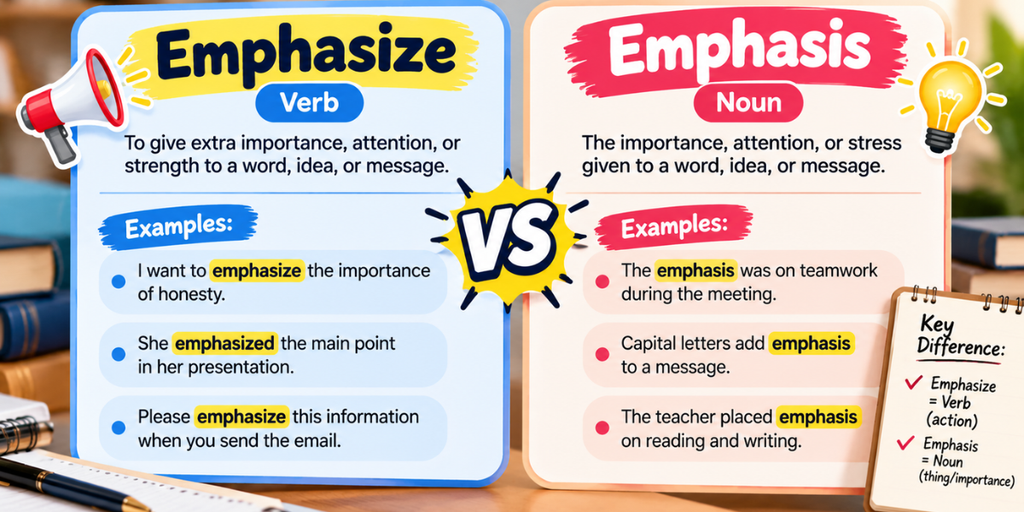
Although emphasize and emphasis are closely related, they serve different grammatical purposes.
Emphasize is a verb. It describes the action of giving something extra importance or attention.
Emphasis is a noun. It describes the importance, attention, or stress given to something.
Emphasize as a Verb
Examples:
- “I want to emphasize the deadline.”
- “She emphasized the importance of honesty.”
- “Please emphasize the main point in your presentation.”
In each sentence, the word describes an action.
Emphasis as a Noun
Examples:
- “The teacher placed emphasis on reading.”
- “The emphasis was on teamwork.”
- “Capital letters add emphasis to a message.”
Here, the word refers to the importance or stress placed on something.
Emphasized and Emphasizing
Emphasized is commonly used as the past tense or past participle of the verb. Meanwhile, emphasizing describes an action in progress or serves as a gerund.
For example:
- “He emphasized the final sentence.”
- “She is emphasizing the most important details.”
In everyday texting, you may encounter “Emphasized” as a notification in iMessage. In that case, it refers to a specific message reaction rather than simply the grammatical meaning of the word.
Synonyms for Emphasize
If you want to express the same idea without repeatedly using the word emphasize, several alternatives may help.
| Synonym | Meaning | Example |
|---|---|---|
| Highlight | Draw attention to something | “Please highlight the key point.” |
| Stress | Give something special importance | “I want to stress the deadline.” |
| Underscore | Reinforce the importance of an idea | “The results underscore the need for action.” |
| Accentuate | Make a feature more noticeable | “The design accentuates the main heading.” |
| Reinforce | Strengthen an idea or message | “She reinforced her point with an example.” |
| Focus on | Direct attention toward something | “Let’s focus on the main issue.” |
| Draw attention to | Make people notice something | “The announcement draws attention to the changes.” |
Although these words share similar meanings, they are not always interchangeable. For example, “highlight” often suggests making something visually or verbally noticeable, while “reinforce” suggests strengthening an existing idea.
Therefore, choose the synonym that best fits your sentence.
How to Emphasize a Message Without Sounding Rude
Emphasis can make communication clearer, but too much of it may create misunderstandings. Fortunately, a few simple techniques can help you communicate confidently without sounding aggressive.
Choose the Most Important Words
Instead of capitalizing an entire sentence, highlight only the most important word.
For example, “Please send the document TODAY” draws attention to the deadline without making the entire message look like shouting.
Use Punctuation Carefully
An exclamation mark can express enthusiasm or urgency. However, several exclamation marks in a serious conversation may make the message appear overly intense.
Therefore, use punctuation that matches your intended tone.
Match Your Tone to the Audience
A playful message to a close friend may include emojis, repeated letters, and informal expressions. In contrast, a professional message should generally use clear language and restrained formatting.
For example, “I’m SO excited!!! 🎉” may work well with friends, while “I’m very pleased with the results” is more appropriate for a formal email.
Avoid Excessive Capitalization
Writing every word in capital letters can make a message difficult to read and may be interpreted as shouting.
Instead, emphasize one or two key words. This approach keeps the message readable while still communicating your main point.
Clarify Your Meaning When Necessary
If your message concerns a sensitive subject, use clear wording rather than relying entirely on punctuation.
For example, instead of writing “FINE!!!”, you could say, “That’s okay, but I’m still a little disappointed.”
This makes your feelings easier to understand and reduces the chance of misinterpretation.
Frequently Asked Questions About Emphasize in Text
1. What does emphasize mean in text messages?
Emphasize means to give extra importance or attention to a word, phrase, or idea. People often use capitalization, punctuation, emojis, and formatting to make their messages more expressive.
2. What does “Emphasized” mean on an iPhone?
On an iPhone, an “Emphasized” notification in Messages generally indicates that someone used the double-exclamation-mark Tapback reaction on your message. It often communicates emphasis, excitement, surprise, or a strong response.
3. What does it mean when someone emphasizes your text?
It means they are highlighting or reacting strongly to something you said. Depending on the conversation, this may communicate excitement, agreement, surprise, urgency, or frustration.
4. Does emphasizing a text mean someone is angry?
No. Emphasis does not automatically indicate anger. Capital letters, punctuation, and message reactions can express excitement, affection, surprise, or other emotions as well.
5. How do you emphasize a word in a text message?
You can capitalize a word, repeat it, use punctuation, add an emoji, or apply bold formatting if your messaging app supports it. For example, “I’m REALLY excited!” emphasizes the speaker’s excitement.
6. What is the difference between emphasize and emphasis?
Emphasize is a verb that describes the action of highlighting something. Emphasis is a noun that describes the importance or attention given to it.
7. Can emojis be used to emphasize a message?
Yes. Emojis can reinforce the tone of a message. For example, “That was amazing! 🎉” uses a celebration emoji to strengthen the expression of excitement.
8. What are some synonyms for emphasize?
Common synonyms include highlight, stress, underscore, accentuate, reinforce, and draw attention to. The best choice depends on the sentence and intended meaning.
9. How do you emphasize a message without using capital letters?
You can use bold or italic formatting, punctuation, descriptive words, or emojis. For example, “I absolutely love this!” emphasizes the feeling without using capital letters.
10. What does emphasize mean in iMessage compared with regular texting?
In regular texting, emphasize generally means to give a word or idea extra importance. In iMessage, an “Emphasized” notification usually refers to the double-exclamation-mark Tapback reaction attached to a message.
Final Thoughts on Emphasize Meaning in Text
Understanding what emphasize means in text can help you interpret messages more accurately and express yourself clearly. In general, to emphasize something means to give it extra importance, attention, or emotional strength.
People can emphasize words using capital letters, punctuation, emojis, repetition, and text formatting. Meanwhile, on an iPhone, an “Emphasized” notification usually refers to the double-exclamation-mark reaction in Apple’s Messages app.
However, emphasis does not always mean anger or frustration. It can also communicate excitement, surprise, affection, agreement, or urgency. Therefore, consider the surrounding conversation before deciding what someone intends.
Finally, use emphasis thoughtfully in your own messages. By choosing the right words and formatting, you can make your meaning clearer, highlight important information, and reduce the chances of misunderstandings.
