DK meaning in text Have you ever received a message containing “DK” and wondered what those two letters mean? You are not alone! Texting abbreviations can sometimes be confusing, especially when someone sends a short reply without explaining what they mean.
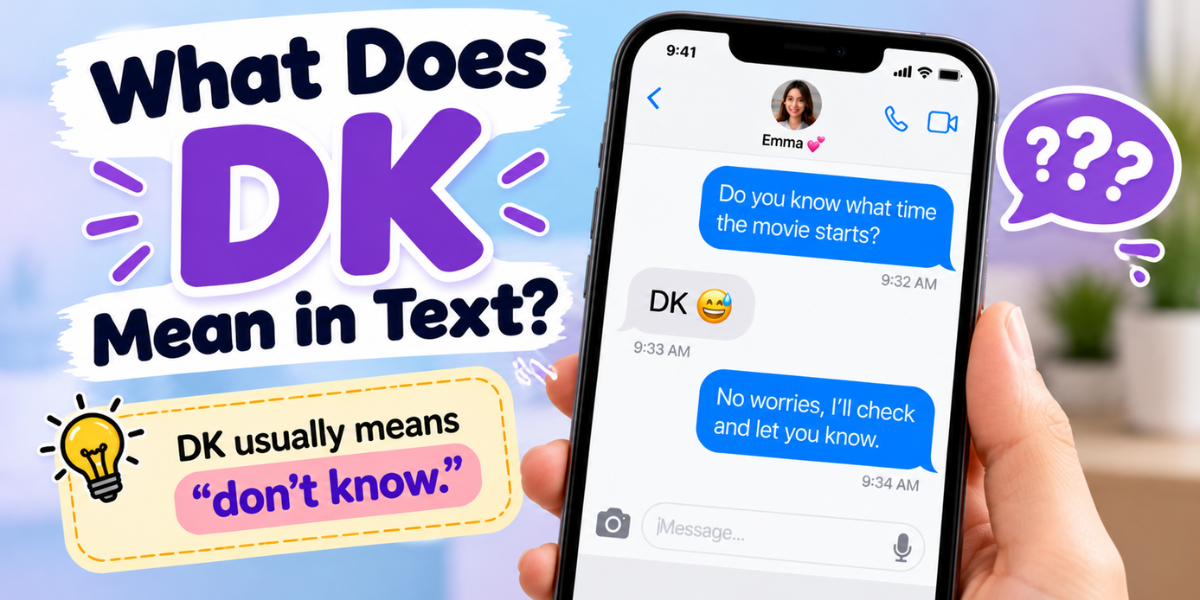
So, what does DK mean in text? DK usually stands for “don’t know.” People use this informal abbreviation when they do not have an answer, feel uncertain, or lack information about something. For example, if you ask a friend, “What time does the movie start?” and they reply “DK,” they are saying they don’t know.
However, the meaning can depend on the conversation. In casual messages, DK generally expresses uncertainty. In gaming, entertainment, or technical discussions, it may have a different meaning.
In this guide, you’ll learn the DK meaning in text, how people use it on social media, how it differs from IDK, and how to respond when someone sends it. Additionally, you’ll discover practical examples to help you understand this abbreviation in everyday conversations.
What Does DK Mean in Text?
In text messages, DK means “don’t know.” It is a short, informal way to tell someone that you do not know an answer or cannot provide the information they need.
People often use DK in quick conversations because it takes less time to type than a complete sentence. Consequently, it fits naturally into casual chats, group messages, and social media conversations. DK meaning in text
For example, imagine that your friend asks where another friend went. If you have no idea, you might simply reply, “DK.”
Here are a few common examples:
- “DK where he went.” — Don’t know where he went.
- “DK what time it starts.” — Don’t know what time it starts.
- “DK, ask Sarah.” — Don’t know; ask Sarah.
- “DK yet.” — Don’t know yet.
- “DK what happened.” — Don’t know what happened.
As you can see, the meaning remains straightforward in each example. The sender is communicating a lack of knowledge or certainty.
What Does DK Stand For?
DK stands for “don’t know” in casual texting. It is an informal abbreviation formed from the first letters of the two words.
Unlike some internet abbreviations, DK does not usually represent a complicated phrase. Instead, it is a simple shortcut used to make messages quicker. DK meaning in text
For example, someone might write:
Full sentence: “I don’t know where the keys are.”
Short message: “DK where the keys are.”
Both messages communicate a similar idea. However, the shorter version is more casual and may sound less complete.
Is DK Slang or an Abbreviation?
DK is an informal texting abbreviation. People sometimes call it slang because it appears in casual digital conversations rather than formal writing.
However, it is important to remember that DK is not appropriate for every situation. While friends may understand it immediately, a coworker or professional contact might prefer a complete sentence.
Therefore, use DK when the conversation is informal and the meaning is clear. In professional situations, writing “I don’t know” or “I’m not sure” is generally better. DK meaning in text
Read More: TYSM Meaning in Text: What Does TYSM Mean in Chat & Social Media?
How Is DK Used in Everyday Conversations?
People use DK in different situations, but the main idea is usually the same: they do not have the information being requested.
Nevertheless, the exact message can express several slightly different kinds of uncertainty.
1. DK to Express a Lack of Information
The most common use of DK is to explain that someone does not know an answer.
For example:
Friend: “Do you know where Mike lives?”
You: “DK.”
In this conversation, you are simply saying that you do not know Mike’s location. There is no additional meaning implied by the abbreviation.
Similarly, someone might use DK when asked about an event, a person’s plans, or the details of a situation.
2. DK When Someone Is Unsure
Sometimes, a person has not decided what they think or does not have enough information to answer confidently. DK meaning in text
For example:
Friend: “Are you joining us for dinner?”
You: “DK yet. I’ll let you know.”
Here, the message means that you have not decided whether you will attend. The word “yet” also suggests that your answer could change later.
Therefore, DK can communicate uncertainty rather than a permanent lack of knowledge.
3. DK When Someone Needs More Information
A person may also use DK because they cannot answer a question without checking something first.
For example:
You: “What time is the meeting tomorrow?”
Coworker: “DK. I’ll check the schedule.”
The coworker does not have the answer immediately but intends to find it.
In this situation, the additional sentence makes the meaning clearer. It also shows that the person is willing to follow up. DK meaning in text
What Does DK Mean on WhatsApp, Instagram, Snapchat, and TikTok?
The DK meaning in text generally stays the same across messaging apps and social media platforms. It usually means “don’t know” when someone uses it in an ordinary conversation.
However, the surrounding messages can help you understand why the person used it.
DK Meaning on WhatsApp
On WhatsApp, people commonly use short abbreviations to communicate quickly with friends, relatives, and colleagues.
For example:
You: “Do you know when Ali is arriving?”
Friend: “DK, maybe around 6.”
Your friend is saying they do not know the exact arrival time. The word “maybe” suggests that they have a guess but cannot confirm it.
Likewise, DK might appear in family group chats, conversations about plans, or discussions about everyday activities.
DK Meaning on Instagram
On Instagram, DK can appear in direct messages and comments when someone does not know an answer.
For example:
You: “What’s the name of that song in your story?”
Friend: “DK 😅”
The person is telling you they do not know the song’s name. The emoji may make the message feel more casual, but it does not change the abbreviation’s basic meaning.
Similarly, someone might use DK when discussing a post, asking about a location, or responding to a question about another account.
DK Meaning on Snapchat
Snapchat conversations are often quick and informal. Therefore, people may use DK when answering questions without typing a full sentence.
For example:
You: “Are we meeting at the usual place?”
Friend: “DK, let me ask them.”
This reply means that your friend does not know the plan yet and will try to find out.
However, DK is not an exclusive Snapchat abbreviation. It can be used in many types of digital communication.
DK Meaning on TikTok
On TikTok, DK may appear in comments, direct messages, or conversations about videos.
For example:
You: “Who is the person in this video?”
Friend: “DK.”
The friend simply does not know the person’s identity.
Nevertheless, context matters more when you are discussing a specific game, character, creator, or entertainment franchise. In those situations, DK might refer to something other than “don’t know.”
Does DK Have Different Meanings Depending on Context?
Yes. Although DK usually means “don’t know” in casual texting, the same letters can represent other things in different contexts.
This is why you should always consider the subject of a conversation before deciding what an abbreviation means.
DK as “Don’t Know”
When DK appears in an ordinary text conversation, “don’t know” is usually the most reasonable interpretation.
For example:
You: “Who won the match?”
Friend: “DK.”
The friend is saying they do not know who won.
DK as Donkey Kong
In gaming conversations, DK can refer to Donkey Kong, the well-known video game character and franchise.
For example:
Friend: “I’m playing DK tonight.”
If you are discussing video games, DK might refer to Donkey Kong rather than “don’t know.”
The surrounding topic helps you identify the intended meaning.
DK as Denmark’s Country-Code Domain
DK is also the country-code top-level domain associated with Denmark. You might encounter it in website addresses ending in .dk.
For example, if someone discusses a website’s domain, DK may refer to Denmark rather than a texting abbreviation.
This meaning is relevant to websites and internet addresses, not usually to everyday chat messages.
DK in Technical or Specialized Discussions
In technical documents, DK may represent a field-specific term, label, or abbreviation. Its meaning depends on the subject and the terminology used by the organization or industry.
Consequently, you should not assume that every occurrence of DK means “don’t know.”
A simple rule: If DK appears in a casual conversation, start with “don’t know.” If it appears in gaming, a website address, or a specialist document, check the surrounding context.
Is DK Rude or Disrespectful in Text?
DK is not inherently rude. In most casual conversations, it simply means that the sender does not know something.
However, a short reply can sometimes sound blunt, particularly when the other person expects a more thoughtful answer.
For example:
You: “Do you know if my application was approved?”
Friend: “DK.”
The response may sound abrupt because the question is important. Nevertheless, the friend might genuinely lack the information.
Compare it with this reply:
Friend: “I’m not sure yet, but I’ll check and let you know.”
The second response sounds more helpful because it explains the situation and offers a next step.
When DK Sounds Neutral
DK usually sounds neutral when someone asks a simple question and the sender does not know the answer.
For example:
You: “What time does the store close?”
Friend: “DK, sorry.”
This is a straightforward response. The word “sorry” also makes the message sound more considerate.
When DK May Sound Dismissive
DK can feel dismissive when someone uses it repeatedly without engaging with the conversation, especially when the topic is important.
For example:
You: “Can we talk about what happened yesterday?”
Friend: “DK.”
This reply might feel unhelpful because it does not address the request to talk.
Even so, you cannot determine someone’s feelings from two letters alone. They may be busy, confused, uncomfortable, or unsure how to respond.
How Punctuation and Emojis Affect DK
Punctuation and emojis can influence how a short message feels.
| Message | Possible interpretation |
|---|---|
| “DK” | A simple, direct response |
| “dk lol” | Casual or playful uncertainty |
| “DK 😅” | Uncertainty with a lighthearted tone |
| “DK yet” | The answer is not known at the moment |
| “DK, I’ll check” | Uncertainty with an offer to follow up |
| “DK.” | A brief response that may sound blunt in some contexts |
These are possible interpretations, not fixed rules. Different people use punctuation and emojis differently.
Therefore, consider the whole conversation instead of assuming that a period, capital letters, or an emoji reveals the sender’s exact feelings.
DK vs. IDK: What’s the Difference?
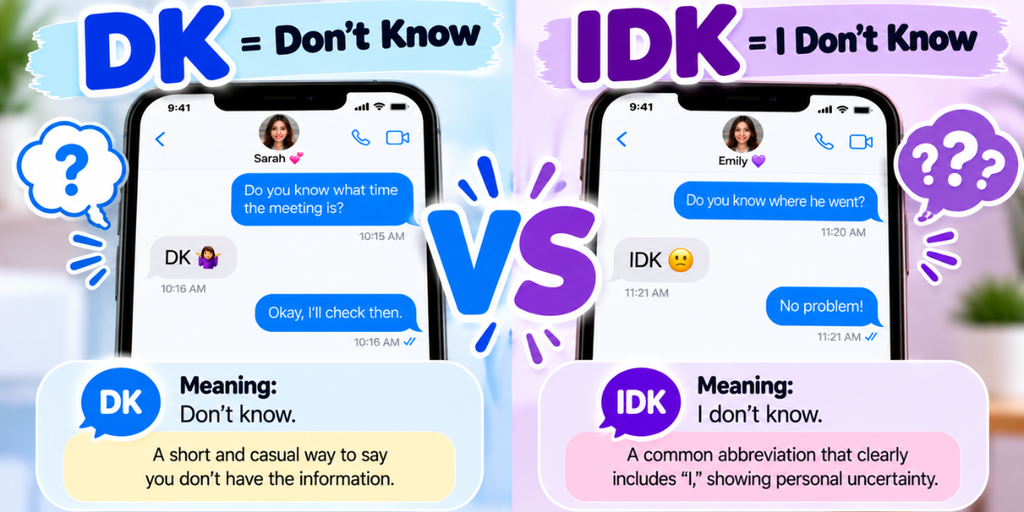
DK and IDK are closely related, but there is a small difference in their wording.
DK means “don’t know,” while IDK means “I don’t know.” Both are used to express uncertainty or a lack of information in casual conversations.
The main difference is that IDK includes the word “I,” making the meaning more explicit.
| Abbreviation | Full meaning | Example |
|---|---|---|
| DK | Don’t know | “DK where she went.” |
| IDK | I don’t know | “IDK where she went.” |
| IK | I know | “IK where she went.” |
| IDC | I don’t care | “IDC what we watch.” |
| TBH | To be honest | “TBH, I don’t know.” |
Which Is More Common: DK or IDK?
IDK is a widely recognized texting abbreviation because it clearly means “I don’t know.” DK is shorter, but it can sound less complete without context.
For example:
Friend: “Do you know where the party is?”
Reply 1: “IDK.”
Reply 2: “DK.”
Both replies communicate a lack of knowledge. However, IDK is more explicit, while DK is an abbreviated, informal response.
DK vs. IDC
It is especially important not to confuse DK with IDC.
DK means “don’t know,” while IDC means “I don’t care.”
For example:
You: “Which movie should we watch?”
Friend: “DK.”
Your friend does not know which movie to choose.
However:
Friend: “IDC, you choose.”
This means your friend does not care which movie you select.
The distinction matters because not knowing something is very different from not caring about it.
Real Text Message Examples Using DK
Now that you understand the meaning, let’s look at realistic examples of DK in everyday conversations.
Example 1: Asking About Someone’s Location
Alex: “Do you know where John is?”
Sam: “DK, I haven’t seen him today.”
Meaning: Sam does not know John’s location and provides a little extra information.
Example 2: Making Weekend Plans
Emma: “Are we going out on Saturday?”
Olivia: “DK yet. I’ll confirm tomorrow.”
Meaning: Olivia has not decided or does not have enough information to confirm the plans.
Example 3: Asking About a Movie
You: “What’s the name of that movie you watched?”
Friend: “DK, I forgot the name.”
Meaning: Your friend cannot remember the title.
Example 4: In a Group Chat
Friend 1: “Who is bringing snacks?”
Friend 2: “DK. Ask everyone.”
Meaning: The sender does not know who is bringing snacks and suggests checking with the group.
Example 5: Discussing School or Work
You: “When is the next assignment due?”
Classmate: “DK, check the course page.”
Meaning: Your classmate does not know the deadline and recommends checking the official information.
Example 6: Asking About a Social Media Video
You: “Where was this video filmed?”
Friend: “DK 😅”
Meaning: Your friend does not know the filming location. The emoji may add a casual or slightly embarrassed tone.
Example 7: Asking About a Decision
You: “Should we order pizza or burgers?”
Friend: “DK, you choose.”
Meaning: Your friend does not know which option to select and leaves the decision to you.
These examples show that DK is usually simple to interpret. In most situations, it communicates uncertainty without implying a particular emotion.
How to Respond When Someone Texts DK
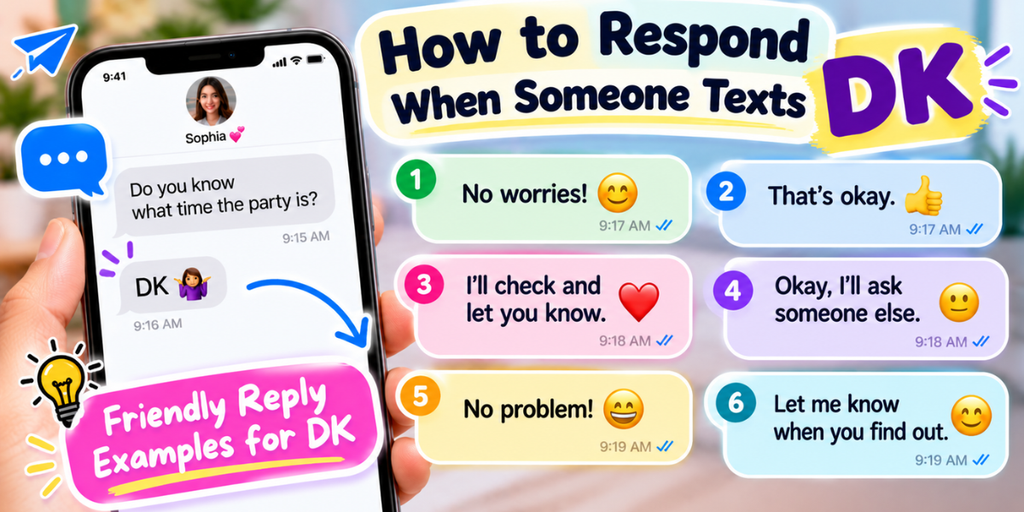
Your response should depend on the question you asked and whether you need a definite answer.
In many situations, a short, friendly reply is enough. However, if the information is important, you may need to ask a follow-up question or check another source.
1. Use a Friendly Response
If the person genuinely does not know, there is no need to make the conversation awkward.
You could reply:
- “No worries!”
- “That’s okay.”
- “Alright, thanks anyway.”
- “No problem, I’ll ask someone else.”
These responses work well in casual conversations because they acknowledge the answer without putting pressure on the sender.
2. Ask for Clarification
Sometimes, you need more information than the sender can provide.
For example:
You: “Do you know what time the event starts?”
Friend: “DK.”
Your reply: “Okay, do you know who might have the schedule?”
This response helps you find another way to get the answer.
3. Give Them Time to Find Out
If someone says they do not know yet, you can allow them to follow up later.
For example:
Friend: “DK yet. I’ll check.”
Your reply: “Sounds good. Let me know when you find out.”
This keeps the conversation friendly while making the next step clear.
4. Use a Professional Response at Work
If a coworker sends DK in a work chat, respond according to the importance of the information.
For example:
Coworker: “DK when the report will be ready.”
Your reply: “No problem. Let’s confirm the deadline with the project manager.”
This approach focuses on solving the problem rather than criticizing the abbreviation.
Can You Use DK in Professional Messages?
Although DK is useful in casual conversations, it is generally better to avoid it in formal emails, business proposals, and important workplace messages.
Professional communication benefits from complete sentences that clearly explain what you know and what you still need to confirm.
For example, instead of writing:
“DK when the order will arrive.”
You could write:
“I’m not sure when the order will arrive, but I’ll confirm the delivery date.”
Similarly, instead of replying “DK” to a manager’s question, you might say:
“I don’t have that information yet. I’ll check and get back to you.”
These alternatives sound clearer and more helpful. Furthermore, they show that you are willing to find the information rather than simply ending the conversation.
Of course, informal workplace chats can vary by team. If your colleagues regularly use abbreviations, DK may be understood. Nevertheless, complete wording is the safer choice when communicating with customers, managers, or people outside your organization.
Frequently Asked Questions About DK Meaning in Text
1. What does DK mean in text?
DK usually means “don’t know.” It is an informal abbreviation used when someone does not know an answer or is unsure about something.
2. What does DK stand for in texting?
In casual texting, DK stands for “don’t know.” The exact meaning can differ in specialized contexts, so consider the conversation before interpreting it.
3. Is DK the same as IDK?
They have nearly the same meaning. DK means “don’t know,” while IDK means “I don’t know.” Both express uncertainty, although IDK is more explicit.
4. Is DK considered slang?
DK is an informal texting abbreviation. People may describe it as slang because it is commonly used in casual online conversations rather than formal writing.
5. Is DK rude when someone texts it?
Not necessarily. DK usually communicates a lack of knowledge. However, it may sound blunt in a serious conversation if the sender provides no explanation or follow-up.
6. What does DK mean on WhatsApp?
On WhatsApp, DK generally means “don’t know.” It is used in casual messages when someone does not have the answer to a question.
7. What does DK mean on Snapchat?
DK on Snapchat usually means “don’t know.” The abbreviation has the same basic meaning as it does in ordinary text messages.
8. What does DK mean in gaming?
In gaming, DK can mean something specific to the game or community, including Donkey Kong. The correct interpretation depends on the discussion.
9. What is the difference between DK and IDC?
DK means “don’t know,” while IDC means “I don’t care.” The first expresses a lack of knowledge; the second expresses a lack of concern or preference.
10. How should I respond when someone says DK?
You can respond with “No worries,” “I’ll check,” or “Let me know when you find out.” If you need the information urgently, ask someone who can confirm it.
Final Thoughts on DK Meaning in Text
The DK meaning in text is usually simple: DK stands for “don’t know.” It is a casual abbreviation that people use when they do not have an answer, are unsure about something, or cannot provide the information someone needs.
However, the meaning can change in specific contexts. For example, DK may refer to Donkey Kong in gaming or Denmark’s country-code domain in website addresses. Therefore, always consider the surrounding conversation before deciding what the letters mean.
Additionally, remember that DK is not automatically rude or dismissive. A short reply may simply mean that the sender does not know the answer.
Ultimately, if you receive DK in an ordinary text message, “don’t know” is usually the best interpretation. If you need more information, ask a follow-up question and keep the conversation clear and friendly.
