
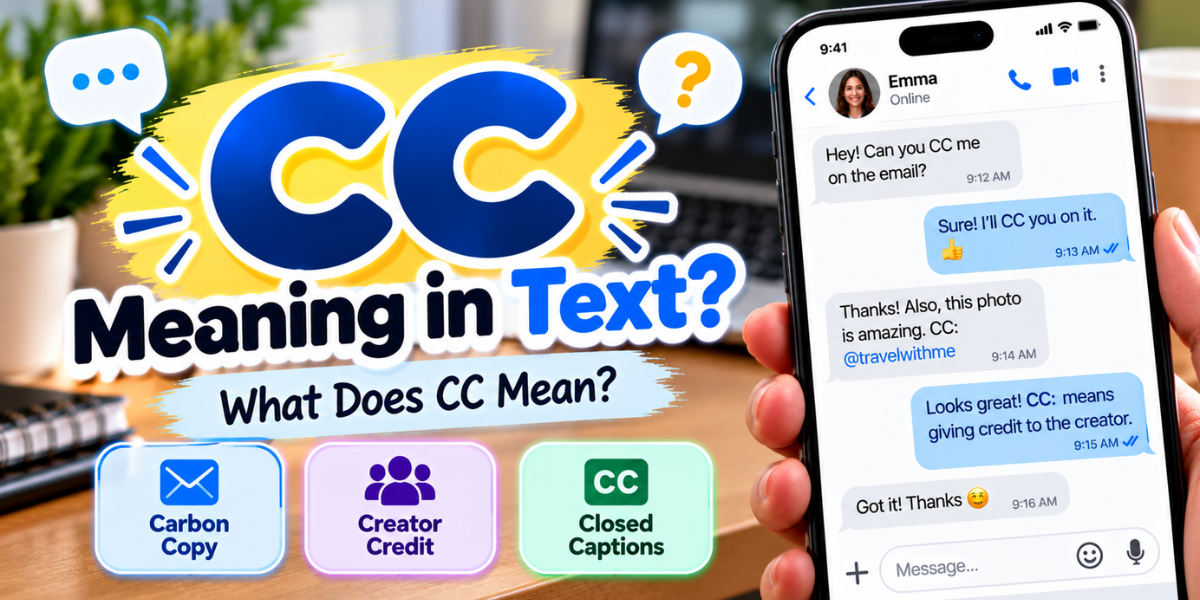
CC meaning in text Have you ever received a message containing “CC” and wondered what it means? You are not alone! The abbreviation CC can have different meanings depending on where and how someone uses it. For example, it commonly means “carbon copy” in emails, while on social media, it may refer to giving credit to the original creator. In videos, however, CC usually stands for “closed captions.”
So, what does CC mean in text messages? The answer depends on the conversation and the platform. Although CC is not always traditional texting slang, people frequently use it in digital communication, online posts, emails, and comments.
In this guide, you will discover the most common meanings of CC, how to understand it in different situations, and how to respond when someone uses it. Additionally, you will find practical examples, related abbreviations, and answers to frequently asked questions.
Let’s explore everything you need to know about CC!
What Does CC Mean in Text?
In text messages and online communication, CC most commonly refers to “carbon copy,” “credit,” or “closed captions,” depending on the context. However, its meaning can change between email conversations, social media posts, and video platforms.
For instance, someone might write “I’ll CC you on the email” when they want to include you in an email conversation. Meanwhile, a social media user might write “CC: @username” to acknowledge the person who created a picture, video, or idea.
Similarly, if you see a CC button on a video player, it generally allows you to turn captions on or off.
What Does CC Stand For?
CC traditionally stands for carbon copy. The term comes from the carbon paper that people once used to create duplicate copies of written documents.
Today, the abbreviation is widely associated with email communication. Nevertheless, it also has other meanings in modern digital environments.
Here are the most common interpretations:
- Carbon Copy: Including another person in an email conversation.
- Creator Credit: Acknowledging the person who originally created content.
- Closed Captions: Displaying spoken dialogue and relevant sounds as text in a video.
- Credit Card: Referring to a payment card in certain conversations.
- Cubic Centimeters: Describing engine displacement or volume in technical contexts.
Therefore, you should not assume that CC always has the same meaning. Instead, look at the surrounding words, the platform, and the purpose of the message.
Why Does CC Have Different Meanings?
Many abbreviations develop multiple meanings because people use them in different situations. CC is a good example of this process.
In professional communication, it usually refers to email recipients. On social media, it may indicate content credit. Likewise, on video platforms, it commonly relates to captions.
Consequently, the easiest way to understand CC is to consider the situation in which it appears.
What Does CC Mean in an Email?
In email communication, CC stands for carbon copy. It allows you to send a copy of an email to additional recipients while keeping their email addresses visible to the other recipients who can see the message.
For example, imagine that you are sending an important business update to your manager. You might also want your colleague to know about the discussion. In this case, you can add your colleague to the CC field.
As a result, your colleague receives the email and can follow the conversation without necessarily being the main person responsible for responding.
What Happens When You CC Someone?
When you add someone to the CC field, that person receives a copy of the email. Their address is generally visible to the other recipients, including those in the To and CC fields.
However, CC does not automatically mean that the person must reply. Instead, it often keeps them informed about a conversation or decision.
For example:
You: “I’ll CC you when I send the project update.”
Meaning: “I’ll include you as an additional recipient so you can see the email.”
Another example is:
Colleague: “Please CC Sarah on the report.”
Meaning: “Please include Sarah in the email so she receives a copy.”
Therefore, CC is especially useful for workplace updates, project discussions, announcements, and other communications where several people need the same information. CC meaning in text
When Should You Use CC in an Email?
You can use CC when someone needs to stay informed but is not necessarily the primary recipient.
Common situations include:
- Keeping a manager informed about a project.
- Including a colleague in a customer-related discussion.
- Sharing meeting details with relevant team members.
- Keeping another department updated on a decision.
- Ensuring that a supervisor can follow an important conversation.
Nevertheless, use CC thoughtfully. Adding unnecessary recipients can create clutter and expose their email addresses to others. If privacy is important, consider using BCC instead.
What Is the Difference Between CC and BCC?
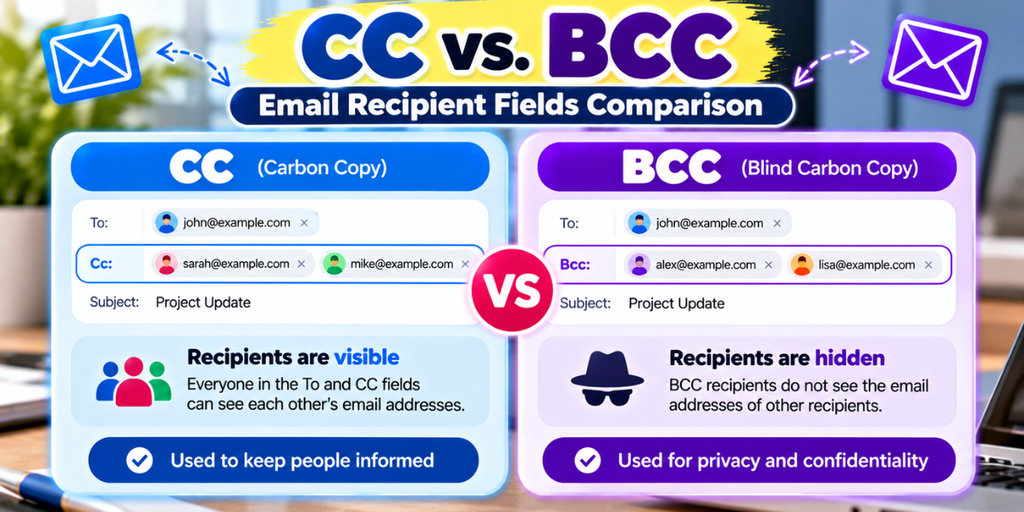
CC and BCC both allow you to send an email to additional people. However, there is one important difference: BCC hides the addresses of its recipients from other recipients.
| Feature | CC | BCC |
|---|---|---|
| Full form | Carbon Copy | Blind Carbon Copy |
| Recipient receives the email | Yes | Yes |
| Address visible to other recipients | Generally yes | No |
| Common purpose | Keeping people informed openly | Sending copies privately |
| Example | Including a teammate in a project update | Sending an announcement while protecting recipient privacy |
For example, if you CC three colleagues, they can generally see one another’s addresses. In contrast, if you BCC those colleagues, their addresses are hidden from the other recipients.
As a result, choose the option that best suits your communication needs and privacy requirements.
What Does CC Mean on Social Media?

On social media, CC may mean giving credit to a content creator or acknowledging the person associated with a post. However, this usage is informal, and CC does not have one universally accepted meaning across every platform.
You may encounter it in captions, comments, video descriptions, or posts that share another person’s work. CC meaning in text
For example, someone might publish a photograph and write:
“Beautiful photography! CC: @alexcreates”
In this example, the person may be crediting the photographer. Nevertheless, because social media conventions vary, the exact meaning should be understood from the surrounding content.
What Does CC Mean on Instagram?
On Instagram, CC may be used to acknowledge a creator, photographer, or other person associated with a picture or video.
For example:
“Loved this outfit inspiration! CC: @fashiondaily”
The poster may be identifying the account that inspired the post or deserves credit. However, CC is not an official Instagram feature with one fixed definition, so the intended meaning depends on the user’s wording.
If someone tags you with CC, check the caption and the content itself. They might be acknowledging your contribution, referencing your work, or including you in a conversation.
What Does CC Mean on TikTok?
On TikTok, CC may appear in video captions, comments, or descriptions when users want to acknowledge a creator or source. CC meaning in text
For instance:
“Loved this edit! CC to the original creator.”
Here, CC indicates that the original creator should receive recognition.
However, TikTok users may also use CC in other ways. In a video-player context, CC can refer to closed captions rather than creator credit.
Therefore, distinguish between a social media caption and a video accessibility setting before deciding what the abbreviation means.
What Does CC Mean in a Social Media Comment?
The meaning of CC in a comment depends on the conversation.
Consider these examples:
- “CC: @maria” — This may credit or acknowledge Maria.
- “Can you CC me in the email?” — This refers to carbon copy.
- “Turn on CC if you need captions.” — This refers to closed captions.
As you can see, the same two letters can serve different purposes. For that reason, the surrounding words are often more useful than the abbreviation alone.
Helpful tip: If you are unsure whether CC means creator credit, ask the person what they intended. It is better to clarify than to assume.
What Does CC Mean in Videos?
When you see a CC button on a video player, it usually stands for closed captions. These captions display spoken dialogue and may also describe relevant sounds, such as music, laughter, or background noise.
Closed captions help viewers follow videos when they cannot hear the audio clearly or prefer to read along. They can also support people who are deaf or hard of hearing.
For example, YouTube and many other video platforms provide caption controls when captions are available.
Why Are Closed Captions Useful?
Closed captions make video content more accessible and easier to follow in different environments.
For example, you might watch a video on a bus without headphones. Alternatively, you may be viewing content in a noisy room where hearing every word is difficult. CC meaning in text
In these situations, captions can help you understand the message without relying entirely on sound.
They are also useful when watching videos in a language you are learning, although caption accuracy and language availability can vary.
What Is the Difference Between CC and Subtitles?
CC and subtitles both display text associated with video content. However, they are not always identical.
| Feature | Closed Captions (CC) | Subtitles |
|---|---|---|
| Spoken dialogue | Usually included | Usually included |
| Relevant sound descriptions | May be included | Often omitted |
| Main accessibility purpose | Helps viewers who cannot hear all audio | Often helps viewers understand dialogue or another language |
| Example | “[Door slams] Where are you?” | “Where are you?” |
The distinction can vary by platform and content provider. Nevertheless, closed captions generally include additional information about important sounds, whereas subtitles often focus primarily on spoken dialogue.
Therefore, if you see CC next to a video, it usually refers to the captioning feature rather than texting slang.
Read More: What Does IFY Meaning in Text? Slang, Examples & Replies
Other Meanings of CC
Although carbon copy, creator credit, and closed captions are common interpretations, CC can have other meanings in specific situations.
The key is to avoid applying a technical definition to an ordinary conversation or assuming that an informal abbreviation has the same meaning everywhere. CC meaning in text
CC Meaning as Credit Card
In financial conversations, CC can stand for credit card.
For example:
“Can I pay with CC?”
This means:
“Can I pay with a credit card?”
Similarly, someone might write “CC payment” when discussing a payment made by credit card.
However, this interpretation is more likely in a conversation about shopping, banking, bills, or payment methods than in a casual chat about someone’s day. CC meaning in text
CC Meaning as Cubic Centimeters
In technical contexts, cc can mean cubic centimeters, a unit used to measure volume.
It frequently appears in discussions about motorcycles, cars, engines, and certain medical measurements.
For example:
“My bike has a 150 cc engine.”
This describes an engine displacement of approximately 150 cubic centimeters.
In this context, cc is a measurement rather than a texting abbreviation. The meaning is usually clear because the conversation involves engines, equipment, or volume.
CC in Gaming and Other Online Communities
In gaming, CC can stand for crowd control. It refers to abilities or effects that restrict an opponent’s movement or actions.
For example, a player might say:
“Use your CC before the boss attacks.”
In this case, the player is talking about a gameplay strategy rather than email recipients or social media credit.
Likewise, certain professional or specialist communities use CC for other terms. Consequently, context remains essential whenever you encounter an unfamiliar abbreviation.
CC Meaning in Real Text Message Examples
The best way to understand CC is to see how people might use it in everyday communication. The following examples demonstrate several common interpretations.
Example 1: CC in a Work Conversation
Person A: “Did you send the client report?”
Person B: “Yes, and I CC’d you so you can review it.”
Meaning: Person B included Person A as an additional email recipient.
Example 2: Asking Someone to Include a Colleague
Person A: “Please CC Daniel on the meeting email.”
Person B: “Sure, I’ll add him.”
Meaning: Person A wants Daniel to receive a copy of the email.
Example 3: CC as Creator Credit
Person A: “Who made this amazing edit?”
Person B: “CC: @creativealex in the caption.”
Meaning: Person B appears to be identifying or crediting the creator. Because social media usage varies, the exact intention depends on the post.
Example 4: CC in a Video Conversation
Person A: “I can’t hear the dialogue properly.”
Person B: “Try turning on CC.”
Meaning: Person B recommends enabling closed captions.
Example 5: CC as Credit Card
Person A: “What payment methods do they accept?”
Person B: “They accept cash and CC.”
Meaning: CC refers to a credit card.
Example 6: CC in a Gaming Chat
Person A: “Why couldn’t the enemy move?”
Person B: “Our character used CC.”
Meaning: CC refers to crowd control, an effect that restricts an opponent’s actions.
Example 7: CC in a Motorcycle Discussion
Person A: “What size engine does your bike have?”
Person B: “It’s a 200 cc model.”
Meaning: CC refers to cubic centimeters, a unit used to describe engine displacement.
Example 8: CC in a Social Media Caption
Person A: “Can I share your photograph?”
Person B: “Yes, but please mention me for credit.”
Meaning: This conversation explains the idea of creator credit. Although someone might use CC in a related caption, writing the request clearly helps avoid confusion.
These examples show why context matters. Before interpreting CC, consider the topic, the platform, and the words surrounding the abbreviation.
How Should You Respond When Someone Uses CC?
Your response should depend on what the person means. Fortunately, you usually do not need to make the conversation complicated. CC meaning in text
If someone uses CC in an email-related discussion, acknowledge the request or confirm that you understand.
For example:
Message: “I’ll CC you on the email.”
Possible response: “Thanks! I’ll keep an eye out for it.”
If someone asks you to CC another person, you could reply:
“Sure, I’ll include them.”
On the other hand, if someone uses CC in a social media caption to acknowledge your work, a simple thank-you may be appropriate.
For example:
“Thanks for the credit! I appreciate it.”
If you see CC on a video, you generally do not need to respond at all. Simply enable the captions if you want to use them.
What If You Don’t Understand CC?
If the context is unclear, asking a short question is perfectly reasonable.
You could say:
- “What do you mean by CC here?”
- “Do you mean carbon copy?”
- “Are you referring to closed captions?”
- “Does CC mean credit in this post?”
These questions help you understand the intended meaning without making assumptions.
Similarly, if you are using CC yourself, consider spelling it out the first time in an unfamiliar conversation. Clear communication is particularly important in professional emails and situations where misunderstandings could cause problems.
Common Mistakes People Make About CC
Although CC is a short abbreviation, people sometimes misunderstand how it works.
Here are a few common mistakes to avoid.
1. Assuming CC Always Means Carbon Copy
Carbon copy is a widely recognized meaning, especially in email. Nevertheless, CC can also refer to captions, creator credit, credit cards, and other context-specific terms. CC meaning in text
Therefore, always consider the situation before interpreting it.
2. Confusing CC With BCC
CC recipients are generally visible to other recipients, whereas BCC recipients are hidden from them. This distinction matters when sending messages that involve private or sensitive recipient information.
3. Assuming CC Always Means Giving Credit
Some social media users use CC to acknowledge creators. However, this is an informal convention rather than a universal rule. Check the caption or ask the poster if the meaning is uncertain.
4. Treating Closed Captions as Ordinary Slang
When CC appears as a video-player control, it normally refers to closed captions. It is a feature designed to display text associated with the audio, not necessarily an abbreviation used in a chat message.
5. Using Abbreviations Without Enough Context
Short forms save time, but they can also confuse readers. For example, sending only “CC” without explaining what you need might leave someone guessing.
Instead, write a clear message such as “Please CC me on the email” or “Please add closed captions to the video.”
Frequently Asked Questions About CC
1. What does CC mean in text?
CC can mean carbon copy, creator credit, or closed captions, depending on the context. In email-related conversations, carbon copy is especially common. On social media, it may refer to crediting a creator, while in videos it usually means closed captions.
2. What does CC stand for?
CC most traditionally stands for carbon copy. However, it can also stand for closed captions, credit card, cubic centimeters, and crowd control in particular contexts.
3. What does CC mean in an email?
In an email, CC stands for carbon copy. It allows you to send a copy of a message to additional recipients, whose addresses are generally visible to the other recipients.
4. What does CC mean on Instagram?
On Instagram, CC may refer to giving credit to a creator or acknowledging someone associated with a post. Nevertheless, it is not a fixed platform-wide definition, so you should check the caption and surrounding context.
5. What does CC mean on TikTok?
On TikTok, CC may refer to creator credit in a caption or comment. Alternatively, when used as a video-player control, CC generally stands for closed captions.
6. Does CC mean closed captions?
Yes. In videos, CC usually stands for closed captions. These display spoken dialogue and may also include descriptions of relevant sounds.
7. What is the difference between CC and BCC?
CC stands for carbon copy, while BCC stands for blind carbon copy. CC recipients are generally visible to other recipients, whereas BCC recipients’ addresses are hidden from them.
8. Does CC mean credit card?
Yes. In financial or shopping conversations, CC can stand for credit card. For example, “Do you accept CC?” usually means “Do you accept credit cards?” when discussing payment.
9. What does 150 cc mean?
In an engine-related conversation, 150 cc means 150 cubic centimeters of engine displacement. It is a technical measurement, not a texting slang term.
10. Is CC a slang word?
CC is primarily an abbreviation rather than a traditional slang word. Its meaning depends on the setting, including email communication, social media, video captions, gaming, and technical discussions.
11. How do I know which meaning of CC someone intends?
Look at the surrounding words and the subject of the conversation. Email discussions usually point to carbon copy, video controls indicate closed captions, and social media captions may suggest creator credit. If you are still unsure, ask the person to clarify. CC meaning in text
12. How should I reply when someone says they will CC me?
A simple response such as “Thanks, I’ll look out for it” works well. If the person is asking you to include another recipient, you can say, “Sure, I’ll add them to the email.”
Final Thoughts on CC Meaning in Text
So, what does CC mean in text? It depends on the context. In email communication, CC usually means carbon copy. On social media, it may refer to giving credit to a creator. Meanwhile, in videos, CC commonly stands for closed captions.
The abbreviation can also mean credit card, cubic centimeters, or crowd control in specific situations. Therefore, understanding the conversation is the best way to identify its intended meaning.
Ultimately, you do not need to memorize every possible definition. Instead, pay attention to the platform, the surrounding words, and the topic being discussed. If the meaning is still unclear, simply ask for clarification.
Now that you understand CC, you can recognize it more confidently in text messages, emails, social media posts, and online conversations.
