

legal rights in everyday situations Everyday life involves more legal situations than most people realize. You may enter into a contract when signing up for a phone plan, exercise consumer rights when purchasing a product, or rely on workplace protections when starting a new job. Similarly, renting a home, making an online purchase, sharing personal information, or dealing with authorities can all involve legal rights and responsibilities.
Understanding your legal rights does not mean you need to become a lawyer. Instead, it means knowing the basics, keeping important records, asking the right questions, and understanding when professional legal advice may be necessary.
Because laws vary between countries, states, provinces, and local jurisdictions, a right that applies in one location may not apply in exactly the same way somewhere else. Therefore, always verify specific legal requirements with an appropriate official source or qualified legal professional.
What Are Legal Rights?
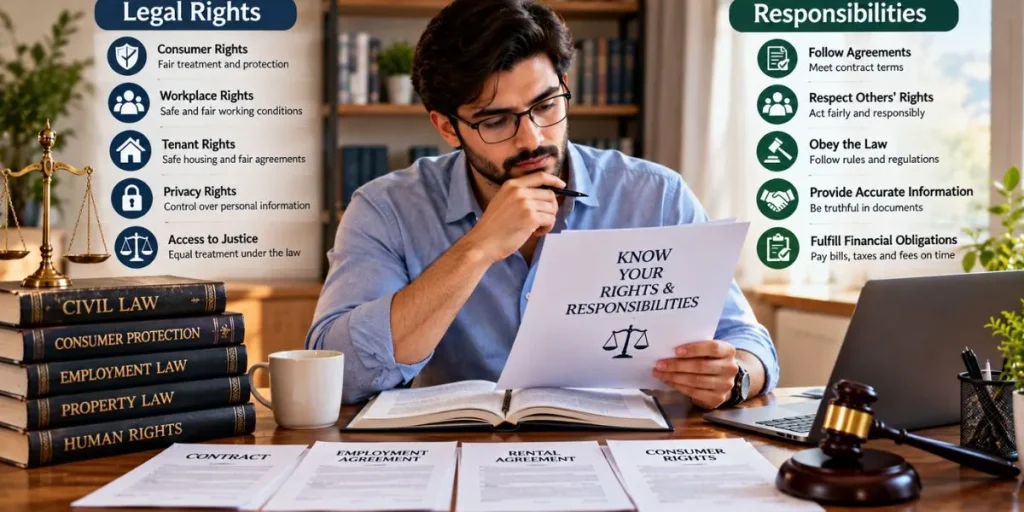
Legal rights are protections, freedoms, or entitlements recognized and enforced by law. They can apply to many areas of life, including employment, housing, consumer transactions, privacy, contracts, transportation, and personal safety.
At the same time, legal rights come with responsibilities. For example, you may have protections as a consumer, but you may also be expected to follow the terms of a valid agreement. Likewise, employees have workplace protections while also having responsibilities under employment policies and applicable laws.
In simple terms, understanding your legal rights helps you make more informed decisions.
Legal Rights vs. Legal Responsibilities
A legal right generally describes something the law allows, protects, or entitles you to. A legal responsibility, on the other hand, describes something you are required to do or avoid doing.
Understanding both sides is important. Knowing only your rights without understanding your responsibilities can lead to confusion or unnecessary disputes.
Why Laws Differ by Location
One of the most important things to remember is that laws are not universal. Consumer protection, employment rules, rental regulations, police procedures, privacy protections, and legal deadlines can vary significantly by jurisdiction.
Consequently, online legal information should be treated as general educational information unless it specifically applies to your location.
Why Understanding Your Legal Rights Matters
Knowing your basic legal rights can help you recognize when you need additional information or assistance. It can also help you avoid preventable mistakes.
For instance, reading a contract before signing it may help you understand cancellation requirements. Keeping receipts may make it easier to resolve a consumer dispute. Similarly, maintaining employment records can be useful if a workplace disagreement develops.
Most importantly, legal awareness gives you a better starting point when something goes wrong.
You do not have to memorize every law. Instead, focus on knowing where to find reliable information and when to seek professional help.
Know Your Rights as a Consumer
Almost everyone is a consumer. You purchase food, clothing, electronics, services, subscriptions, transportation, and countless other products throughout your life.
Consumer protection laws may provide certain rights concerning defective products, misleading advertising, warranties, refunds, repairs, replacements, and unfair business practices. However, the exact protections and remedies depend on local law and the type of transaction.
Keep Receipts and Purchase Records
Keep receipts, invoices, order confirmations, warranty documents, and relevant communications whenever practical.
These records can provide useful evidence if you need to question a charge, return a product, make a warranty claim, or resolve a dispute.
Understand Return and Refund Policies
Before making an expensive purchase, check the seller’s return, cancellation, and refund policies. Do not automatically assume that every purchase can be returned simply because you changed your mind.
Instead, understand the terms before completing the transaction.
Understand Contracts Before You Sign

Contracts are part of everyday life. You may encounter them when renting a home, accepting employment, purchasing insurance, joining a gym, taking a loan, subscribing to a service, or signing up for telecommunications.
Before signing a contract, take time to understand what you are agreeing to.
Pay particular attention to:
- Payment requirements
- Contract duration
- Cancellation rules
- Automatic renewal
- Fees and penalties
- Notice requirements
- Dispute procedures
- Responsibilities of each party
Read the Fine Print
Although reading a long agreement may seem inconvenient, it can prevent unpleasant surprises later.
If something is unclear, ask questions before signing. Furthermore, if the agreement involves significant money, property, long-term obligations, or complicated legal terms, consider asking a qualified legal professional to review it.
Know Your Rights at Work
Employment is another area where legal rights and responsibilities can become important.
Depending on your jurisdiction, employment laws may address issues such as wages, working hours, workplace safety, discrimination, harassment, leave, contracts, and termination.
However, workplace protections differ considerably between locations.
Keep Employment Records
Maintain copies of important employment documents, including your contract, payslips, relevant policies, schedules, and significant workplace communications.
If a disagreement occurs, a clear written record can help establish what happened and when.
Document Workplace Problems
If you experience a serious workplace issue, record relevant facts rather than relying only on memory. Include dates, communications, witnesses where appropriate, and copies of supporting documents.
If the situation involves potential discrimination, harassment, unpaid wages, termination, or another serious concern, consider obtaining advice from an appropriate employment authority or qualified legal professional.
Understand Your Rights as a Tenant
Renting a home can involve important legal protections for both tenants and landlords.
Rental laws may cover issues such as security deposits, repairs, property conditions, privacy, rent payments, notices, and eviction procedures.
Because these rules vary significantly by location, never assume that a rule you found online applies to your rental agreement.
Read Your Rental Agreement Carefully
Before moving into a property, understand the rent, deposit, maintenance responsibilities, notice requirements, restrictions, and other important terms.
Keep a copy of the signed agreement for your records.
Document the Property’s Condition
Photographs or videos taken at the appropriate time can help document the condition of a rental property.
Also, keep records of repair requests, rent payments, notices, and important communications with the landlord or property manager.
Protect Your Privacy and Personal Information
Your personal information has become an important part of everyday legal and digital life.
Websites, apps, employers, financial institutions, retailers, and other organizations may collect different types of information depending on the service and applicable law.
Privacy rules can address matters such as collecting, storing, using, sharing, correcting, or deleting personal information. However, the specific rights available to you depend on the applicable legal framework.
Be Careful With Sensitive Information
Think carefully before sharing identification documents, financial information, passwords, or other sensitive personal details.
Additionally, review privacy settings and understand what information an app or website requests before accepting its terms.
Know Your Rights When Dealing With Authorities

Interactions with police and other authorities can raise important legal questions.
Rules concerning identification, questioning, searches, detention, arrest, traffic stops, and legal representation vary significantly between jurisdictions.
Therefore, avoid relying on broad statements about police powers or individual rights without checking the law where you live.
Stay Calm and Pay Attention
During an official encounter, remain calm and pay attention to what you are being asked to do.
If you do not understand the situation, ask appropriate questions. If the matter is serious, complicated, or potentially criminal, obtaining qualified legal advice can be especially important.
Understand Your Rights After a Car Accident
A traffic accident can quickly become stressful. However, taking sensible steps can help protect your safety and preserve important information.
Where appropriate and safe, you may need to:
- Seek medical attention
- Contact emergency services
- Exchange relevant information
- Photograph the scene and damage
- Identify witnesses
- Notify your insurer
- Keep medical and repair records
Do not assume that you already know who is legally responsible for an accident. Liability can depend on the facts, evidence, insurance arrangements, and applicable law.
Know Your Rights With Online Purchases
Online shopping has created new everyday legal questions.
Before purchasing something online, check the seller’s identity, pricing, delivery terms, refund policy, cancellation conditions, and subscription details.
After purchasing, save your order confirmation, receipts, delivery information, and relevant communications.
Watch for Automatic Renewals
Free trials and subscription services may automatically renew under certain terms. Therefore, check the renewal conditions before entering payment information.
If you notice an unauthorized transaction, contact the relevant payment provider or financial institution promptly and keep records of your communications.
May You Like To Read More: 15+ Ways to Create a More Balanced and Meaningful Life
Protect Yourself When Signing Digital Agreements
Many modern contracts are accepted with a simple click.
Terms of service, app agreements, subscription contracts, privacy notices, and electronic agreements can contain important information about your obligations.
Although you may not need to read every word of every agreement, pay particular attention to costs, cancellation procedures, automatic renewals, data practices, and dispute provisions.
A few minutes of attention can sometimes prevent a much bigger problem later.
Learn How to Document a Legal Problem
Good documentation can be extremely valuable when dealing with an everyday legal dispute.
Depending on the situation, keep copies of:
- Contracts
- Receipts
- Emails
- Text messages
- Payment records
- Photos
- Videos
- Official notices
- Letters
- Medical records
- Insurance documents
Also, consider creating a simple timeline that records important dates and events.
Most importantly, preserve original records and avoid altering documents or communications that may later become relevant.
What Should You Do If You Think Your Rights Were Violated?
If you believe your legal rights may have been violated, avoid making an immediate decision based solely on emotion.
Instead, consider these general steps:
- Stay calm and assess what happened.
- Identify the agreement, rule, or law that may apply.
- Gather relevant documents and evidence.
- Check an authoritative source for your jurisdiction.
- Contact the relevant company, organization, or authority when appropriate.
- Consider formal complaint or dispute-resolution procedures.
- Seek qualified legal advice if the issue is serious or complicated.
This approach can help you move from frustration to a clearer understanding of your options.
When Should You Seek Legal Advice?
Not every disagreement requires a lawyer. Many minor disputes can potentially be resolved directly with a business, employer, landlord, insurer, or relevant organization.
However, professional legal advice may be particularly important when:
- A significant amount of money is involved
- You receive an important legal notice
- You face criminal allegations
- You suffer a serious injury
- Property ownership is disputed
- A major contract is involved
- Your employment is terminated under disputed circumstances
- A legal deadline is approaching
- You are unsure about your obligations
- The consequences of making a mistake could be significant
Getting advice early can sometimes help you understand your options before a situation becomes more complicated.
How to Find Reliable Legal Information
The internet contains enormous amounts of legal information, but not all of it is accurate or relevant to your situation.
Whenever possible, prioritize:
- Government websites
- Courts and official legal resources
- Regulatory agencies
- Consumer-protection organizations
- Legal-aid organizations
- Qualified lawyers and licensed legal professionals
Be Careful With Social Media Legal Advice
A short social media video may sound convincing while leaving out important facts or jurisdictional differences.
Therefore, use online content as a starting point rather than automatically treating it as legal advice.
Also, check when an article was published or updated. Laws and regulations can change.
Common Legal Mistakes to Avoid
Many everyday legal problems become more difficult because people overlook simple precautions.
Try to avoid:
Signing Without Reading
Do not sign important agreements without understanding the major terms.
Ignoring Important Notices
Legal, employment, housing, insurance, or financial notices may contain deadlines that matter.
Failing to Keep Records
Save important documents, receipts, agreements, and communications.
Waiting Too Long to Get Help
Some legal matters have deadlines. If you are unsure, investigate promptly.
Assuming Another Person’s Experience Applies to You
Two people can face seemingly similar situations but have different legal outcomes because their contracts, locations, facts, or applicable laws differ.
Frequently Asked Questions About Everyday Legal Rights
What legal rights should everyone know?
People should understand basic rights and responsibilities related to contracts, consumer transactions, employment, housing, privacy, online purchases, financial services, and interactions with authorities. The exact protections depend on local law.
How can I find out what my legal rights are?
Start with official government, court, regulatory, or consumer-protection resources for your jurisdiction. For complicated matters, consider speaking with a qualified legal professional.
What should I do if I think my rights have been violated?
Document what happened, preserve relevant records, identify the applicable jurisdiction, and research reliable legal information. If the matter is serious, seek professional legal advice.
Do I need a lawyer for every legal problem?
No. Some everyday disputes can be handled directly or through formal complaint and dispute-resolution procedures. However, serious or complicated matters may require professional advice.
Why is documentation important?
Documents can help establish what was agreed, what happened, when events occurred, and what communications took place. Good records can therefore make a dispute easier to understand and resolve.
Conclusion: Know Your Rights, Responsibilities, and Options
Understanding your legal rights in everyday situations does not require you to know every law. Instead, it requires awareness, careful decision-making, and a willingness to find reliable information when something important happens.
Read contracts before signing them. Keep records of important transactions. Understand your workplace and rental documents. Protect your personal information. Be cautious with online agreements, purchases, and subscriptions. Furthermore, know when an everyday disagreement has become serious enough to require professional legal advice.
Most importantly, remember that legal rights vary by jurisdiction. What applies in one country or region may not apply somewhere else.
By becoming more legally aware, you can make better-informed decisions, recognize when additional help may be needed, and approach everyday legal situations with greater confidence and preparation.
Disclaimer: This article provides general educational information and is not legal advice. Laws and legal procedures vary by jurisdiction and can change over time. For advice about a specific situation, consult a qualified legal professional or an appropriate official authority in your location.
