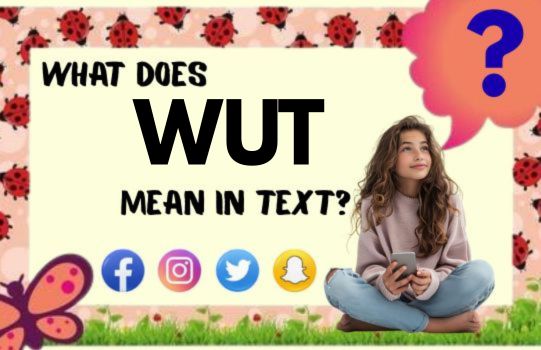
Three letters, zero punctuation, and somehow it communicates everything perfectly. If you have ever wondered what does WUT mean in text, you are asking exactly the right question. It is one of those spellings that looks like a typo at first glance but is absolutely, intentionally not one.
People use it constantly across text messages, Instagram comments, Snapchat replies, and TikTok threads. It is everywhere once you start noticing it. Understanding what does WUT mean in text goes deeper than just knowing the definition. It is about understanding the attitude, the energy, and the emotion packed into that deliberate misspelling. This article is going to walk you through all of it clearly and simply.
What Does WUT Mean in Text? 💬
Let us get straight to the point.
What does WUT mean in text has a simple core answer: WUT means “What.” That is the literal translation. But the way it is spelled changes everything about how it lands in a conversation.
When someone types WUT instead of WHAT, they are not making a spelling error. They are making a stylistic choice. They are expressing a heightened reaction, a more exaggerated version of the word that carries surprise, disbelief, humor, or dramatic emphasis depending on the moment.
Think of it this way. “What?” is a question. “WUT?” is a whole mood.
Why Do People Spell “What” as “WUT”? 🤔
This is where it gets genuinely interesting.
The shift from WHAT to WUT is a classic example of expressive spelling in digital communication. People instinctively modify spelling to inject emotion into written text the same way voice tone does in spoken conversation.
When you type in all caps or stretch a word out, you are doing the same thing. WUT is just a more specific and culturally recognized version of that impulse.
It also sounds slightly different when you read it in your head. WUT has a blunter, more abrupt quality than WHAT. That bluntness is actually the point. It hits harder. It reads funnier. It communicates shock or confusion with a personality that the standard spelling simply cannot deliver.
Over time that stylistic choice became its own recognized term with its own cultural identity in digital slang.
Emotional Tone Behind WUT 💭
1. Surprise 😲
The most common emotional driver behind WUT is genuine surprise.
Someone tells you unexpected news, shares something you never saw coming, or drops a piece of information that temporarily short-circuits your response. Your fingers type WUT before your brain has fully processed the situation.
It is fast, instinctive, and perfectly communicates that the information caught you completely off guard. This version of WUT shows up in conversations multiple times a day for most active texters.
2. Playful Confusion 😄
Not every WUT is serious. A lot of the time it is just lighthearted and fun.
Your friend sends a completely unhinged meme at midnight. Your sibling texts you something that makes zero logical sense. Your group chat starts a conversation that spirals into pure chaos. The natural response to all of these is a cheerful, unbothered WUT.
There is warmth in this version. It is not dismissive or annoyed. It is genuinely delighted by the absurdity of whatever just happened.
3. Dramatic Reaction 🎭
Sometimes people use WUT purely for theatrical effect.
The information does not even have to be that surprising. But leaning into the drama of the moment by firing back WUT makes the conversation more entertaining and expressive. It amplifies the reaction deliberately.
This version is especially common among people who have a naturally dramatic texting style and use expressive slang as a core part of their communication personality.
4. Mild Disbelief 🙄
Then there is the quieter, more skeptical WUT.
Someone says something questionable. A claim that does not quite add up. A story that sounds slightly too convenient to be true. This WUT carries a raised eyebrow energy. It is not quite calling someone out but it is definitely not fully buying in either.
It sits somewhere between “I am not sure I believe you” and “please explain yourself immediately.”
WUT in Different Messaging Platforms 📱
WUT in Text Messages 💬
In direct text message exchanges, WUT tends to be raw and spontaneous.
It is a gut reaction. Something lands in your chat, your fingers respond immediately, and WUT is what comes out. There is very little filter involved. That is actually part of what makes it feel so genuine in a personal conversation.
WUT on Instagram 📸
On Instagram, WUT lives primarily in comment sections and story replies.
Someone posts something unexpected, shares wild news in their caption, or puts up a story that genuinely baffles their followers. The comment section fills up with WUTs almost immediately. It functions as a collective reaction, a shared expression of disbelief or humor that bonds the audience together around a single moment.
WUT on Snapchat 👻
Snapchat is built around spontaneous reaction and WUT fits that format perfectly.
Someone snaps you something bizarre or unexpected and your immediate reply is WUT. The ephemeral nature of the platform actually makes the response feel even more reactive and genuine because everything on Snapchat happens in real time with minimal overthinking.
WUT on TikTok 🎵
TikTok is probably where WUT gets the most visible workout.
Comment sections under unexpected videos, plot twist reveals, and genuinely shocking content are flooded with WUTs. It has become almost a standardized reaction on the platform, a shorthand that the entire TikTok community recognizes instantly as a marker of genuine surprise or entertained confusion.
Is WUT Considered Slang? 🏷️
Yes, absolutely. WUT is classified as internet slang and more specifically as a form of expressive or phonetic spelling.
It is not a new word with its own independent meaning. It is a deliberate stylistic transformation of an existing word designed to communicate a specific emotional quality that the original spelling does not carry on its own.
Linguists who study digital communication categorize this kind of spelling variation as part of the natural evolution of written language in informal digital spaces. It is creative, intentional, and culturally coded. That makes it slang by every meaningful definition of the term.
When Should You Use WUT? ✅
Use WUT when you want to express genuine surprise without writing a whole sentence about it.
Use it when something genuinely catches you off guard, when a conversation takes an unexpected turn, or when you want to react to something absurd in a way that sounds human and natural rather than stiff.
It works best in casual conversations with people you already have a relaxed dynamic with. The more comfortable the relationship, the more naturally WUT fits.
Avoid it in serious conversations where your actual comprehension of something needs to be clear. And skip it entirely in professional settings where miscommunication carries real consequences.
WUT vs WHAT — Is There a Difference? 🆚
On the surface they mean the same thing. But in practice they feel completely different.
WHAT is neutral. It asks for clarification or information without adding emotional texture. It is clean, standard, and appropriate in almost any setting.
WUT is loaded. It carries surprise, humor, drama, or disbelief baked right into the spelling. It is expressive in a way that WHAT simply is not.
If someone tells you they got a promotion, replying “what?” sounds like you did not hear them. Replying “WUT?!” sounds like you are genuinely thrilled and shocked for them.
That tonal gap between the two versions is small in theory but enormous in practice. Choosing WUT over WHAT is always a deliberate emotional choice even when it feels automatic.
Why WUT Became Popular in Online Culture 🌐
WUT grew out of the same cultural moment that gave rise to most internet slang: the early 2000s era of instant messaging, forums, and chat rooms.
In those spaces, people were inventing new ways to communicate emotions through text at lightning speed. Expressive spelling, deliberate typos, and phonetic alternatives became tools for injecting personality into written words that would otherwise fall flat.
WUT spread because it worked. It captured a specific feeling more efficiently than anything else available. Once enough people started using it and recognizing it, it became part of the shared vocabulary of online communication in a way that has only grown stronger over the years.
Common Mistakes About WUT 🚫
The most common mistake people make is assuming WUT is a typo.
It is not. Anyone fluent in digital slang knows exactly what they are typing when they send WUT. Correcting someone’s “WUT” by responding with “don’t you mean WHAT?” is one of the fastest ways to reveal that you are not reading the tone correctly.
Another mistake is using WUT sarcastically in a conversation where the other person is being genuine or vulnerable. In those moments, WUT can come across as dismissive even if that was never the intention.
A third mistake is overusing it. Like any expressive tool, WUT loses its impact when it gets deployed for everything. Save it for moments where it genuinely fits and it will always land well.
How to Respond When Someone Says WUT 💬
How you respond to a WUT depends entirely on what triggered it.
If you just shared surprising news, the WUT is an invitation to elaborate. Give them more details. Let the conversation breathe and expand from there.
If it was a reaction to something absurd or funny, lean into the energy. Match their playfulness. Keep the tone light.
If the WUT felt confused rather than surprised, clarify what you said. Sometimes information genuinely did not land clearly and the WUT is asking you to try again in simpler terms.
Reading the context is everything. A WUT is rarely the end of a conversation. It is almost always an opening for more.
Can WUT Be Used Alone? 💡
Yes, and it often is.
A standalone “WUT” with no additional words is a completely valid and understood response in digital communication. It says everything it needs to say on its own.
No follow-up required. No explanation needed. Just WUT, sitting there, communicating a full emotional reaction in three letters.
This is actually one of the things that makes it such an effective piece of slang. Its meaning is clear whether it appears alone or embedded in a longer message. That versatility keeps it useful across almost every conversation type.
Psychological Insight Into Expressive Spelling 🧠
There is real psychology behind why people choose spellings like WUT over standard alternatives.
Psychologists who study digital language behavior note that expressive spelling serves as a form of emotional punctuation. In face-to-face conversation, tone of voice, facial expression, and body language all carry emotional information that words alone cannot. In text, we have none of those tools.
So people invent substitutes. Expressive spelling is one of the most effective ones. When you read WUT, your brain processes not just the meaning of the word but also the emotional register being communicated by the unconventional spelling.
It is genuinely sophisticated communication behavior even when it looks like the opposite.
Featured Snippet Style Answer 🎯
What does WUT mean in text?
WUT means “What” and is used in texting and online communication as an expressive, informal spelling that conveys surprise, confusion, disbelief, or humor. It is not a typo. It is a deliberate stylistic choice that adds emotional tone to an otherwise neutral word. Commonly used across text messages, Instagram, Snapchat, and TikTok, WUT is a recognized piece of internet slang that has been part of digital communication culture since the early days of online chat.
Real Conversation Examples 💬
Here is how WUT plays out in actual text exchanges.
Your friend texts: “I just ran into your ex at the grocery store and they were buying a wedding cake.” Your response: “WUT?!” No other words needed. That single response communicates shock, disbelief, and the urgent need for more information all at once.
Another scenario: Someone in your group chat says they ate an entire pizza by themselves at 2am and sends a photo as evidence. The chat erupts in WUTs. It is not disapproval. It is collective entertained disbelief.
Or a lighter one: Your sibling texts you completely out of nowhere saying “do you think penguins dream?” You reply “WUT lol what is going on in your head.” Playful confusion with genuine affection behind it.
These examples show the range that WUT covers. Shock, humor, absurdity, and everything in between.
Is WUT Inclusive and Safe to Use? ✅
WUT is a completely neutral term. It has no harmful origins, carries no exclusionary meaning, and does not target any group or individual.
It is as inclusive as slang gets. Anyone can use it, anyone can receive it, and it reads the same way across different backgrounds and communities.
The only time WUT can create friction is when it is used dismissively in a moment that calls for genuine engagement. The word itself is safe. The moment you choose to deploy it is what requires thoughtfulness.
Evolution of Digital Language 🌍
WUT is a small but meaningful piece of a much larger story about how written language adapts to new environments.
Every generation has developed its own communication shortcuts. Written abbreviations, coded phrases, and deliberate stylistic choices are not new. What is new is the speed at which digital slang evolves and the scale at which it spreads.
A term that originates in a small online community can reach global recognition within months. WUT is a perfect example of that process. What started as a quirky spelling choice in early internet chat rooms became a globally understood emotional shorthand used by millions every single day.
Language has always been alive. Digital communication just accelerated the heartbeat.
Read More Related Article
Frequently Asked Questions ❓
What does WUT mean in text?
WUT means “What” and is used as an expressive spelling to communicate surprise, confusion, humor, or disbelief in casual digital conversations.
Is WUT rude?
No. WUT is a friendly and casual expression. It only comes across as dismissive if used in the wrong emotional context, not because of anything inherent in the word itself.
Is WUT a typo?
Absolutely not. WUT is a deliberate expressive spelling choice. Anyone fluent in internet slang uses it intentionally to communicate a specific emotional tone.
Can adults use WUT?
Yes, of course. WUT is not age-restricted. Anyone who communicates casually online can use it naturally and appropriately in the right context.
Should I use WUT in professional emails?
No. Keep WUT in personal, casual conversations. Professional communication requires clear and standard language regardless of how relaxed the workplace culture is.
Conclusion — Final Thoughts 🎯
Now you know exactly what does WUT mean in text and you have everything you need to use it, read it, and respond to it with total confidence. Three letters. One powerful little reaction. That is the magic of well-evolved digital slang.
WUT is more than a misspelling. It is a culturally fluent emotional shorthand that has earned its place in modern communication. Understanding it means you are reading conversations more accurately, responding more naturally, and connecting more genuinely with the people you talk to every day.
Stay current. Stay curious. And the next time someone fires a WUT your way, you will know exactly what they mean.
