
Angela Davis quotes is one of the most influential American scholars, activists, authors, and thinkers of the modern era. Her work has explored racism, feminism, capitalism, incarceration, prison abolition, education, freedom, and the possibilities of collective social change.
This collection of Angela Davis quotes brings together verified short quotations, key ideas, and original paraphrases inspired by her documented teachings and interviews. The themes include freedom, justice, feminism, racial equality, education, activism, resistance, prison abolition, capitalism, hope, and social transformation.
Best Angela Davis Quotes
Here are some of the most powerful and memorable ideas associated with Angela Davis:
- “Prisons do not disappear social problems, they disappear human beings.”
- “Freedom is a constant struggle.”
- “I am no longer accepting the things I cannot change. I am changing the things I cannot accept.”
- “We have to talk about liberating minds as well as liberating society.”
- “Walls turned sideways are bridges.”
- “In a racist society, it is not enough to be non-racist. We must be anti-racist.”
- “The revolution is not a one-time event.”
- “Radical simply means grasping things at the root.”
- “It is in collectivities that we find reservoirs of hope and optimism.”
- “You have to act as if it were possible to radically transform the world.”
- “Education, not incarceration.”
- “The idea of freedom is not something that can be achieved once and for all.”
- “A radical feminist perspective is one that seeks to transform the world.”
- “Abolition is about rethinking the kind of future we want.”
- “We have to envision a different future.”
These ideas reflect several recurring themes in Davis’s work: freedom as an ongoing struggle, collective action, education, abolition, feminism, and the need to imagine alternatives to unjust institutions.
Angela Davis Quotes About Freedom
Freedom is one of the central ideas in Angela Davis’s work.
Rather than treating freedom as something that can simply be declared or achieved once, Davis has repeatedly examined freedom as an ongoing political and social struggle.
Her discussions of Frederick Douglass, Black liberation, feminism, and abolition all return to the question of what genuine freedom requires.
Freedom wisdom inspired by Angela Davis
- Freedom must be continually defended.
- Political freedom means little without meaningful access to education and opportunity.
- Liberation cannot be separated from economic justice.
- Freedom must include people who have historically been excluded from it.
- A society cannot call itself free while entire communities remain oppressed.
- Freedom requires challenging institutions that reproduce inequality.
- Individual freedom is connected to collective freedom.
- Liberation is a process rather than a finished destination.
- The struggle for freedom belongs to every generation.
- Freedom becomes meaningful when people can shape the conditions of their own lives.
- Social movements expand our understanding of what freedom can mean.
- Freedom requires imagination as well as resistance.
- A just society must make freedom materially possible.
- The language of freedom should be measured against people’s lived realities.
- True liberation cannot depend on the oppression of another group.
Davis has discussed freedom in relation to Black liberation, feminism, abolition, and collective struggle, emphasizing that freedom must be understood beyond narrow individual definitions.
Angela Davis Quotes About Justice
Justice is not simply about punishing individuals after harm occurs. Davis’s work asks broader questions about the social and economic conditions that produce inequality.
Justice lessons inspired by Angela Davis
- Justice requires understanding the roots of inequality.
- A fair society must address systemic problems rather than only individual symptoms.
- Punishment cannot substitute for social investment.
- Justice should create possibilities for healing and transformation.
- Communities deserve institutions that address their real needs.
- Equality requires more than equal language; it requires meaningful opportunity.
- Social justice begins with recognizing structural inequality.
- A society should be judged by how it treats vulnerable communities.
- Justice requires listening to people whose voices have been ignored.
- Systems should be examined by the consequences they produce.
- Transformative justice asks how society can prevent harm while creating healthier communities.
- Justice is connected to education, housing, healthcare, and economic opportunity.
- A more just society requires collective participation.
- Justice cannot be separated from history.
- Understanding injustice is the beginning of challenging it.
Davis has argued for moving beyond punitive responses toward approaches that address social and economic conditions underlying harm.
Angela Davis Quotes About Feminism
Angela Davis has played a major role in Black feminist thought.
Her work challenges approaches to feminism that treat gender as separate from race, class, sexuality, economics, and other structures of power.
Angela Davis feminism quotes and wisdom
- Feminism must examine the experiences of women across race and class.
- Women’s liberation cannot be separated from racial justice.
- Gender equality requires challenging the structures that reproduce inequality.
- Black women’s experiences reveal how multiple forms of oppression can overlap.
- Feminism should transform society rather than simply place more women inside existing power structures.
- Reproductive freedom is connected to economic and racial justice.
- Feminism must include women whose voices have historically been marginalized.
- Liberation requires examining the relationship between gender and economic power.
- Feminist movements become stronger when they embrace difference.
- Women’s rights are inseparable from broader struggles for justice.
- Feminism can help us understand connections between different forms of oppression.
- Equality requires transforming institutions as well as changing attitudes.
- Feminist politics should challenge violence in all its forms.
- A liberatory feminism must imagine alternatives to oppressive institutions.
- Feminism can become a framework for collective transformation.
Davis’s feminist work has consistently examined the intersections of race, gender, class, incarceration, labor, and reproductive politics.
Angela Davis Quotes About Racism
Racism is another central theme in Davis’s scholarship and activism.
Her work encourages readers to understand racism not only as individual prejudice but also as something embedded within institutions, economic structures, political systems, and historical relationships.
Wisdom about racism
- Racism cannot be solved by individual attitudes alone.
- Structural racism can survive even when individuals claim to oppose prejudice.
- History continues to influence contemporary institutions.
- Racial justice requires examining systems as well as personal behavior.
- Racism and economic inequality often reinforce one another.
- Communities affected by racism must be part of creating solutions.
- Anti-racism requires action, not merely personal disagreement with prejudice.
- Racial liberation is connected to economic and political liberation.
- Education can help expose historical systems of racial inequality.
- Social change requires confronting uncomfortable histories.
- Racial justice demands institutional transformation.
- Racism cannot be understood separately from power.
- Liberation requires challenging systems that normalize inequality.
- Silence can allow oppressive structures to continue.
- Collective organizing can challenge deeply established systems.
Read More: 200+ Best Thich Nhat Hanh Quotes About Mindfulness, Love & Life
Angela Davis Quotes About Equality
Equality is broader than treating everyone identically.
Davis’s work encourages us to examine whether people actually have access to education, housing, healthcare, safety, political participation, and economic opportunity.
Equality wisdom
- Equality must be meaningful in people’s everyday lives.
- Equal rights mean little without equal access to opportunity.
- Economic inequality can limit political freedom.
- Education should not depend entirely on wealth.
- Healthcare is connected to social justice.
- Housing is part of a broader conversation about equality.
- Political equality requires meaningful participation.
- Social equality requires confronting historical exclusion.
- A just society must expand opportunity rather than concentrate it.
- Equality cannot be achieved by ignoring structural differences.
- Collective wellbeing matters alongside individual achievement.
- A society should measure progress by who gains access to opportunity.
- Equality requires challenging inherited systems of privilege.
- Social movements can expand the meaning of equality.
- Justice requires making equality practical rather than merely symbolic.
Angela Davis Quotes About Education
Education is an especially important theme in Davis’s thinking.
In a Democracy Now! interview, Davis explicitly discussed shifting resources from incarceration toward education, housing, healthcare, and other institutions that meet people’s needs.
Angela Davis education quotes and wisdom
- “Education, not incarceration.”
- Education can become a pathway toward liberation.
- Knowledge gives people tools for questioning the world around them.
- Critical thinking can challenge inherited assumptions.
- Schools should expand possibilities rather than reproduce inequality.
- Education should be available regardless of economic background.
- Learning can help people understand the history behind present inequalities.
- Students can become participants in social transformation.
- Education is connected to freedom.
- Intellectual curiosity can challenge systems of power.
- Education should encourage people to question rather than simply obey.
- A democratic society needs an educated population.
- Knowledge becomes powerful when it is connected with action.
- Education can help communities imagine alternatives.
- Learning should expand people’s capacity to participate in society.
Davis has connected education directly with liberation and has criticized societies that devote greater resources to incarceration than to educational opportunity.
Angela Davis Quotes About Activism
Davis’s life and work emphasize the importance of sustained activism.
For her, meaningful change rarely happens because of one individual acting alone. Movements, communities, organizing, and collective action are essential.
Activism wisdom
- Change requires participation.
- Activism is a long-term commitment.
- Social movements create possibilities that individuals alone may not create.
- Organizing turns frustration into collective power.
- Movements need both vision and practical action.
- Activism requires patience as well as courage.
- Social change often begins with people challenging what seems normal.
- Every generation inherits struggles from the generations before it.
- Activists must be willing to imagine alternatives.
- Collective action can shift public consciousness.
- Organizing can transform isolated concerns into shared movements.
- Resistance becomes stronger when people work together.
- Movements survive through solidarity.
- Political change requires persistence.
- The work continues even after a major victory.
Angela Davis Quotes About Social Change
Social change is not a single event. It is an ongoing process involving political movements, cultural transformation, education, organizing, and institutional change.
Social change wisdom
- Change begins when people question what society treats as inevitable.
- A better future must be imagined before it can be built.
- Social transformation requires collective participation.
- Institutions can change when movements challenge their assumptions.
- Progress should be measured by improvements in people’s lives.
- Social movements create new political possibilities.
- Change requires both resistance and construction.
- Removing an unjust institution is only part of transformation.
- Communities need alternatives, not merely criticism.
- The future is shaped by the choices people make collectively.
- Social change often begins at the margins.
- Hope becomes stronger when it is connected to action.
- Transformation requires confronting uncomfortable realities.
- People can create new possibilities even within difficult circumstances.
- The struggle for justice continues across generations.
Angela Davis Quotes About Prison Abolition
Prison abolition is one of the most recognizable parts of Angela Davis’s work.
Her abolitionist argument is not simply about closing prisons. It involves asking why societies rely so heavily on incarceration and what alternative institutions could address education, healthcare, housing, mental health, poverty, and safety.
Angela Davis prison abolition quotes
- “Prisons do not disappear social problems, they disappear human beings.”
- “The prison is considered so natural and so normal that it is extremely hard to imagine life without them.”
- “Why don’t we have other institutions?”
- Abolition requires imagining a society that does not depend on incarceration.
- Prison abolition asks us to rethink how society responds to harm.
- A different future requires institutions that meet people’s needs.
- Abolition is about transformation, not simply destruction.
- Communities need alternatives to punishment.
- Education and healthcare can address problems that prisons cannot solve.
- Safety should not depend exclusively on violence or incarceration.
- Abolition asks what society could build instead.
- Social problems cannot be solved simply by removing people from public view.
- Prisons can conceal poverty and inequality without solving them.
- A new approach to justice requires imagination.
- Abolition requires addressing the conditions that contribute to incarceration.
Davis has repeatedly explained that abolition involves building alternatives and shifting resources toward education, housing, healthcare, recreation, and other community institutions.
Angela Davis Quotes About Mass Incarceration
Mass incarceration is connected in Davis’s work to broader questions about race, poverty, economics, education, and social policy.
Mass incarceration wisdom
- Incarceration can hide social problems rather than solve them.
- Prison populations reflect broader social inequalities.
- Poverty and lack of opportunity can contribute to pathways into incarceration.
- Education can provide alternatives to punitive institutions.
- Mental healthcare should not be replaced by incarceration.
- Communities need resources before they need more punishment.
- Criminal justice policy should be examined through a racial and economic lens.
- Incarceration can separate people from families and communities.
- Social investment can create alternatives to punishment.
- The growth of prisons raises questions about what society values.
- A prison-centered society may overlook the conditions that produce harm.
- Public safety requires more than policing and punishment.
- Communities deserve meaningful opportunities to prevent harm.
- Mass incarceration should be examined alongside inequality.
- Transformative justice asks what could replace punishment as the default response.
Angela Davis Quotes About Capitalism
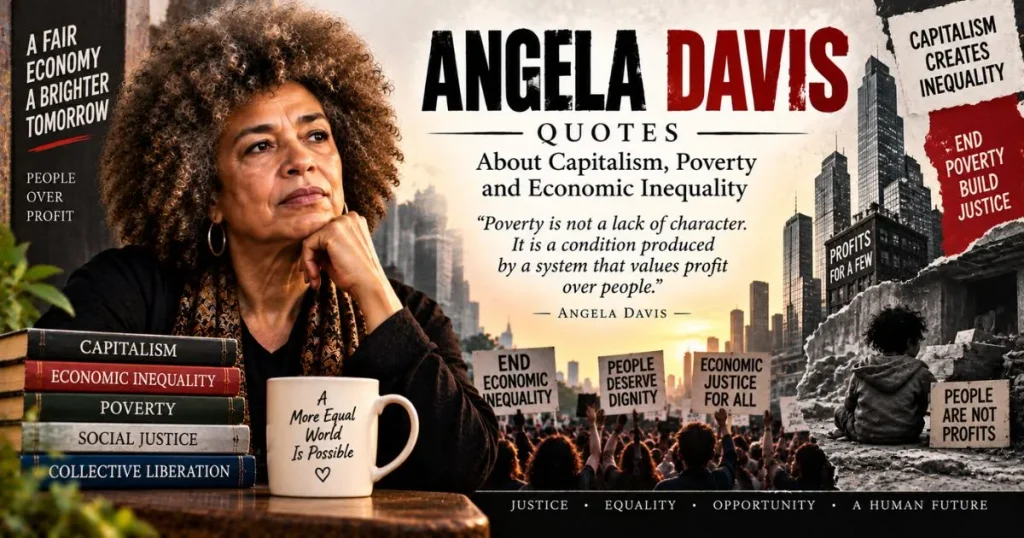
Davis’s political thought frequently examines capitalism, economic inequality, racism, and institutional power together.
Capitalism and inequality wisdom
- Economic systems influence people’s access to freedom.
- Wealth inequality can reinforce political inequality.
- Poverty cannot be understood separately from social structures.
- Economic justice is part of the broader struggle for liberation.
- Individual success cannot solve structural inequality by itself.
- Social problems require collective rather than purely individual solutions.
- Labor and economic power shape people’s everyday lives.
- Capitalism can interact with systems of racial inequality.
- Economic transformation is connected to political transformation.
- A just society must ask who benefits from existing institutions.
- Poverty should not be treated simply as an individual failure.
- Economic opportunity affects the meaning of freedom.
- Social justice requires confronting material inequality.
- Communities need resources that create genuine opportunity.
- Structural change requires examining the economic foundations of society.
Angela Davis Quotes About Poverty
Poverty appears throughout Davis’s discussions of incarceration, education, healthcare, and social justice.
Poverty and social justice
- Poverty should not be criminalized.
- Lack of resources can shape people’s choices.
- Education can provide pathways beyond poverty.
- Healthcare should not depend entirely on wealth.
- Housing is connected to dignity and freedom.
- Social policy should address causes rather than simply punish consequences.
- Economic opportunity can reduce dependence on punitive institutions.
- Communities deserve investment rather than neglect.
- Poverty is shaped by social structures as well as individual circumstances.
- A just society must confront material deprivation.
- Social equality requires attention to economic conditions.
- People’s needs should be addressed before they become criminalized.
- Economic justice and racial justice are deeply connected.
- Collective solutions can address problems individual effort cannot solve.
- Freedom becomes limited when basic necessities remain inaccessible.
Angela Davis Quotes About Resistance
Resistance is central to Davis’s understanding of social movements.
Resistance does not simply mean opposing something. It can also mean building alternatives, creating solidarity, challenging dominant ideas, and imagining a different future.
Resistance wisdom
- Resistance begins when people refuse to accept injustice as inevitable.
- Courage grows through collective action.
- Movements create strength through solidarity.
- Resistance can challenge what society considers normal.
- People can resist oppression while building something new.
- Political imagination is part of resistance.
- Resistance requires persistence.
- Movements can transform public understanding.
- Organizing turns individual frustration into collective action.
- Resistance is strengthened by education.
- Historical knowledge can inform contemporary struggles.
- Hope can become a form of resistance.
- Building alternatives is itself an act of resistance.
- Solidarity connects struggles that might otherwise appear separate.
- The struggle continues when one generation passes it to another.
Angela Davis Quotes About Revolution
Davis’s writing and interviews often use revolutionary language to describe deep structural transformation.
Revolution and transformation
- Revolution means changing the conditions that reproduce inequality.
- A revolutionary vision asks what society could become.
- Transformation requires more than changing individual leaders.
- Institutions can be redesigned around human needs.
- Revolutionary thinking begins by questioning what appears inevitable.
- A different world requires different social relationships.
- Transformation requires imagination and action.
- The future can be built through collective struggle.
- Revolution involves changing systems, not simply changing personalities.
- Deep change requires addressing economic, racial, and gender inequality.
- Abolition can be understood as a transformative project.
- Social movements can make previously unimaginable futures possible.
- Revolutionary change requires sustained participation.
- Transformation is both political and social.
- A better world must be constructed, not merely imagined.
In a 2020 interview, Davis described abolition as a process of rethinking the social, economic, and political future rather than simply removing existing institutions.
Angela Davis Quotes About Women’s Rights
Women’s rights form an important part of Davis’s broader feminist framework.
Women’s rights wisdom
- Women’s liberation must include women across race and class.
- Reproductive freedom is connected to broader freedom.
- Gender equality requires economic opportunity.
- Women’s experiences cannot be separated from racial and economic structures.
- Feminism should challenge systems that produce inequality.
- Women’s liberation is connected to community liberation.
- Feminist movements become stronger when they include marginalized voices.
- Gender justice requires institutional change.
- Women deserve political, economic, and reproductive autonomy.
- Feminism should question structures of power rather than simply seek inclusion within them.
Angela Davis Quotes About Reproductive Rights
Davis’s feminist writing has examined reproductive rights alongside race, class, and economic inequality.
Reproductive freedom wisdom
- Reproductive freedom is connected to women’s autonomy.
- Access to reproductive healthcare affects the meaning of freedom.
- Reproductive politics must be examined through race and class.
- Women’s choices are influenced by economic conditions.
- Reproductive justice requires meaningful access to healthcare.
- Freedom includes the ability to make decisions about one’s own body.
- Reproductive inequality can deepen existing social inequalities.
- Feminist movements must listen to women whose experiences differ from dominant narratives.
Angela Davis Quotes About Hope
Despite the seriousness of the problems she addresses, Davis’s work is deeply connected to the possibility of transformation.
She has emphasized collective movements as reservoirs of hope and encouraged people to act as though radical change is possible.
Hope and optimism
- Hope becomes powerful when connected to action.
- Social movements create reasons to believe change is possible.
- The future is not predetermined.
- People can challenge systems that appear permanent.
- Collective action can create unexpected possibilities.
- Hope can survive even during difficult struggles.
- A better future begins with imagination.
- Optimism does not require ignoring injustice.
- Hope can motivate people to organize.
- The possibility of change grows when people work together.
- Every generation can contribute to a longer struggle for justice.
- Hope is strongest when it becomes collective.
Davis has spoken about “reservoirs of hope and optimism” within collectivities, emphasizing the importance of collective movements rather than isolated individual action.
Angela Davis Quotes About Courage
Courage does not always look dramatic. Sometimes it means continuing difficult work when immediate results are uncertain.
Courage wisdom
- Courage means challenging what appears inevitable.
- Speaking against injustice can require personal risk.
- Collective courage is stronger than isolated bravery.
- Courage grows through solidarity.
- Social change requires people willing to imagine alternatives.
- Courage includes admitting when existing systems are failing.
- Challenging injustice requires persistence.
- Education can give people the courage to question authority.
- Courage means continuing even when progress is slow.
- A courageous movement creates possibilities for people who come after it.
Angela Davis Quotes About Collective Action
One of the clearest lessons from Davis’s work is that social transformation cannot depend entirely on individual heroism.
Collective action wisdom
- Individual effort matters, but movements create lasting power.
- Communities can accomplish what isolated individuals cannot.
- Solidarity connects different struggles.
- Collective organizing can change public consciousness.
- Movements create opportunities for political participation.
- Shared goals can unite people across differences.
- Social transformation requires cooperation.
- Listening is part of organizing.
- Movements grow when people recognize their interconnected struggles.
- Collective action transforms hope into possibility.
- Organizing requires patience.
- Long-term change depends on relationships.
- Solidarity is stronger when it includes differences.
- A movement becomes powerful when people see themselves as part of something larger.
Angela Davis Quotes About Community
Community is essential to discussions of justice and abolition because Davis’s work repeatedly asks what institutions should do for people.
Community wisdom
- Communities need resources that support human wellbeing.
- Safety can be strengthened through education and social investment.
- Community institutions can provide alternatives to punishment.
- Strong communities depend on meaningful participation.
- People deserve spaces where they can learn and grow.
- Community care can address problems before they become crises.
- Social justice requires listening to communities.
- Institutions should serve the people affected by them.
- Community organizing can create lasting change.
- Collective care is part of a more humane society.
Angela Davis Quotes About Education and Liberation
Education and liberation are closely connected in Davis’s thought.
Learning can help people understand history, question assumptions, recognize structures of power, and imagine alternatives.
Education and freedom
- Education can expand political imagination.
- Knowledge can challenge inherited systems.
- Students can become agents of social change.
- Critical thinking is essential to democracy.
- Education should encourage questioning.
- Access to education is connected to freedom.
- Learning can reveal relationships between seemingly separate problems.
- Historical knowledge can strengthen contemporary movements.
- Education can help people imagine alternatives to oppression.
- A society committed to equality must invest in education.
Angela Davis Quotes About Change
Change is a recurring theme throughout her activism and scholarship.
Change wisdom
- Change often begins with questioning what is considered normal.
- Social transformation requires persistence.
- Small reforms can sometimes open space for deeper change.
- Movements can shift what society believes is possible.
- Change requires both criticism and construction.
- A better society requires new institutions.
- Transformation takes time.
- The future depends on collective choices.
- People can change political possibilities through organizing.
- Change becomes sustainable when communities participate in it.
- Social transformation requires imagination.
- Change is not simply replacing one person with another.
- Structural change requires examining the systems themselves.
- A different future requires different priorities.
- Social change becomes possible when people refuse to accept injustice as permanent.
Short Angela Davis Quotes
Here are concise, verified or commonly documented short expressions that work particularly well for quote graphics and social media. Always verify exact wording and source before publishing as direct quotations.
- “Freedom is a constant struggle.”
- “Radical simply means grasping things at the root.”
- “Walls turned sideways are bridges.”
- “Education, not incarceration.”
- “Prisons do not disappear social problems.”
- “The revolution is not a one-time event.”
- “We have to envision a different future.”
- “Abolition is about rethinking the kind of future we want.”
- “We have to talk about liberating minds.”
- “You have to act as if it were possible.”
- “Freedom is a constant struggle.”
- “In collectivities we find hope.”
- “Radical change” begins with collective action.
- “Freedom” requires more than formal rights.
- “Education” can become a path toward liberation.
Famous Angela Davis Quotes
Some of the most frequently associated quotations and ideas include:
“Freedom is a constant struggle.”
This phrase captures the idea that liberation is not a single historical event. Every generation faces its own forms of inequality and must continue the work of expanding freedom.
“Prisons do not disappear social problems, they disappear human beings.”
This quotation summarizes one of the central arguments of Davis’s prison abolition work: incarceration can remove people from public view without addressing the underlying conditions that contribute to social problems.
“Radical simply means grasping things at the root.”
The idea of radicalism here is not simply about being extreme. It is about examining the underlying causes of a problem rather than only treating its visible symptoms.
“Walls turned sideways are bridges.”
This memorable expression can be understood as an invitation to transform barriers into possibilities for connection.
“Education, not incarceration.”
This short phrase expresses Davis’s argument that society should invest in institutions that expand people’s opportunities rather than relying primarily on punitive systems.
Angela Davis Quotes for Students
Davis’s career as a scholar makes her ideas especially relevant to students.
Student inspiration
- Question what you are taught.
- Learn history from multiple perspectives.
- Connect knowledge with action.
- Think critically about institutions.
- Do not confuse conventional wisdom with truth.
- Education can expand your imagination.
- Read beyond the obvious sources.
- Learn from movements that came before you.
- Ask who benefits from existing systems.
- Use education to understand the world rather than simply pass exams.
- Intellectual curiosity can become a form of freedom.
- Students can participate in social transformation.
Angela Davis Quotes About Changing the World
Changing the world can sound impossible when viewed as an individual responsibility.
Davis’s approach offers another perspective: major transformation can emerge through collective movements, education, organizing, imagination, and sustained struggle.
Change-the-world wisdom
- You do not have to change the world alone.
- Collective action can create possibilities that individuals cannot create by themselves.
- Imagine the society you want before designing its institutions.
- Question what appears permanent.
- Build alternatives while challenging injustice.
- Connect different struggles rather than isolating them.
- Let education expand your political imagination.
- Practice solidarity.
- Turn frustration into organization.
- Remember that today’s impossible idea may become tomorrow’s political reality.
- Work for changes that benefit communities rather than only individuals.
- Leave future generations a stronger foundation for justice.
Angela Davis Quotes About Democracy
Democracy requires more than elections.
For Davis, meaningful democracy must involve people’s ability to participate in shaping the institutions that govern their lives.
Democracy wisdom
- Political participation should be meaningful.
- Democracy requires equality.
- Communities should have a voice in decisions affecting them.
- Freedom requires more than formal political rights.
- Economic inequality can limit democratic participation.
- Education strengthens democratic life.
- Social movements can expand democratic possibilities.
- Institutions should be accountable to the people they serve.
- Democracy must confront racial and economic inequality.
- Collective participation strengthens society.
Angela Davis Quotes About Hope and the Future
The future is a recurring concern in Davis’s work because imagining alternatives is essential to social transformation.
A movement that can only criticize the present may struggle to explain what should replace it.
Future-focused wisdom
- Imagine institutions that serve human needs.
- Build the world you want to see.
- Do not treat today’s systems as permanent.
- Hope becomes meaningful when connected to action.
- Future generations inherit today’s decisions.
- Social movements can make new futures imaginable.
- Collective imagination is politically powerful.
- A different world requires different priorities.
- The future can be shaped through organizing.
- Transformation begins when people believe another arrangement is possible.
20 Powerful Life Lessons From Angela Davis
Beyond politics and activism, Davis’s work offers broader lessons about thinking and living:
- Question what appears inevitable.
- Learn the history behind today’s problems.
- Think structurally as well as individually.
- Value education.
- Listen to marginalized voices.
- Build solidarity.
- Keep hope connected to action.
- Imagine alternatives.
- Understand the relationship between different forms of oppression.
- Challenge injustice rather than normalizing it.
- Recognize the importance of collective action.
- Think beyond short-term solutions.
- Invest in communities.
- Connect freedom with material conditions.
- Make room for different perspectives.
- Continue learning.
- Treat social change as long-term work.
- Build as well as resist.
- Remember that movements depend on people.
- Believe that transformation is possible.
What Makes Angela Davis’s Quotes So Powerful?
Angela Davis’s words remain influential because they do more than provide motivation.
They ask difficult questions.
What does freedom really mean?
What happens when society treats punishment as the answer to every problem?
Can equality exist without economic opportunity?
I Can feminism ignore race and class?
Can a society call itself democratic while entire communities lack meaningful power?
What would we build if we stopped assuming that existing institutions were permanent?
These questions make Davis’s work particularly valuable for readers interested in freedom, feminism, racial justice, social justice, education, activism, and prison abolition.
Frequently Asked Questions About Angela Davis
What is Angela Davis best known for?
Angela Davis is best known as a scholar, author, activist, feminist thinker, and prominent advocate of prison abolition. Her work has examined racial justice, feminism, capitalism, incarceration, education, and social transformation.
What is Angela Davis’s most famous quote?
One of the most widely circulated quotations associated with Davis is:
“Freedom is a constant struggle.”
Another well-known quotation from her prison abolition work is:
“Prisons do not disappear social problems, they disappear human beings.”
Both express major themes in her work: liberation as an ongoing process and the need to address social problems rather than simply hide them through incarceration.
What did Angela Davis say about freedom?
Davis has treated freedom as an ongoing collective struggle rather than something that can be permanently achieved by a single political victory. Her discussions connect freedom with racial justice, gender equality, economic opportunity, education, and social transformation.
What did Angela Davis say about feminism?
Davis’s feminism examines the connections among gender, race, class, economics, incarceration, and other structures of power. Her work has helped shape Black feminist and abolitionist feminist thought.
What did Angela Davis say about prison abolition?
Davis argues that prison abolition requires more than closing prisons. It requires creating alternative institutions and addressing social conditions such as inadequate education, housing, healthcare, mental-health services, and economic opportunity.
Why does Angela Davis support prison abolition?
Her argument is that incarceration often responds to social problems by removing people rather than addressing the underlying conditions that produced those problems. Abolition therefore asks society to imagine different approaches to safety, justice, and community wellbeing.
What did Angela Davis say about education?
Davis has connected education with liberation and argued for shifting resources toward education and other institutions that meet people’s needs rather than relying primarily on incarceration.
What did Angela Davis say about social change?
Davis emphasizes collective movements, organizing, political imagination, and sustained struggle. She has argued that moments of political possibility can create opportunities for radical change when movements are prepared to act.
What does Angela Davis mean by radical?
In the context of her famous expression about being radical, the idea is connected with examining problems at their roots rather than being satisfied with superficial solutions.
What are the main themes in Angela Davis’s work?
The major themes include freedom, racial justice, feminism, capitalism, education, incarceration, prison abolition, collective action, resistance, solidarity, and social transformation.
Final Thoughts
The enduring power of Angela Davis quotes comes from their ability to turn familiar questions upside down.
Instead of asking only how individuals can succeed within existing systems, Davis encourages us to ask whether those systems themselves can be transformed.
Against of asking only how to punish social problems, she asks what institutions could address their causes.
Instead of treating feminism, racial justice, economic equality, and abolition as separate subjects, her work explores the connections among them.
And instead of treating social change as something that happens automatically, she reminds us that movements are built through people who organize, learn, resist, imagine, and act.
Her message is ultimately about possibility.
A different future can be imagined.
A different future can be organized for.
And a different future can be built.
That is why Angela Davis’s words continue to resonate with students, activists, feminists, educators, and anyone interested in freedom, justice, equality, and meaningful social change.
